. 2014 Mar 3;7(3):265-310.
doi: 10.3390/ph7030265.

Antimicrobial peptides from fish

Affiliations

Antimicrobial peptides from fish

Jorge A Masso-Silva et al. Pharmaceuticals (Basel). .

Abstract

Antimicrobial peptides (AMPs) are found widely distributed through Nature, and participate in the innate host defense of each species. Fish are a great source of these peptides, as they express all of the major classes of AMPs, including defensins, cathelicidins, hepcidins, histone-derived peptides, and a fish-specific class of the cecropin family, called piscidins. As with other species, the fish peptides exhibit broad-spectrum antimicrobial activity, killing both fish and human pathogens. They are also immunomodulatory, and their genes are highly responsive to microbes and innate immuno-stimulatory molecules. Recent research has demonstrated that some of the unique properties of fish peptides, including their ability to act even in very high salt concentrations, make them good potential targets for development as therapeutic antimicrobials. Further, the stimulation of their gene expression by exogenous factors could be useful in preventing pathogenic microbes in aquaculture.


Figures
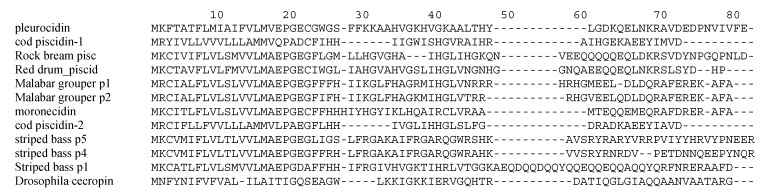
Figure 1
Figure 1
Alignment of piscidins. Mature peptide sequences were obtained from published data and from the PubMed protein database, and were aligned using MacVector software. The Drosophila cecropin A1 sequences is provided for comparison as a representative member of the cecropin family.
Figure 2
Figure 2
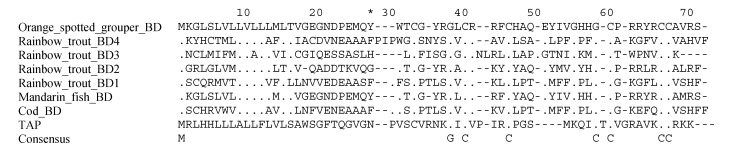
Alignment of β-defensins. Precursor peptide sequences were obtained from published data and from the PubMed protein database, and were aligned using MacVector software. The bovine β-defensin, Tracheal Antimicrobial Peptide (TAP) is shown for comparison. The conserved β-defensin cysteine spacing is shown in the consensus line. The first residue of the mature peptide region (based on the isolated TAP sequence) is denoted with an asterisk.
Figure 3
Figure 3
Alignment of hepcidins. Representative precursor peptide sequences were obtained from published data and from the PubMed protein database, and were aligned using MacVector software. Human hepcidin is shown for comparison. The first residue of the mature peptide region is denoted with an asterisk.
Figure 4
Figure 4
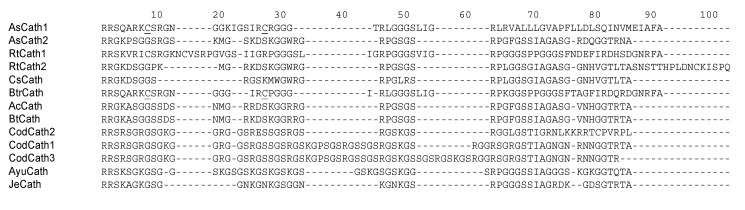
Alignment of fish cathelicidins. Mature peptide sequences were obtained from published data and from the PubMed protein database, and were aligned using MacVector software. Characteristic cysteine residues found in certain classes of fish cathelicidins are underlined. As, Atlantic salmon; Rt, Rainbow trout; Cs, Chinook salmon; Btr, Brown trout; Ac, Arctic char; Bt, Brook trout; Je, Japanese eel.
Figure 5
Figure 5
Alignment of histone-derived peptides. Representative peptide sequences were obtained from published data and from the PubMed protein database, and were aligned using MacVector software. Since the sequences are homolgous to different histone peptide fragments, there is no shared sequence homology.

References

    1. Ganz T., Selsted M.E., Szklarek D., Harwig S.S., Daher K., Bainton D.F., Lehrer R.I. Defensins. Natural peptide antibiotics of human neutrophils. J. Clin. Investig. 1985;76:1427–1435. doi: 10.1172/JCI112120. - DOI - PMC - PubMed
    1. Lehrer R.I., Selsted M.E., Szklarek D., Fleischmann J. Antibacterial activity of microbicidal cationic proteins 1 and 2, natural peptide antibiotics of rabbit lung macrophages. Infect. Immun. 1983;42:10–14. - PMC - PubMed
    1. Zasloff M. Magainins, a class of antimicrobial peptides from Xenopus skin: Isolation, characterization of two active forms, and partial cDNA sequence of a precursor. Proc. Natl. Acad. Sci. USA. 1987;84:5449–5453. doi: 10.1073/pnas.84.15.5449. - DOI - PMC - PubMed
    1. Primor N., Tu A.T. Conformation of pardaxin, the toxin of the flatfish Pardachirus marmoratus. Biochim. Biophys. Acta. 1980;626:299–306. doi: 10.1016/0005-2795(80)90124-5. - DOI - PubMed
    1. Oren Z., Shai Y. A class of highly potent antibacterial peptides derived from pardaxin, a pore-forming peptide isolated from Moses sole fish Pardachirus marmoratus. Eur. J. Biochem. 1996;237:303–310. - PubMed