The role of viral introductions in sustaining community-based HIV epidemics in rural Uganda: evidence from spatial clustering, phylogenetics, and egocentric transmission models
- PMID: 24595023
- PMCID: PMC3942316
- DOI: 10.1371/journal.pmed.1001610
The role of viral introductions in sustaining community-based HIV epidemics in rural Uganda: evidence from spatial clustering, phylogenetics, and egocentric transmission models
Abstract
Background: It is often assumed that local sexual networks play a dominant role in HIV spread in sub-Saharan Africa. The aim of this study was to determine the extent to which continued HIV transmission in rural communities--home to two-thirds of the African population--is driven by intra-community sexual networks versus viral introductions from outside of communities.
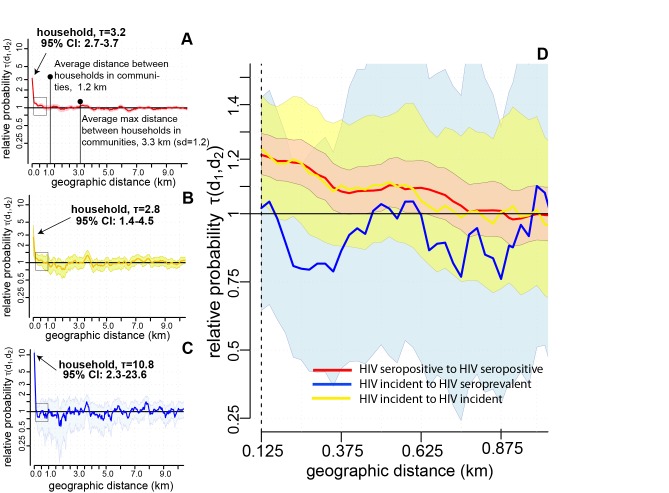
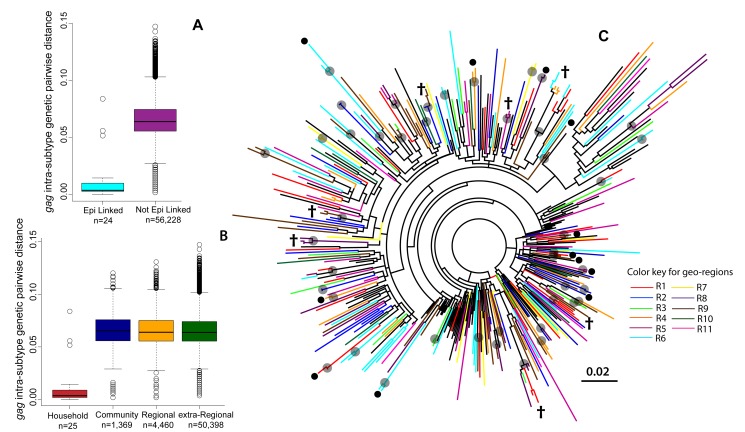
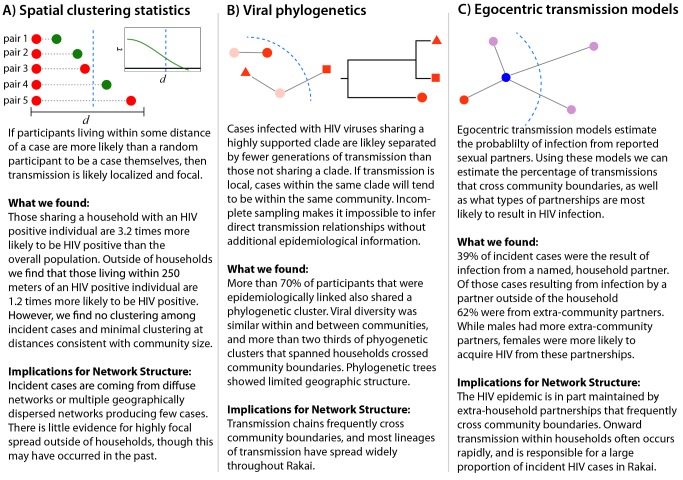
Methods and findings: We analyzed the spatial dynamics of HIV transmission in rural Rakai District, Uganda, using data from a cohort of 14,594 individuals within 46 communities. We applied spatial clustering statistics, viral phylogenetics, and probabilistic transmission models to quantify the relative contribution of viral introductions into communities versus community- and household-based transmission to HIV incidence. Individuals living in households with HIV-incident (n = 189) or HIV-prevalent (n = 1,597) persons were 3.2 (95% CI: 2.7-3.7) times more likely to be HIV infected themselves compared to the population in general, but spatial clustering outside of households was relatively weak and was confined to distances <500 m. Phylogenetic analyses of gag and env genes suggest that chains of transmission frequently cross community boundaries. A total of 95 phylogenetic clusters were identified, of which 44% (42/95) were two individuals sharing a household. Among the remaining clusters, 72% (38/53) crossed community boundaries. Using the locations of self-reported sexual partners, we estimate that 39% (95% CI: 34%-42%) of new viral transmissions occur within stable household partnerships, and that among those infected by extra-household sexual partners, 62% (95% CI: 55%-70%) are infected by sexual partners from outside their community. These results rely on the representativeness of the sample and the quality of self-reported partnership data and may not reflect HIV transmission patterns outside of Rakai.
Conclusions: Our findings suggest that HIV introductions into communities are common and account for a significant proportion of new HIV infections acquired outside of households in rural Uganda, though the extent to which this is true elsewhere in Africa remains unknown. Our results also suggest that HIV prevention efforts should be implemented at spatial scales broader than the community and should target key populations likely responsible for introductions into communities.
Conflict of interest statement
JL is a
Figures
References
-
- Anderson RM, May RM, Boily MC, Garnett GP, Rowley JT (1991) The spread of HIV-1 in Africa: sexual contact patterns and the predicted demographic impact of AIDS. Nature 352: 581–589. - PubMed
-
- Doherty IA, Padian NS, Marlow C, Aral SO (2005) Determinants and consequences of sexual networks as they affect the spread of sexually transmitted infections. J Infect Dis 191 Suppl 1: S42–S54. - PubMed
-
- Hagenaars TJ, Donnelly CA, Ferguson NM (2004) Spatial heterogeneity and the persistence of infectious diseases. J Theor Biol 229: 349–359. - PubMed
-
- Deredec A, Courchamp F (2003) Extinction thresholds in host-parasite dynamics. Ann Zool Fennici 40: 115.
-
- Grosskurth H, Gray R, Hayes R, Mabey D, Wawer M (2000) Control of sexually transmitted diseases for HIV-1 prevention: understanding the implications of the Mwanza and Rakai trials. Lancet 355: 1981–1987. - PubMed
Publication types
MeSH terms
Grants and funding
LinkOut - more resources
Full Text Sources
Other Literature Sources
Medical