Randomized Controlled Trial
. 2014 Sep 10;21(8):1156-63.
doi: 10.1089/ars.2014.5888. Epub 2014 Apr 10.

Do fish oil omega-3 fatty acids enhance antioxidant capacity and mitochondrial fatty acid oxidation in human atrial myocardium via PPARγ activation?

Affiliations
Randomized Controlled Trial

Do fish oil omega-3 fatty acids enhance antioxidant capacity and mitochondrial fatty acid oxidation in human atrial myocardium via PPARγ activation?

Ethan J Anderson et al. Antioxid Redox Signal. .

Abstract

Abstract Studies in experimental models suggest that n-3 polyunsaturated fatty acids (PUFAs) improve metabolic and anti-inflammatory/antioxidant capacity of the heart, although the mechanisms are unclear and translational evidence is lacking. In this study, patients ingested a moderately high dose of n-3 PUFAs (3.4 g/day eicosapentaenoic (EPA) and doxosahexaenoic acid (DHA) ethyl-esters) for a period of 2-3 weeks before having elective cardiac surgery. Blood was obtained before treatment and at the time of surgery, and myocardial tissue from the right atrium was also dissected during surgery. Blood EPA levels increased and myocardial tissue EPA and DHA levels were significantly higher in n-3 PUFA-treated patients compared with untreated, standard-of-care control patients. Interestingly, n-3 PUFA patients had greater nuclear transactivation of peroxisome proliferator-activated receptor-γ (PPARγ), fatty acid metabolic gene expression, and enhanced mitochondrial respiration supported by palmitoyl-carnitine in the atrial myocardium, despite no difference in mitochondrial content. Myocardial tissue from n-3 PUFA patients also displayed greater expression and activity of key antioxidant/anti-inflammatory enzymes. These findings lead to our hypothesis that PPARγ activation is a mechanism by which fish oil n-3 PUFAs enhance mitochondrial fatty acid oxidation and antioxidant capacity in human atrial myocardium, and that this preoperative therapeutic regimen may be optimal for mitigating oxidative/inflammatory stress associated with cardiac surgery.


Figures
<b>FIG. 1.</b>
FIG. 1.
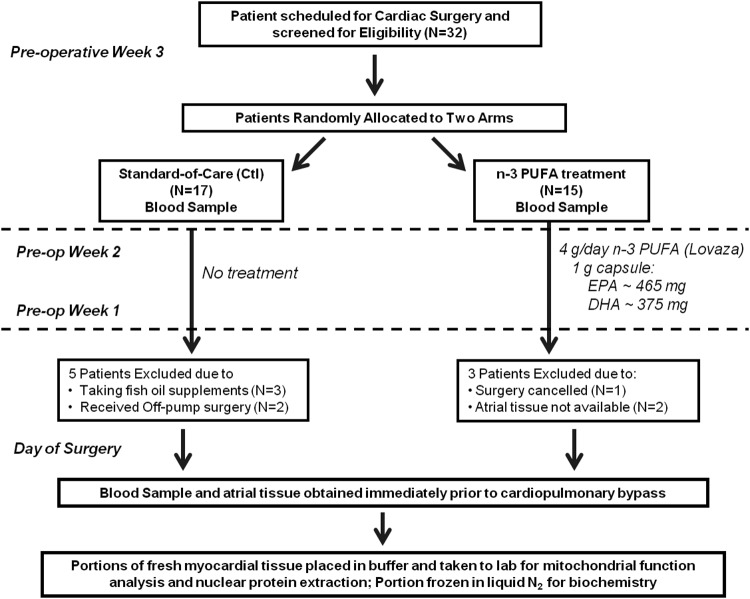
Flow chart of patient screening and enrollment, and overall experimental design for this study.
<b>FIG. 2.</b>
FIG. 2.
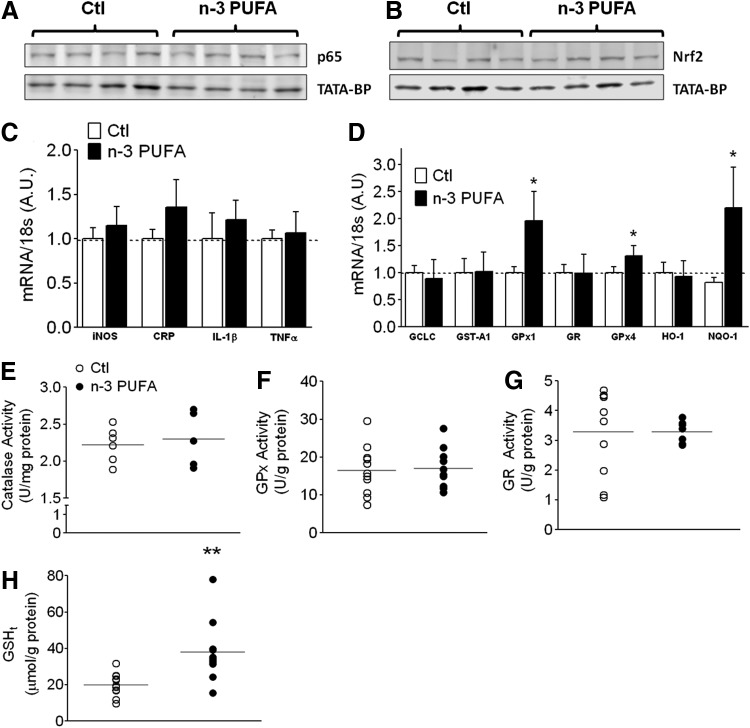
Inflammation, redox-related gene expression, and antioxidant enzymes in atrial myocardium. Representative immunoblots of (A), NFκB-p65, and (B) Nrf2 in nuclear extracts prepared from 4 individual Ctl and n-3 PUFA-treated patients, with TATA-binding protein (TATA-BP) as loading control. Expression of genes known to be activated by NFκB (C), and those activated by Nrf2 (D) are shown for both treatment groups. Activity of antioxidant enzymes in atrial homogenate from both treatment groups is shown for (E), Catalase, (F), glutathione peroxidase (GPx), (G), glutathione reductase (GR), and (H), total GSH (GSHt). Gene expression data are reported as mean±SD. Raw data are shown for enzyme activity and GSHt in both treatment groups, along with the mean (faint horizontal line). N=10–12 for each group. *p<0.05 versus Ctl, **p<0.01 versus Ctl.
<b>FIG. 3.</b>
FIG. 3.
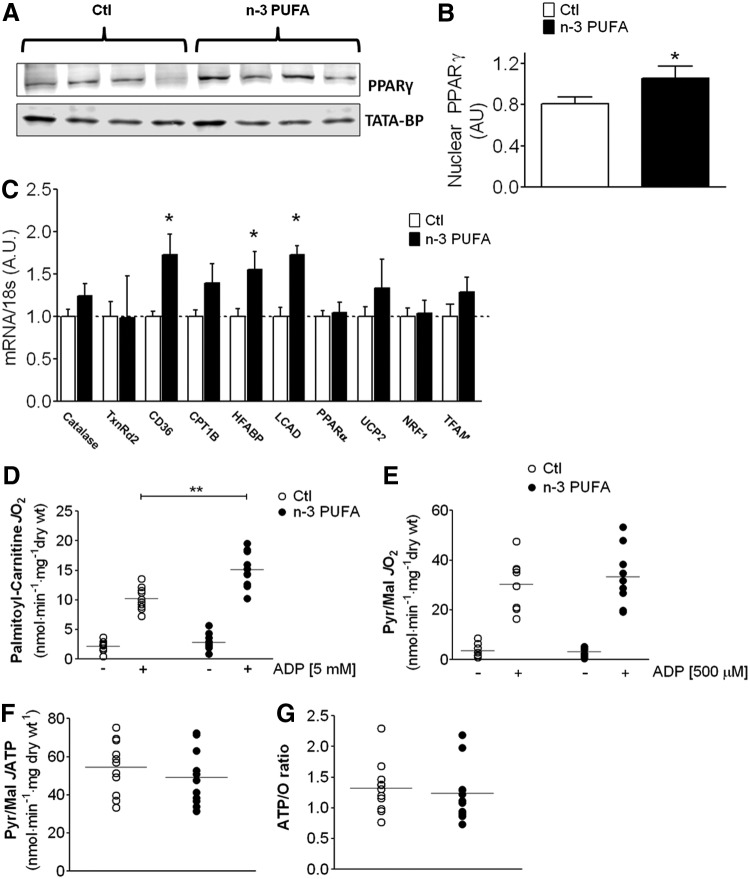
PPARγ activation and mitochondrial function parameters in atrial myocardium. Shown in (A) are representative immunoblots of PPARγ in nuclear extracts prepared from 4 individual Ctl and n-3 PUFA-treated patients, with TATA-binding protein (TATA-BP) as nuclear protein loading control. In (B) is densitometry analysis of nuclear PPARγ in atrial tissue from both groups (N=10). Shown in (C) is expression of genes known to be activated by PPARγ. Rates of basal and maximal ADP-stimulated (5 mM) mitochondrial O2 consumption supported by (D) palmitoyl-carnitine in both treatment groups. Data shown in (E) are rates of mitochondrial O2 consumption supported by pyruvate+malate (PM) in the absence and presence of ADP (500 μM). In (F) are rates of mitochondrial ATP release with PM+500 μM ADP, and in (G) are ATP/O ratio in the presence of PM+500 μM ADP. Gene expression data are reported as mean±SD. Raw data are shown for mitochondrial experiments in both treatment groups, along with the mean (faint horizontal line). N=10–12 for each group, for all experiments. *p<0.05 versus Ctl, **p<0.01 versus Ctl.
<b>FIG. 4.</b>
FIG. 4.
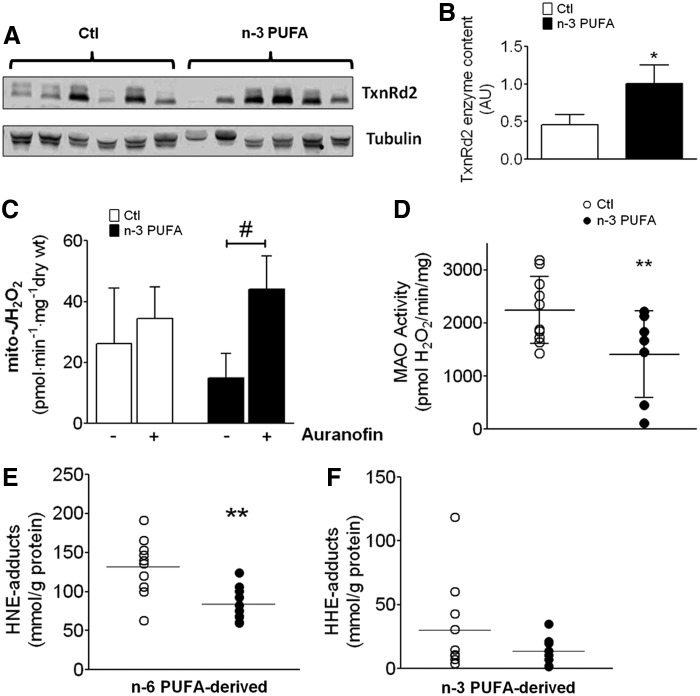
TxnRd2, mitochondrial ROS generation, and PUFA-derived carbonyl stress in atrial myocardium. Shown in (A) are representative immunoblots of TxnRd2 in atrial tissue homogenate from 6 individual Ctl and n-3 PUFA-treated patients, with Tubulin as the loading control. In (B) is densitometry analysis of TxnRd2 in whole atrial tissue from both groups (N=8–10). In (C) are rates of mitochondrial ROS generation (JH2O2) coming from the ETS in permeabilized myofibers supported by PM+100 μM ADP, in the absence and presence of TxnRd2 inhibitor auranofin. In (D) is the rate of MAO activity (with tyramine-supported H2O2 production as index) in atrial tissue homogenate from both treatment groups. Protein carbonyl adducts in atrial tissue formed by (E), n-6 PUFA-derived aldehyde 4-hydroxynonenal (HNE), and (F), n-3 PUFA-derived aldehyde 4-hydroxyhexenal (HHE), are shown for both treatment groups. Raw data are shown for enzyme activity and PUFA-derived carbonyl adducts in both treatment groups, along with the mean (faint horizontal line). N=8–12 for each group, for all experiments. *p<0.05 versus Ctl, **p<0.01 versus Ctl, #p<0.05 versus. no Auranofin.

References

    1. Anderson EJ, Thayne K, Harris M, Carraway K, and Shaikh SR. Aldehyde stress and up-regulation of Nrf2-mediated antioxidant systems accompany functional adaptations in cardiac mitochondria from mice fed n-3 polyunsaturated fatty acids. Biochem J 441: 359–366, 2012 - PMC - PubMed
    1. De Caterina R. n-3 fatty acids in cardiovascular disease. N Engl J Med 364: 2439–2450, 2011 - PubMed
    1. Fisher-Wellman KH, Mattox TA, Thayne K, Katunga LA, La Favor JD, Neufer PD, Hickner RC, Wingard CJ, and Anderson EJ. Novel role for thioredoxin reductase-2 in mitochondrial redox adaptations to obesogenic diet and exercise in heart and skeletal muscle. J Physiol 591: 3471–3486, 2013 - PMC - PubMed
    1. Gao G. and Dudley SC., Jr Redox regulation, NF-kappaB, and atrial fibrillation. Antioxid Redox Signal 11: 2265–2277, 2009 - PMC - PubMed
    1. Metcalf RG, James MJ, Gibson RA, Edwards JR, Stubberfield J, Stuklis R, Roberts-Thomson K, Young GD, and Cleland LG. Effects of fish-oil supplementation on myocardial fatty acids in humans. Am J Clin Nutr 85: 1222–1228, 2007 - PubMed

Publication types

MeSH terms