


Acute respiratory and cardiovascular admissions after a public smoking ban in Geneva, Switzerland
- PMID: 24599156
- PMCID: PMC3944023
- DOI: 10.1371/journal.pone.0090417
Acute respiratory and cardiovascular admissions after a public smoking ban in Geneva, Switzerland
Abstract
Background: Many countries have introduced legislations for public smoking bans to reduce the harmful effects of exposure to tobacco smoke. Smoking bans cause significant reductions in admissions for acute coronary syndromes but their impact on respiratory diseases is unclear. In Geneva, Switzerland, two popular votes led to a stepwise implementation of a state smoking ban in public places, with a temporary suspension. This study evaluated the effect of this smoking ban on hospitalisations for acute respiratory and cardiovascular diseases.
Methods: This before and after intervention study was conducted at the University Hospitals of Geneva, Switzerland, across 4 periods with different smoking legislations. It included 5,345 patients with a first hospitalisation for acute coronary syndrome, ischemic stroke, acute exacerbation of chronic obstructive pulmonary disease, pneumonia and acute asthma. The main outcomes were the incidence rate ratios (IRR) of admissions for each diagnosis after the final ban compared to the pre-ban period and adjusted for age, gender, season, influenza epidemic and secular trend.
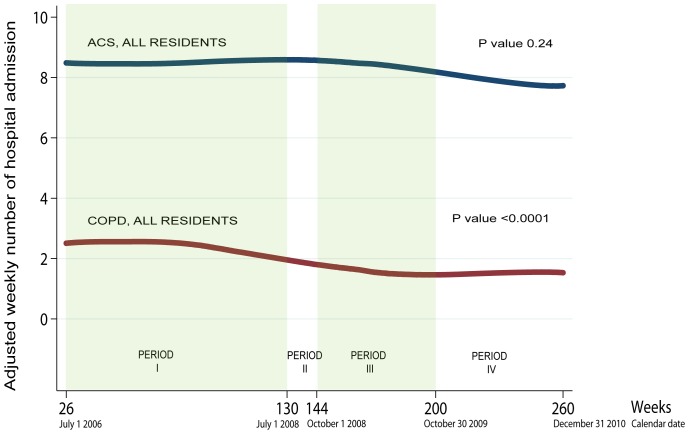
Results: Hospitalisations for acute exacerbation of chronic obstructive pulmonary disease significantly decreased over the 4 periods and were lowest after the final ban (IRR=0.54 [95%CI: 0.42-0.68]). We observed a trend in reduced admissions for acute coronary syndromes (IRR=0.90 [95%CI: 0.80-1.00]). Admissions for ischemic stroke, asthma and pneumonia did not significantly change.
Conclusions: A legislative smoking ban was followed by a strong decrease in hospitalisations for acute exacerbation of chronic obstructive pulmonary disease and a trend for reduced admissions for acute coronary syndrome. Smoking bans are likely to be very beneficial for patients with chronic obstructive pulmonary disease.
Conflict of interest statement
Figures
References
-
- US Department of Health and Human Services (2006) The Health consequences of involuntary exposure to tobacco smoke: A report of the Surgeon General. Atlanta GA: US Department of Health and Human Services, Centers for Disease Control and Prevention, National Center for Chronic Disease Prevention and Health Promotion, Office on Smoking and Health. http://www.cdc.gov/tobacco/data_statistics/sgr/2006/. Accessed 4 September 2013.
-
- Barnoya J, Glantz SA (2005) Cardiovascular effects of second-hand smoke: Nearly as large as smoking. Circulation 111: 2684–2698. - PubMed
-
- He J, Vupputuri S, Allen K, Prerost MS, Hughes J, et al. (1999) Passive smoking and the risk of coronary heart disease. A meta-analysis of epidemiologic studies. N Engl J Med 340: 920–926. - PubMed
-
- Oono IP, Mackay DF, Pell JP (2011) Meta-analysis of the association between secondhand smoke exposure and stroke. J Pub Health 33: 496–502. - PubMed
Publication types
MeSH terms
Substances
LinkOut - more resources
Full Text Sources
Other Literature Sources
Medical
