


Influence of the X-chromosome on neuroanatomy: evidence from Turner and Klinefelter syndromes
- PMID: 24599451
- PMCID: PMC3942570
- DOI: 10.1523/JNEUROSCI.2790-13.2014
Influence of the X-chromosome on neuroanatomy: evidence from Turner and Klinefelter syndromes
Abstract
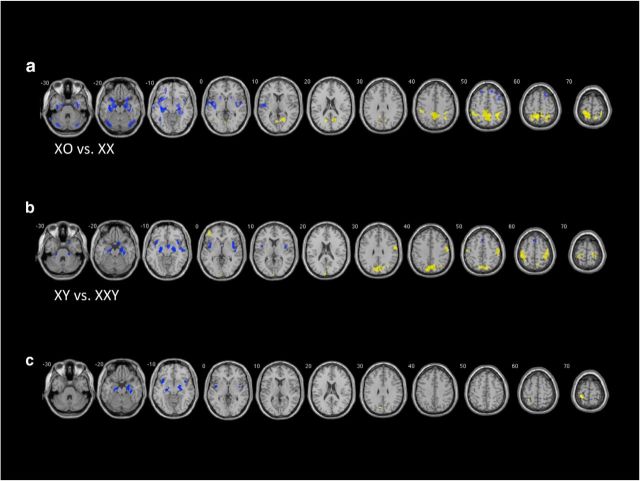
Studies of sex effects on neurodevelopment have traditionally focused on animal models investigating hormonal influences on brain anatomy. However, more recent evidence suggests that sex chromosomes may also have direct upstream effects that act independently of hormones. Sex chromosome aneuploidies provide ideal models to examine this framework in humans, including Turner syndrome (TS), where females are missing one X-chromosome (45X), and Klinefelter syndrome (KS), where males have an additional X-chromosome (47XXY). As these disorders essentially represent copy number variants of the sex chromosomes, investigation of brain structure across these disorders allows us to determine whether sex chromosome gene dosage effects exist. We used voxel-based morphometry to investigate this hypothesis in a large sample of children in early puberty, to compare regional gray matter volumes among individuals with one (45X), two (typically developing 46XX females and 46XY males), and three (47XXY) sex chromosomes. Between-group contrasts of TS and KS groups relative to respective sex-matched controls demonstrated highly convergent patterns of volumetric differences with the presence of an additional sex chromosome being associated with relatively decreased parieto-occipital gray matter volume and relatively increased temporo-insular gray matter volumes. Furthermore, z-score map comparisons between TS and KS cohorts also suggested that this effect occurs in a linear dose-dependent fashion. We infer that sex chromosome gene expression directly influences brain structure in children during early stages of puberty, extending our understanding of genotype-phenotype mechanisms underlying sex differences in the brain.
Keywords: Klinefelter syndrome; Turner syndrome; neuroimaging; sex chromosome.
Figures

References
-
- Archer J. Sex differences in aggression in real-world settings: a meta-analytic review. Rev Gen Psychol. 2004;8:291–322. doi: 10.1037/1089-2680.8.4.291. - DOI
Publication types
MeSH terms
Grants and funding
LinkOut - more resources
Full Text Sources
Other Literature Sources
Medical
Research Materials
