


Variants in the ATM-CHEK2-BRCA1 axis determine genetic predisposition and clinical presentation of papillary thyroid carcinoma
- PMID: 24599715
- PMCID: PMC4058861
- DOI: 10.1002/gcc.22162
Variants in the ATM-CHEK2-BRCA1 axis determine genetic predisposition and clinical presentation of papillary thyroid carcinoma
Abstract
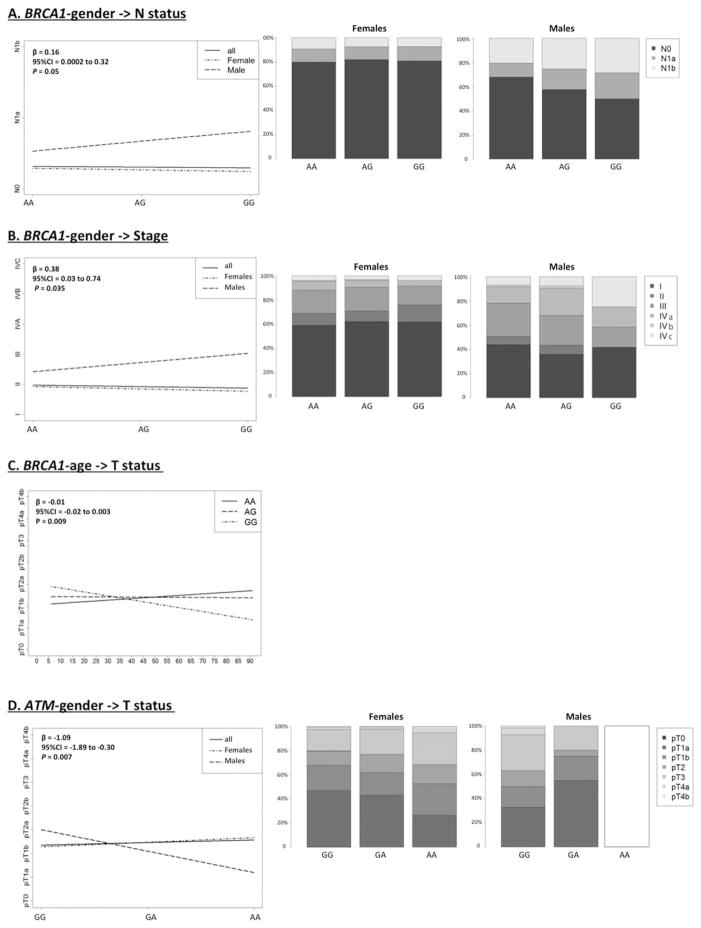
The risk of developing papillary thyroid carcinoma (PTC), the most frequent form of thyroid malignancy, is elevated up to 8.6-fold in first-degree relatives of PTC patients. The familial risk could be explained by high-penetrance mutations in yet unidentified genes, or polygenic action of low-penetrance alleles. Since the DNA-damaging exposure to ionizing radiation is a known risk factor for thyroid cancer, polymorphisms in DNA repair genes are likely to affect this risk. In a search for low-penetrance susceptibility alleles we employed Sequenom technology to genotype deleterious polymorphisms in ATM, CHEK2, and BRCA1 in 1,781 PTC patients and 2,081 healthy controls. As a result of the study, we identified CHEK2 rs17879961 (OR = 2.2, P = 2.37e-10) and BRCA1 rs16941 (odds ratio [OR] = 1.16, P = 0.005) as risk alleles for PTC. The ATM rs1801516 variant modifies the risk associated with the BRCA1 variant by 0.78 (P = 0.02). Both the ATM and BRCA1 variants modify the impact of male gender on clinical variables: T status (P = 0.007), N status (P = 0.05), and stage (P = 0.035). Our findings implicate an important role of variants in the ATM- CHEK2- BRCA1 axis in modification of the genetic predisposition to PTC and its clinical manifestations.
Copyright © 2014 Wiley Periodicals, Inc.
Figures
References
-
- Adjadj E, Schlumberger M, de Vathaire F. Germ-line DNA polymorphisms and susceptibility to differentiated thyroid cancer. Lancet Oncol. 2009;10:181–190. - PubMed
-
- Akulevich NM, Saenko VA, Rogounovitch TI, Drozd VM, Lushnikov EF, Ivanov VK, Mitsutake N, Kominami R, Yamashita S. Polymorphisms of DNA damage response genes in radiation-related and sporadic papillary thyroid carcinoma. Endocr Relat Cancer. 2009;16:491–503. - PubMed
-
- Barrett JH, Iles MM, Harland M, Taylor JC, Aitken JF, Andresen PA, Akslen LA, Armstrong BK, Avril MF, Azizi E, Bakker B, Bergman W, Bianchi-Scarra G, Bressac-de Paillerets B, Calista D, Cannon-Albright LA, Corda E, Cust AE, Debniak T, Duffy D, Dunning AM, Easton DF, Friedman E, Galan P, Ghiorzo P, Giles GG, Hansson J, Hocevar M, Hoiom V, Hopper JL, Ingvar C, Janssen B, Jenkins MA, Jonsson G, Kefford RF, Landi G, Landi MT, Lang J, Lubinski J, Mackie R, Malvehy J, Martin NG, Molven A, Montgomery GW, van Nieuwpoort FA, Novakovic S, Olsson H, Pastorino L, Puig S, Puig-Butille JA, Randerson-Moor J, Snowden H, Tuominen R, Van Belle P, van der Stoep N, Whiteman DC, Zelenika D, Han J, Fang S, Lee JE, Wei Q, Lathrop GM, Gillanders EM, Brown KM, Goldstein AM, Kanetsky PA, Mann GJ, Macgregor S, Elder DE, Amos CI, Hayward NK, Gruis NA, Demenais F, Bishop JA, Bishop DT. Genome-wide association study identifies three new melanoma susceptibility loci. Nat Genet. 2011;43:1108–1113. - PMC - PubMed
-
- Botstein D, Risch N. Discovering genotypes underlying human phenotypes: Past successes for mendelian disease, future approaches for complex disease. Nat Genet. 2003;33:228–237. - PubMed
-
- Brennan P, McKay J, Moore L, Zaridze D, Mukeria A, Szeszenia-Dabrowska N, Lissowska J, Rudnai P, Fabianova E, Mates D, Bencko V, Foretova L, Janout V, Chow WH, Rothman N, Chabrier A, Gaborieau V, Odefrey F, Southey M, Hashibe M, Hall J, Boffetta P, Peto J, Peto R, Hung RJ. Uncommon CHEK2 mis-sense variant and reduced risk of tobacco-related cancers: Case control study. Hum Mol Genet. 2007;16:1794–1801. - PubMed
Publication types
MeSH terms
Substances
Grants and funding
LinkOut - more resources
Full Text Sources
Other Literature Sources
Medical
Research Materials
Miscellaneous
