Review
. 2014 Feb 18:7:75-88.
doi: 10.2147/IJNRD.S39739. eCollection 2014.

Obesity, hypertension, and chronic kidney disease

Affiliations
Review

Obesity, hypertension, and chronic kidney disease

Michael E Hall et al. Int J Nephrol Renovasc Dis. .

Abstract

Obesity is a major risk factor for essential hypertension, diabetes, and other comorbid conditions that contribute to development of chronic kidney disease. Obesity raises blood pressure by increasing renal tubular sodium reabsorption, impairing pressure natriuresis, and causing volume expansion via activation of the sympathetic nervous system and renin-angiotensin-aldosterone system and by physical compression of the kidneys, especially when there is increased visceral adiposity. Other factors such as inflammation, oxidative stress, and lipotoxicity may also contribute to obesity-mediated hypertension and renal dysfunction. Initially, obesity causes renal vasodilation and glomerular hyperfiltration, which act as compensatory mechanisms to maintain sodium balance despite increased tubular reabsorption. However, these compensations, along with increased arterial pressure and metabolic abnormalities, may ultimately lead to glomerular injury and initiate a slowly developing vicious cycle that exacerbates hypertension and worsens renal injury. Body weight reduction, via caloric restriction and increased physical activity, is an important first step for management of obesity, hypertension, and chronic kidney disease. However, this strategy may not be effective in producing long-term weight loss or in preventing cardiorenal and metabolic consequences in many obese patients. The majority of obese patients require medical therapy for obesity-associated hypertension, metabolic disorders, and renal disease, and morbidly obese patients may require surgical interventions to produce sustained weight loss.

Keywords: glomerular filtration rate; renin–angiotensin–aldosterone system; sodium reabsorption; sympathetic nervous system; type II diabetes; visceral adiposity.


Figures

Figure 1
Figure 1
Adjusted relative risk for end-stage renal disease (ESRD) by body mass index (BMI). Notes: In this retrospective cohort study of 320,252 adults who were followed for 15 to 35 years, the rate of ESRD increased in a stepwise manner as BMI increased. This relationship was not affected by blood pressure levels or diabetes. The model was adjusted for age, sex, race, education level, smoking status, history of myocardial infarction, serum cholesterol level, proteinuria, hematuria, and serum creatinine level. Copyright © 2006. Adapted from Hsu CY, McCulloch CE, Iribarren C, Darbinian J, Go AS. Body mass index and risk for end-stage renal disease. Ann Intern Med. 2006;144(1):21–28.
Figure 2
Figure 2
Kidney survival rate of IgA nephropathy patients in the group with a BMI <25 kg/m2 and the group with a BMI >25 kg/m2. Notes: The 5 and 10 year kidney survival rates in the patients with BMI <25 kg/m2 were 100% and 85%, respectively, compared to 82.6% and 43.5%, respectively, in the group with BMI >25 kg/m2. Copyright © 2012. Adapted from Kataoka H, Ohara M, Shibui K, et al. Overweight and obesity accelerate the progression of IgA nephropathy: prognostic utility of a combination of BMI and histopathological parameters. Clin Exp Nephrol. 2012;16(5):706–712. Abbreviations: BMI, body mass index; IgA, immunoglobulin A.
Figure 3
Figure 3
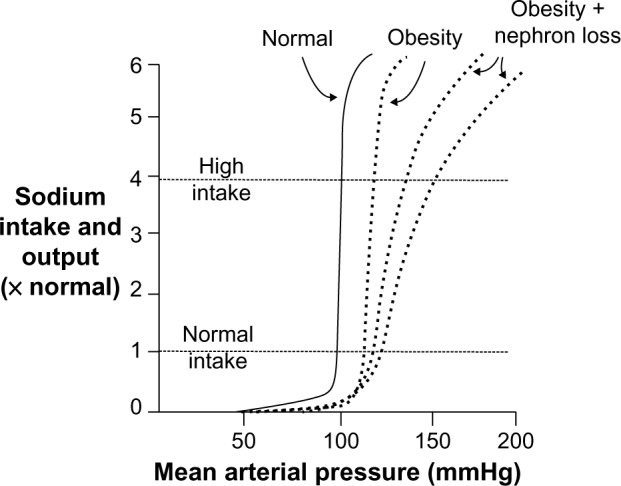
Effect of obesity to shift the renal-pressure natriuresis curve to higher arterial pressure. Note: With chronic obesity, lasting for many years, there may be a gradual loss of nephron function, further impairment of pressure natriuresis, increasing salt-sensitivity, and higher blood pressures.
Figure 4
Figure 4
Relationship between body mass index and systolic and diastolic blood pressures in 22,354 Korean subjects. Note: Adapted with permission from Wolters Kluwer Health: Journal of Hypertension. Jones DW, Kim JS, Andrew ME, Kim SJ, Hong YP. Body mass index and blood pressures in Korean men and women: the Korean National Blood Pressure Survey. J Hypertens. 1994;12(12):1433–1437. Copyright © 1994.
Figure 5
Figure 5
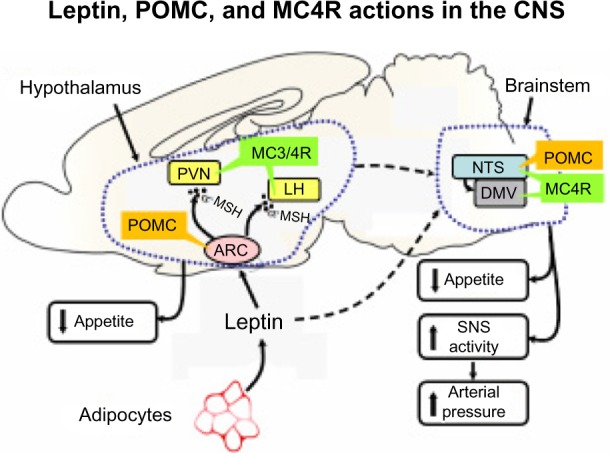
Possible links between leptin and its effects on the hypothalamus, sympathetic nervous system (SNS) activity, and hypertension. Notes: Within the hypothalamus, one of the key pathways of leptin’s action on appetite, SNS activity, and blood pressure is stimulation of the proopiomelanocortin (POMC) neurons in the arcuate nucleus (ARC). These neurons send projections to the paraventricular nucleus (PVN) and lateral hypothalamus (LH), releasing α-melanocyte-stimulating hormone (α-MSH), which then acts as an agonist for melanocortin 4 receptors (MC4R). These neurons, in turn, send projections to the nucleus of the solitary tract (NTS) to effect changes in appetite, SNS activity, and arterial pressure. Abbreviations: MC3/4R, melanocortin 3 and 4 receptors; DMV, dorsal motor nucleus of the vagus; LH, lateral hypothalamus.
Figure 6
Figure 6
The incidence of ESRD for obese, normal, and overweight patients and the effect of ramipril treatment. Notes: The incidence of ESRD was substantially higher in patients with obesity (BMI >30 kg/m2) compared with normal and overweight patients. Treatment with the ACEI ramipril reduced the rate of ESRD in all three BMI groups compared to placebo, but the beneficial effect of the drug was much higher in obese patients (incidence rate reduction 86%) than in those with overweight (incidence rate reduction 45%) or normal BMI (incidence rate reduction 42%). Copyright © 2011. American Society of Nephrology. Adapted from Mallamaci F, Ruggenenti P, Perna A, et al; REIN Study Group. ACE Inhibition Is Renoprotective among Obese Patients with Proteinuria. J Am Soc Nephrol. 2011;22(6):1122–1128. Abbreviations: ACEI, angiotensin converting enzyme inhibitor; BMI, body mass index; ESRD, end-stage renal disease.
Figure 7
Figure 7
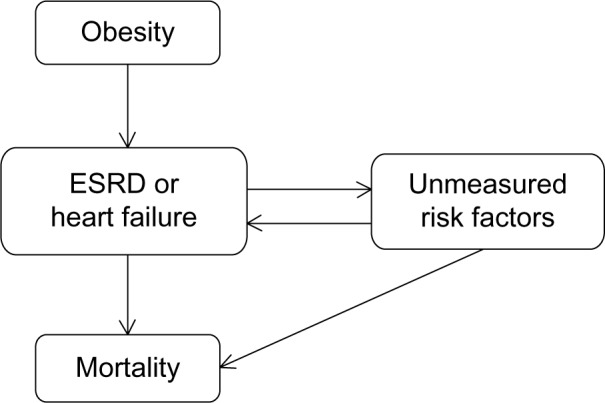
Schematic of potential effects of obesity on debilitating diseases, such as heart failure and ESRD, and impact on mortality of unmeasured risk factors such as poor nutrition, cachexia, unstable hemodynamic status, genetics, and others. Note: The bidirectional relationship between unmeasured risk factors and ESRD and heart failure, indicates that some risk factors for mortality, such as cachexia, can occur as a result of the disease, whereas other unmeasured risk factors may exacerbate the disease beyond that which can be attributed to obesity. Abbreviation: ESRD, end-stage renal disease.
Figure 8
Figure 8
Summary of potential mechanisms by which obesity causes hypertension and renal injury. Note: As renal injury develops, hypertension becomes more severe and more difficult to control, initiating a slowly developing positive feedback that may lead to severe chronic kidney disease. Abbreviations: POMC, hypothalamic proopiomelanocortin; RAAS, renin–angiotensin–aldosterone system; SNS, sympathetic nervous system.

References

    1. Fact Sheet N°311 [webpage on the Internet] Geneva: World Health Organization; [Accessed October 18, 2013]. Obesity and overweight. [updated Mar 2013; cited October 24, 2013]. Available from: http://www.who.int/mediacentre/factsheets/fs311/en/index.html.
    1. Adult obesity facts [webpage on the Internet] Atlanta: Center for Disease Control and Prevention; [Accessed on September 14, 2013]. Obesity and overweight trends in the US, 2011. [updated Aug 2013; cited October 24, 2013]. Available from: http://www.cdc.gov/nccdphp/dnpa/obesity/trend/index.htm.
    1. Hall JE, Henegar JR, Dwyer TM, et al. Is obesity a major cause of chronic renal disease? Adv Ren Replace Ther. 2004;11(1):41–54. - PubMed
    1. Tchernof A, Després JP. Pathophysiology of human visceral obesity: an update. Physiol Rev. 2013;93(1):359–404. - PubMed
    1. Hall JE, Crook ED, Jones DW, Wofford MR, Dubbert PM. Mechanisms of obesity-associated cardiovascular and renal disease. Am J Med Sci. 2002;324(3):127–137. - PubMed

LinkOut - more resources