. 2014 Feb 21:5:53.
doi: 10.3389/fpls.2014.00053. eCollection 2014.

Biofortification of wheat grain with iron and zinc: integrating novel genomic resources and knowledge from model crops

Affiliations

Biofortification of wheat grain with iron and zinc: integrating novel genomic resources and knowledge from model crops

Philippa Borrill et al. Front Plant Sci. .

Abstract

Wheat, like many other staple cereals, contains low levels of the essential micronutrients iron and zinc. Up to two billion people worldwide suffer from iron and zinc deficiencies, particularly in regions with predominantly cereal-based diets. Although wheat flour is commonly fortified during processing, an attractive and more sustainable solution is biofortification, which requires developing new varieties of wheat with inherently higher iron and zinc content in their grains. Until now most studies aimed at increasing iron and zinc content in wheat grains have focused on discovering natural variation in progenitor or related species. However, recent developments in genomics and transformation have led to a step change in targeted research on wheat at a molecular level. We discuss promising approaches to improve iron and zinc content in wheat using knowledge gained in model grasses. We explore how the latest resources developed in wheat, including sequenced genomes and mutant populations, can be exploited for biofortification. We also highlight the key research and practical challenges that remain in improving iron and zinc content in wheat.

Keywords: cereals; genomics; model to crop; nutritional enhancement; transgenic.


Figures
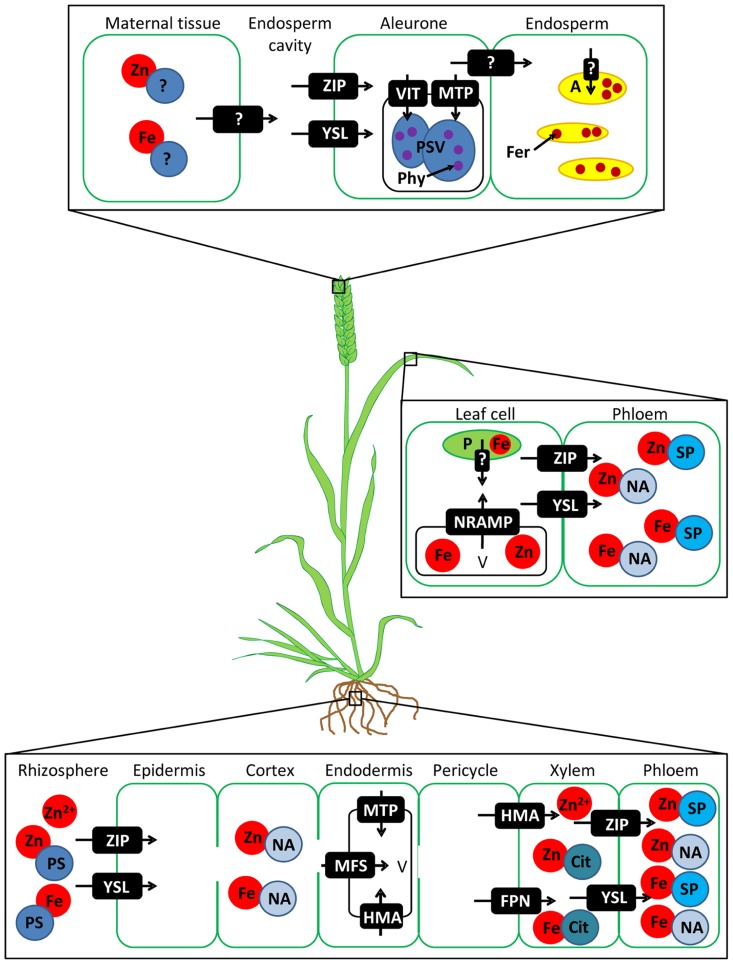
FIGURE 1
FIGURE 1
Simplified proposed pathway for Fe and Zn uptake and translocation to the grain in wheat. Putative classes of transport proteins are shown in white text and are based on evidence from other species. Question marks show unidentified transporters. Free Zn2+ and phytosiderophore (PS) -bound Fe and Zn are absorbed from the soil into root epidermal cells. Fe and Zn move via the apoplast and symplast to the pericycle, but may be sequestered en-route in vacuoles. Fe and Zn are loaded into the xylem and transferred into the phloem in the root, basal shoot or leaf tissues (not shown). Fe and Zn are remobilised from leaf cell plastids (P) and vacuoles (V) and loaded into the phloem for transport to the ear. Fe and Zn are exported from the maternal tissue into the endosperm cavity. After uptake into the aleurone layer most Fe and Zn are sequestered in protein storage vacuoles (PSVs) bound to phytate (Phy). A small proportion of Fe and Zn may enter the endosperm and be stored bound to ferritin (Fer) in amyloplasts (A). ZIP = ZRT-, IRT-like protein, YSL = yellow stripe like transporter, MFS = major facilitator superfamily transporter, MTP = metal tolerance protein, HMA = heavy metal ATPase, FPN = ferroportin, NRAMP = natural resistance-associated macrophage protein, VIT = vacuolar iron transporter, NA = nicotianamine, Cit = citrate, SP = small proteins.

References

    1. Allen A. M., Barker G. L. A., Wilkinson P., Burridge A., Winfield M., Coghill J., et al. (2013). Discovery and development of exome-based, co-dominant single nucleotide polymorphism markers in hexaploid wheat (Triticum aestivum L.). Plant Biotechnol. J. 11 279–295 10.1111/pbi.12009 - DOI - PubMed
    1. Balmer Y., Vensel W. H., Dupont F. M., Buchanan B. B., Hurkman W. J. (2006). Proteome of amyloplasts isolated from developing wheat endosperm presents evidence of broad metabolic capability. J. Exp. Bot. 57 1591–1602 10.1093/jxb/erj156 - DOI - PubMed
    1. Borg S., Brinch-Pedersen H., Tauris B., Holm P. (2009). Iron transport, deposition and bioavailability in the wheat and barley grain. Plant Soil 325 15–24 10.1007/s11104-009-0046-6 - DOI
    1. Borg S., Brinch-Pedersen H., Tauris B., Madsen L. H., Darbani B., Noeparvar S., et al. (2012). Wheat ferritins: improving the iron content of the wheat grain. J. Cereal Sci. 56 204–213 10.1016/j.jcs.2012.03.005 - DOI
    1. Brenchley R., Spannagl M., Pfeifer M., Barker G. L. A., D’Amore R., Allen A. M., et al. (2012). Analysis of the bread wheat genome using whole-genome shotgun sequencing. Nature 491 705–710 10.1038/nature11650 - DOI - PMC - PubMed

LinkOut - more resources
