


Differential effect of wealth quintile on modern contraceptive use and fertility: evidence from Malawian women
- PMID: 24602452
- PMCID: PMC3973841
- DOI: 10.1186/1472-6874-14-40
Differential effect of wealth quintile on modern contraceptive use and fertility: evidence from Malawian women
Abstract
Background: High fertility and wide inequality in wealth distribution are phenomenal problems in sub-Saharan Africa. Modern Contraceptives (MC) are useful for limiting fertility, but are not always easily accessible in Malawi. This study examines the gap in MC use and fertility between women in the richest and poorest Wealth Quintile (WQ).
Methods: The study was cross-sectional in design and utilized Malawi DHS dataset, 2010. It focused on women of reproductive age. The dependent variables are ever and current use of MC. Chi-square and multinomial logistic regression were used for the analysis.
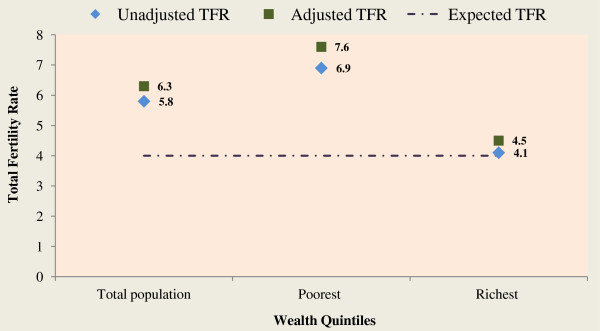
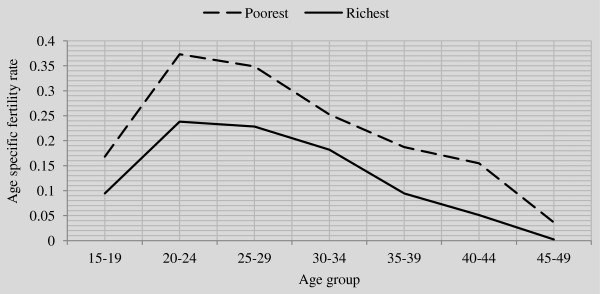
Results: Mean children ever born by women in the poorest and richest WQs were 3.94 ± 2.7 and 2.82 ± 2.3 respectively (p < 0.001). The adjusted total fertility rate (Adj.TFR) was higher among women in the poorest (Adj.TFR = 7.60) WQ than the richest (Adj.TFR = 4.45). The prevalence of ever use of MC was higher among women in the richest WQ (82.4%) than the poorest (66.8%) (p < 0.001). Similar pattern exists for current use of MC; 58.5% and 45.9% for women in the richest and poorest WQs respectively (p < 0.001). Women in the richest WQ were more likely to ever use (OR = 2.36; C.I = 2.07-2.69, p < 0.001) and currently using (OR = 1.66; C.I = 1.40-1.97, p < 0.001) MC than their counterparts in the poorest WQ. Slight reduction in odd-ratio of MC use among women in richest WQ resulted when socio-demographic variables were used as control.
Conclusion: Fertility was higher and the use of MC was lower among women in the poorest than their counterparts in the richest WQ. Ensuring availability of MC at little or no cost may bridge the gap in contraceptive use between women in the poorest and richest WQ in Malawi.
Figures
References
-
- Centre for Disease Control and Prevention. Achievements in public health, 1900–1999: Family planning. MMWR Weekly. 1999;48(47):1073–1080.
-
- United Nations. Millennium Development Goals 2000. New York: 3UN Plaza; 2000. p. 10017.
-
- UNFPA. Programme of Action of the report of International Conference on Population and Development Held in Cairo. 1994.
-
- Bongaarts J, Cleland J, Townsend JW, Bertrand JT, Gupta MD. Family Planning Programs for the 21st Century: Rationale and Design, Volume ix. New York: The Population Council, 2012; 2012. p. 94.
MeSH terms
Substances
LinkOut - more resources
Full Text Sources
Other Literature Sources
Miscellaneous
