


Short-term effects of the particulate pollutants contained in Saharan dust on the visits of children to the emergency department due to asthmatic conditions in Guadeloupe (French Archipelago of the Caribbean)
- PMID: 24603899
- PMCID: PMC3946322
- DOI: 10.1371/journal.pone.0091136
Short-term effects of the particulate pollutants contained in Saharan dust on the visits of children to the emergency department due to asthmatic conditions in Guadeloupe (French Archipelago of the Caribbean)
Abstract
Background: The prevalence of asthma in children is a significant phenomenon in the Caribbean. Among the etiologic factors aggravating asthma in children, environmental pollution is one of the main causes. In Guadeloupe, pollution is primarily transported by Saharan dust including inhalable particles.
Methods: This study assesses, over one year (2011), the short-term effects of pollutants referred to as PM10 (PM10: particulate matter <10 µm) and PM2.5-10 (PM2.5-10: particulate matter >2.5 µm and <10 µm) contained in Saharan dust, on the visits of children aged between 5 and 15 years for asthma in the health emergency department of the main medical facility of the archipelago of Guadeloupe. A time-stratified case-crossover model was applied and the data were analysed by a conditional logistic regression for all of the children but also for sub-groups corresponding to different age classes and genders.
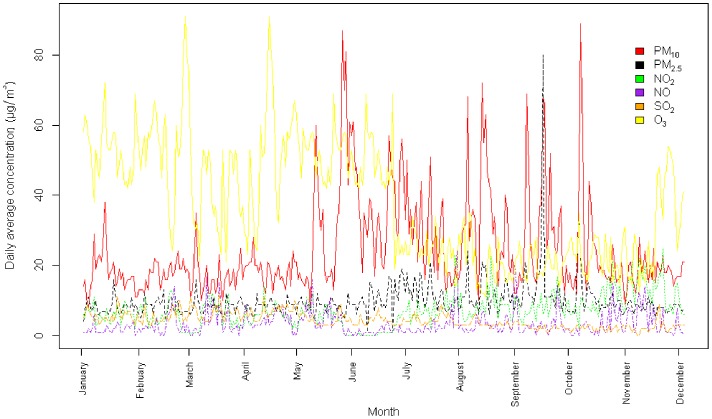
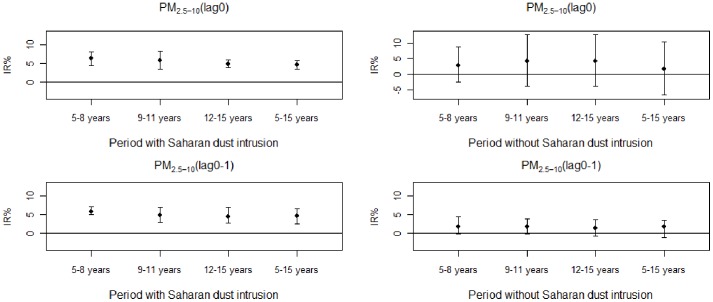
Results: The visits for asthma concerned 836 children including 514 boys and 322 girls. The Saharan dust has affected 15% of the days of the study (337 days) and involved an increase in the average daily concentrations of PM10 (49.7 µg/m3 vs. 19.2 µg/m3) and PM 2.5-10 (36.2 µg/m3 vs. 10.3 µg/m3) compared to days without dust. The excess risk percentages (IR%) for visits related to asthma in children aged between 5 and 15 years on days with dust compared to days without dust were, for PM10, ((IR %: 9.1% (CI95%, 7.1%-11.1%) versus 1.1%(CI95%, -5.9%-4.6%)) and for PM2.5-10 (IR%: 4.5%(CI95%, 2.5%-6.5%) versus 1.6% (CI95%, -1.1%-3.4%). There was no statistical difference in the IR% for periods with Saharan dust among different age group of children and between boys and girls for PM10 and PM2.5-10.
Conclusion: The PM10 and PM2.5-10 pollutants contained in the Saharan dust increased the risk of visiting the health emergency department for children with asthma in Guadeloupe during the study period.
Conflict of interest statement
Figures



References
-
- Mounouchy MA, Cordeau L, Raherison C (2009) Prevalence of asthma and related symptoms among adolescents in Guadeloupe: phase I of the ISAAC survey 2003. Rev Mal Respir 9: 944–51. - PubMed
-
- Mortimer KM, Neas LM, Dockery DW, Redline S, Tager IB (2002) The effect of air pollution on inner-city children with asthma. Eur Respir J 4: 699–705. - PubMed
MeSH terms
Substances
LinkOut - more resources
Full Text Sources
Other Literature Sources
Medical
