


Prevalence & risk factors for soil transmitted helminth infection among school children in south India
- PMID: 24604041
- PMCID: PMC3994744
Prevalence & risk factors for soil transmitted helminth infection among school children in south India
Abstract
Background & objectives: Soil-transmitted helminths (STH) are a major public health problem in tropical and sub-tropical countries, affecting the physical growth and cognitive development in school-age children. This study was aimed to assess the prevalence and risk factors of STH infection among school children aged 6 -14 yr in Vellore and Thiruvanamalai districts in south India.
Methods: Children aged 6-14 yr, going to government and government aided schools (n=33, randomly selected) in Vellore and Thiruvanamalai districts were screened to estimate the prevalence of STH, and a case control study was done on a subset to assess the risk factors for the infection.
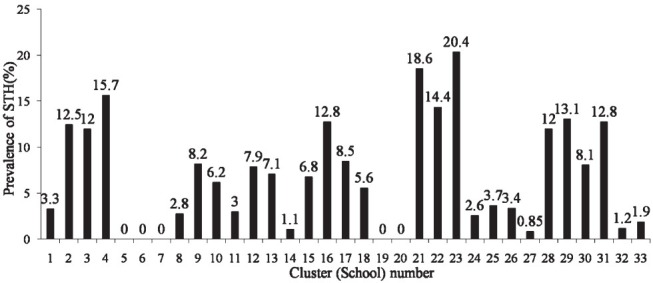
Results: The prevalence of STH was 7.8 per cent, varying widely in schools from 0 to 20.4 per cent, in 3706 screened children. Hookworm (8.4%) rates were high in rural areas, while Ascaris (3.3%) and Trichuris (2.2%) were more prevalent among urban children. Consumption of deworming tablets (OR=0.25, P < 0.01) offered protection, while residing in a field hut (OR=6.73, P=0.02) and unhygienic practices like open air defaecation (OR=5.37, P < 0.01), keeping untrimmed nails (OR=2.53, P=0.01) or eating food fallen on the ground (OR=2.52, P=0.01) were important risk factors for STH infection.
Interpretation & conclusions: Our study indicated that school children with specific risk factors in the studied area were vulnerable subpopulation with elevated risk of STH infection. Identifying risk factors and dynamics of transmission in vulnerable groups can help to plan for effective prevention strategies.
Figures
Comment in
-
India can do more about intestinal worm infections.Indian J Med Res. 2014 Jan;139(1):7-9. Indian J Med Res. 2014. PMID: 24604036 Free PMC article. No abstract available.
References
-
- Geneva: WHO; 2012. World Health Organization (WHO). Eliminating soil transmitted helminthiases as a public health problem in children. Progress Report 2001-2010 and Strategic Plan 2011-2020.
-
- Curtale F, Pezzotti P, Saad YS, Aloi A. An analysis of individual, household, and environmental risk factors for intestinal helminth infection among children in Qena Governorate, Upper Egypt. J Trop Pediatr. 1999;45:14–7. - PubMed
-
- Curtale F, Pezzotti P, Sharbini AL, al Maadat H, Ingrosso P, Saad YS, et al. Knowledge, perceptions and behaviour of mothers toward intestinal helminths in Upper Egypt: implications for control. Health Policy Plan. 1998;13:423–32. - PubMed
-
- Ramesh GN, Malla N, Raju GS, Sehgal R, Ganguly NK, Mahajan RC, et al. Epidemiological study of parasitic infestations in lower socio-economic group in Chandigarh (north India) Indian J Med Res. 1991;93:47–50. - PubMed
MeSH terms
Substances
Grants and funding
LinkOut - more resources
Full Text Sources