


Long-term spatiotemporal stability and dynamic changes in the haemoparasite community of bank voles (Myodes glareolus) in NE Poland
- PMID: 24604428
- PMCID: PMC4103999
- DOI: 10.1007/s00248-014-0390-9
Long-term spatiotemporal stability and dynamic changes in the haemoparasite community of bank voles (Myodes glareolus) in NE Poland
Abstract
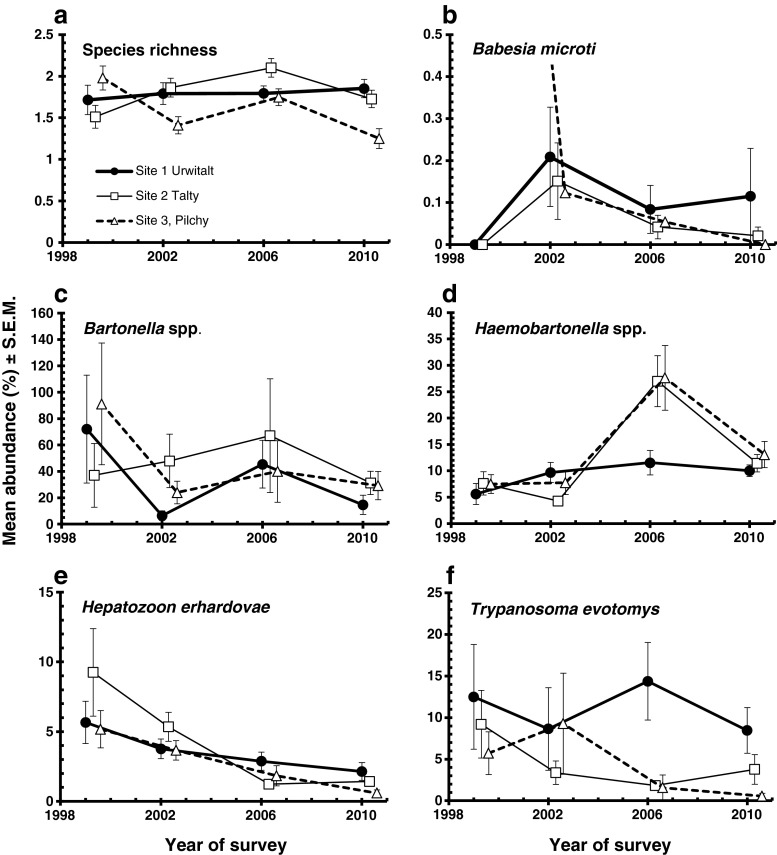
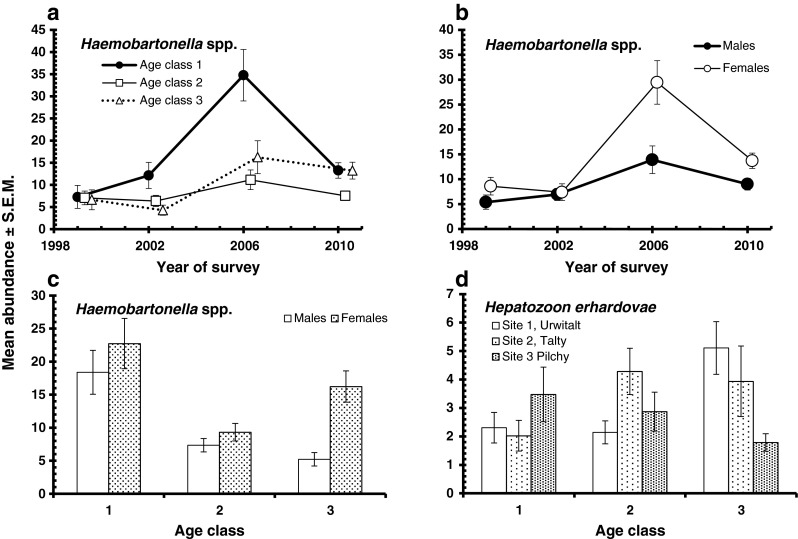
Long-term field studies on parasite communities are rare but provide a powerful insight into the ecological and evolutionary processes shaping host-parasite interactions. The aim of our study was to identify the principal factors regulating long-term trends in the haemoparasite communities of bank voles, and to this end, we sampled three semi-isolated populations of bank voles (n = 880) in 1999, 2002, 2006 and 2010 in the Mazury lake district region of NE Poland. Overall, 90.8 % of the bank voles harboured at least one of the species of haemoparasites studied. Whilst overall prevalence (all species combined) did not vary significantly between the surveys, different temporal changes were detected among voles in each of the three sites. In voles from Urwitałt, prevalence increased consistently with successive surveys, whereas in Tałty, the peak years were 2002 and 2006, and in Pilchy, prevalence oscillated without a clear pattern. Across the study, bank voles harboured a mean of 1.75 ± 0.034 haemoparasite species, and species richness remained stable with no significant between-year fluctuations or trends. However, each of the five constituent species/genera showed a different pattern of spatio-temporal changes. The overall prevalence of Babesia microti was 4.9 %, but this varied significantly between years peaking in 2006 and declining again by 2010. For Bartonella spp., overall prevalence was 38.7 %, and this varied with year of study, but the temporal pattern of changes differed among the three sites. The overall prevalence of Haemobartonella (Mycoplasma) was 68.3 % with an increase in prevalence with year of study in all three sites. Hepatozoon erhardovae had an overall prevalence of 46.8 % but showed a marked reduction with each successive year of the study, and this was consistent in all three sites. The overall prevalence of Trypanosoma evotomys was 15.4 % varying significantly between sites, but showing temporal stability. While overall prevalence of all haemoparasites combined and species richness remained stable over the period of study, among the five haemoparasites, the pattern of spatiotemporal changes in prevalence and abundance of infections differed depending on parasite species. For some genera, host age was shown to play an important role, but a significant effect of host sex was found only for Haemobartonella spp.
Figures



References
-
- Alexander J, Stimson WH. Sex hormones and the course of parasitic infections. Parasitol Today. 1988;4:189–193. doi: 10.1016/0169-4758(88)90077-4. - DOI
-
- Alsarraf M (2012) (Ecology and genetic diversity of blood parasites in bank vole (Myodesglareolus) in the Masurian Lake District). MSc thesis, Department of Parasitology, Faculty of Biology, University of Warsaw, Warsaw 2012
-
- Armstrong PM, Katavolos P, Caporale DA, Smith RP, Spielman A, Telford SR., 3rd Diversity of Babesia infecting deer ticks (Ixodes dammini) Am J Trop Med Hyg. 1998;58:739–742. - PubMed
Publication types
MeSH terms
LinkOut - more resources
Full Text Sources
Other Literature Sources
Molecular Biology Databases
Miscellaneous
