


Regio- and stereoselective 1,2-dihydropyridine alkylation/addition sequence for the synthesis of piperidines with quaternary centers
- PMID: 24604837
- PMCID: PMC4058641
- DOI: 10.1002/anie.201310517
Regio- and stereoselective 1,2-dihydropyridine alkylation/addition sequence for the synthesis of piperidines with quaternary centers
Abstract
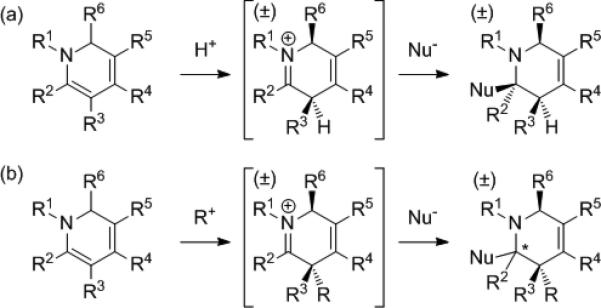
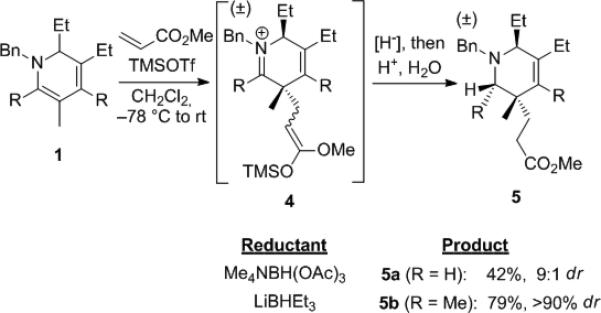
The first example of C alkylation of 1,2-dihydropyridines with alkyl triflates and Michael acceptors was developed to introduce quaternary carbon centers with high regio- and diastereoselectivity. Hydride or carbon nucleophile addition to the resultant iminium ion also proceeded with high diastereoselectivity. Carbon nucleophile addition results in an unprecedented level of substitution to provide piperidine rings with adjacent tetrasubstituted carbon atoms.
Keywords: alkylation; diastereoselectivity; heterocycles; reduction; synthetic methods.
© 2014 WILEY-VCH Verlag GmbH & Co. KGaA, Weinheim.
Figures
References
-
-
For an analysis of the prevalence of piperidines in drugs, see: Roughley SD, Jordan AM. J. Med. Chem. 2011;54:3451–3479.
-
-
-
The structural features of piperidines are consistent with renewed emphasis on the development of drug candidates with increased saturation and nonplanar display of functionality, see: Lovering F, Bikker J, Humblet C. J. Med. Chem. 2009;52:6752–6756. Walters WP, Green J, Weiss JR, Murcko MA. J. Med. Chem. 2011;54:6405–6416. Ritchie TJ, Macdonald SJF. Drug. Discov. Today. 2009;14:1011–1020.
-
-
-
For general reviews on piperidines, see: Michael JP. Nat. Prod. Rep. 2008;25:139–165. Buffat MGP. Tetrahedron. 2004;60:1701–1729. Mitchinson A, Nadin A. J. Chem. Soc. Perkin Trans. 1. 2000:2862–2892. Laschat S, Dickner T. Synthesis. 2000:1781–1813.
-
-
-
For reviews on the synthesis and applications of 1,2-dihydropyridines, see: Bull JA, Mousseau JJ, Pelletier G, Charette AB. Chem. Rev. 2012;112:2642–2713. Silva EMP, Varandas PAMM, Silva AMS. Synthesis. 2013;45:3053–3089. Tanaka K, Fukase K, Katsumura S. Synlett. 2011:2115–2139.
-
-
-
For recent methods for the synthesis of 1,2-dihydropyridines, see Mizoguchi H, Oikawa H, Oguri H. Nature Chem. 2013 Advanced online publication, DOI:10.1038/nchem.1798. Chau ST, Lutz JP, Wu K, Doyle AG. Angew. Chem. 2013;125:9323–9326. Angew. Chem. Int. Ed. 2013;52:9153–9156. Yamakawa T, Yoshikai N. Org. Lett. 2013;15:196–199. Oshima K, Ohmura T, Suginome M. J. Am. Chem. Soc. 2012;134:3699–3702. Amatore M, Leboeuf D, Malacria M, Gandon V, Aubert C. J. Am. Chem. Soc. 2013;135:4576–4579. Nadeau C, Aly S, Belyk K. J. Am. Chem. Soc. 2011;133:2878–2880. Jarvis SBD, Charette AB. Org. Lett. 2011;13:3830–3833.
-
Publication types
MeSH terms
Substances
Grants and funding
LinkOut - more resources
Full Text Sources
Other Literature Sources
