. 2014 Mar 10;21(1):19.
doi: 10.1186/1423-0127-21-19.

Inhibitors of apoptosis proteins in experimental benign prostatic hyperplasia: effects of serenoa repens, selenium and lycopene

Affiliations

Inhibitors of apoptosis proteins in experimental benign prostatic hyperplasia: effects of serenoa repens, selenium and lycopene

Letteria Minutoli et al. J Biomed Sci. .

Retraction in

Abstract

Background: The apoptosis machinery is a promising target against benign prostatic hyperplasia (BPH). Inhibitors of apoptosis proteins (IAPs) modulate apoptosis by direct inhibition of caspases. Serenoa Repens (SeR) may be combined with other natural compounds such as Lycopene (Ly) and Selenium (Se) to maximize its therapeutic activity in BPH. We investigated the effects of SeR, Se and Ly, alone or in association, on the expression of four IAPs, cIAP-1, cIAP-2, NAIP and survivin in rats with experimental testosterone-dependent BPH. Moreover, caspase-3, interleukin-6 (IL-6) and prostate specific membrane antigen (PSMA) have been evaluated.Rats were administered, daily, with testosterone propionate (3 mg/kg/sc) or its vehicle for 14 days. Testosterone injected animals (BPH) were randomized to receive vehicle, SeR (25 mg/kg/sc), Se (3 mg/kg/sc), Ly (1 mg/kg/sc) or the SeR-Se-Ly association for 14 days. Animals were sacrificed and prostate removed for analysis.

Results: BPH animals treated with vehicle showed unchanged expression of cIAP-1 and cIAP-2 and increased expression of NAIP, survivin, caspase-3, IL-6 and PSMA levels when compared with sham animals. Immunofluorescence studies confirmed the enhanced expression of NAIP and survivin with a characteristic pattern of cellular localization. SeR-Se-Ly association showed the highest efficacy in reawakening apoptosis; additionally, this therapeutic cocktail significantly reduced IL-6 and PSMA levels. The administration of SeR, Se and Ly significantly blunted prostate overweight and growth; moreover, the SeR-Se-Ly association was most effective in reducing prostate enlargement and growth by 43.3% in treated animals.

Conclusions: The results indicate that IAPs may represent interesting targets for drug therapy of BPH.


Figures
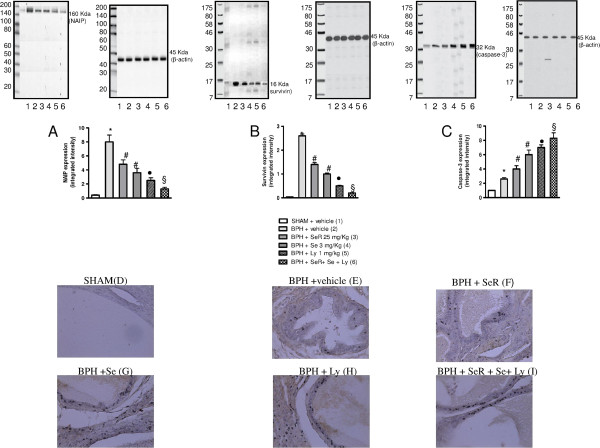
Figure 1
Figure 1
Expression of IAPs, NAIP, Survivin and caspase-3 in the Western Blot and Immunohistocehemical analysis.Top Panel: Representative Western Blot analysis of NAIP (A), survivin (B) and caspase-3 (C). The prostate is collected from Sham rats treated with vehicle and BPH rats treated with either vehicle or SeR (25 mg/Kg) or Se (3 mg/kg) or Ly (1 mg/kg) or Ser + Se + Ly *p < 0.01 vs Sham; #p < 0.05 vs BPH + vehicle; •p < 0.01 vs BPH + vehicle; §p < 0.001 vs BPH + vehicle. Bars represent the mean ± SEM of seven experiments. Bottom Panel: Immunhistochemical detection of Caspase-3. The prostate is collected from Sham rats treated with vehicle (D) and BPH rats treated with either vehicle (E) or SeR (25 mg/Kg) (F) or Se (3 mg/kg) (G) or Ly (1 mg/kg) (H) or SeR + Se + Ly (I). Immunohistochemistry for caspase-3 showed a negative reaction in sham (D). In BPH rats treated with vehicle (E), a focal cytoplasmatic positivity was documented in acini and stromal cells. A progressive enhancement of positivity was observed in BPH rats treated with SeR (F), Se (G), Ly and with the combination of SeR + Se + Ly (I), where it reached the highest expression. Original magnification ×400.
Figure 2
Figure 2
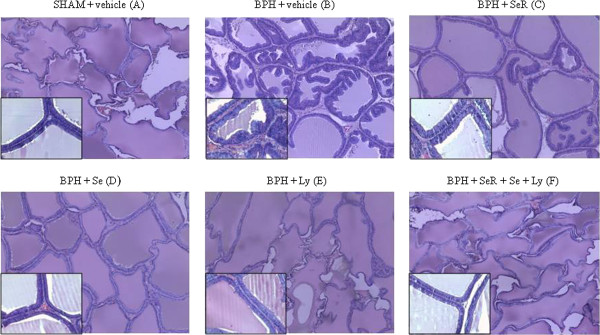
Histological findings. Sham prostate treated with vehicle showing regular acini with cubodail epithelium with round nuclei showing a regular alignment (A). BPH prostate treated with vehicle showed irregular acinar shape with villous projection into the lumen and foci of piling-up hyperplastic nodule with loss of epithelial polarity are evident. The epithelium is cylindric/cuboidal and round/ovoid nuclei are irregularly aligned. Presence of hard stroma and an intact basal layer surrounding the acini (B). Similarly, BPH prostate treated with SeR and Se displayed cilindric/cuboidal epithelial cells but villous projections are just slightly present or absent, respectively. Moderate stroma and intact basal layer around the acini (C-D). Treatment with Ly proved cuboidal epithelial cells, absence of villous projection and the presence of moderate stroma with intact basal layer around the acini (E). Differently, BPH prostate treated with the combination SeR-Se-Ly resembled the histological features of a normal acinar structure (F) (Original magnification ×100 and ×400 in the box).
Figure 3
Figure 3
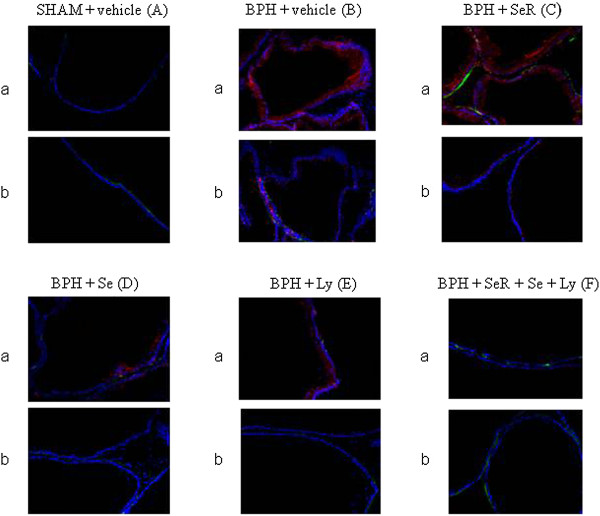
Immunofluorescence analysis of NAIP and Survivin. Immunofluorescence stainings of NAIP (a) and Survivin (b) (in red) and anti-smooth muscle alpha-actin (in green) showed a diffuse positivity in BPH prostatic epithelium treated with vehicle (B). In a lesser extent, the fluorescence was present in BPH prostate treated with SeR, Se and Ly, in a decremental fashion (C, D and E). Differently, NAIP and Survivin were just focally or not detected in Sham and BPH prostate treated with the combination SeR-Se-Ly (A and F, respectively) (Original magnification ×400).
Figure 4
Figure 4
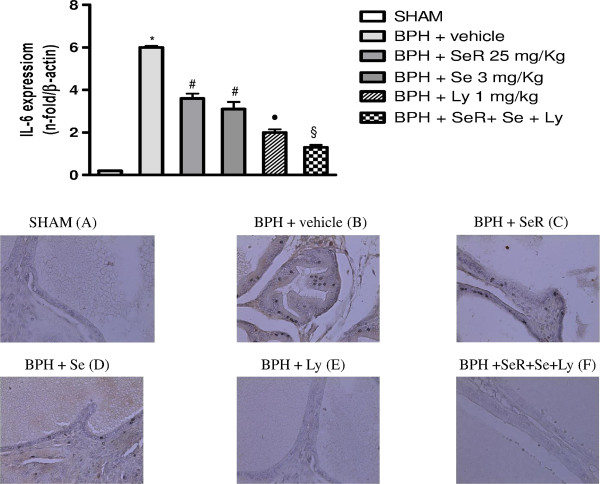
IL-6 mRNA expression and Immunohistochemical analysis of PSMA.Top Panel: Expression of mRNA for IL-6. The prostate is collected from Sham rats treated with vehicle and BPH rats treated with either vehicle or SeR (25 mg/Kg) or Se (3 mg/kg) or Ly (1 mg/kg) or Ser + Se + Ly *p < 0.01 vs Sham; #p < 0.05 vs BPH + vehicle; •p < 0.01 vs BPH + vehicle; §p < 0.001 vs BPH + vehicle. Bars represent the mean ± SEM of seven experiments. Bottom panel: Immunohistochemical detection of PSMA. The prostate is collected from Sham rats treated with vehicle (A) and BPH rats treated with either vehicle (B) or SeR (25 mg/Kg) (C) or Se (3 mg/kg) (D) or Ly (1 mg/kg) (E) or SeR + Se + Ly (F). Immunohistochemistry for PSMA showed a negative reaction in sham (A) as well as in BPH treated with Ly (E) or with the combination SeR + Se + Ly (F). Differently, a moderate cytoplasmatic positivity was observed in acini and stromal cells of BPH rats treated with vehicle (B) and, in a lesser extent, of BPH rats treated with SeR (C) or Se (D). Original magnification ×400.

References

    1. Alison MR, Sarraf CE. Apoptosis: a gene-directed programme of cell death. J R Coll Physicians Lond. 1992;26:25–35. - PMC - PubMed
    1. Fuchs Y, Steller H. Programmed cell death in animal development and disease. Cell. 2011;147:742–758. doi: 10.1016/j.cell.2011.10.033. - DOI - PMC - PubMed
    1. Sebastiano C, Vincenzo F, Tommaso C, Giuseppe S, Marco R, Ivana C, Giorgio R, Massimo M, Giuseppe M. Dietary patterns and prostatic diseases. Front Biosci (Elite Ed) 2012;4:195–204. Review. - PubMed
    1. Djavan B, Fong YK, Chaudry A, Reissigl A, Anagnostou T, Bagheri F, Waldert M, Fajkovic H, Marihart S, Harik M, Spaller S, Remzi M. Progression delay in men with mild symptoms of bladder outlet obstruction: a comparative comparative study of phytotherapy and watchful waiting. World J Urol. 2005;23:253–256. doi: 10.1007/s00345-005-0005-7. - DOI - PubMed
    1. Mitropoulos D, Kyroudi A, Zervas A, Papadoukakis S, Giannopoulos A, Kittas C, Karayannacos P. In vivo effect of the lipido-sterolic extract of Serenoa repens (Permixon) on mast cell accumulation and glandular epithelium trophism in the rat prostate. World J Urol. 2002;19:457–461. - PubMed

Publication types