Review
. 2014;20(35):5574-93.
doi: 10.2174/1381612820666140305224906.

Mitochondrial biogenesis: a therapeutic target for neurodevelopmental disorders and neurodegenerative diseases

Affiliations
Review

Mitochondrial biogenesis: a therapeutic target for neurodevelopmental disorders and neurodegenerative diseases

Martine Uittenbogaard et al. Curr Pharm Des. 2014.

Abstract

In the developing and mature brain, mitochondria act as central hubs for distinct but interwined pathways, necessary for neural development, survival, activity, connectivity and plasticity. In neurons, mitochondria assume diverse functions, such as energy production in the form of ATP, calcium buffering and generation of reactive oxygen species. Mitochondrial dysfunction contributes to a range of neurodevelopmental and neurodegenerative diseases, making mitochondria a potential target for pharmacological-based therapies. Pathogenesis associated with these diseases is accompanied by an increase in mitochondrial mass, a quantitative increase to overcome a qualitative deficiency due to mutated mitochondrial proteins that are either nuclear- or mitochondrial-encoded. This compensatory biological response is maladaptive, as it fails to sufficiently augment the bioenergetically functional mitochondrial mass and correct for the ATP deficit. Since regulation of neuronal mitochondrial biogenesis has been scantily investigated, our current understanding on the network of transcriptional regulators, co-activators and signaling regulators mainly derives from other cellular systems. The purpose of this review is to present the current state of our knowledge and understanding of the transcriptional and signaling cascades controlling neuronal mitochondrial biogenesis and the various therapeutic approaches to enhance the functional mitochondrial mass in the context of neurodevelopmental disorders and adult-onset neurodegenerative diseases.


Conflict of interest statement

CONFLICT OF INTEREST

The authors confirm that this article content has no conflicts of interest.

Figures
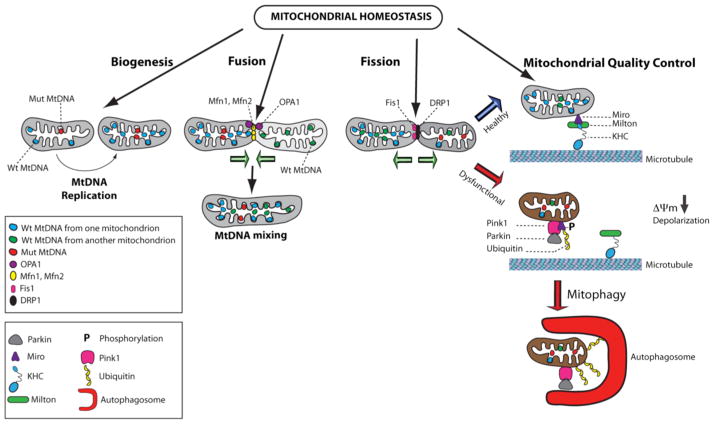
Fig. 1
Fig. 1
Maintenance of mitochondrial homeostasis. Mitochondrial number and health are under the control of three pathways: biogenesis, fusion-fission cycles and mitochondrial quality control. In healthy cells, these pathways are well balanced. Mitochondrial biogenesis involves mtDNA replication, while fusion promotes mtDNA mixing. Wild type mtDNA is illustrated in blue or green, while mutated mtDNA is indicated in red. Execution of the fusion process requires merging of the outer and inner mitochondrial membranes via the sequential action of the GTPase proteins, OPA1 (purple circles) and the mitofusins, Mfn1 and Mfn2 (yellow circles). Mitochondrial mass is also influenced by the process of fission, a process during which one mitochondrion gives rise to two healthy mitochondria. Fission is controlled by the dynamin-related protein DRP1 protein (black circles) and its receptors, such as Fis1 protein (pink circles), which together constrict the membranes to cause separation of mitochondria. The mitochondrial quality control prevents accumulation of dysfunctional mitochondria exhibiting mitochondrial membrane depolarization, which are targeted by the autophagic machinery for clearance. Healthy mitochondria are attached to microtubules via the kinesin heavy chain (KHC in blue) and the Miro-Milton adaptor complex illustrated by purple and green symbols, respectively. Following mitochondrial membrane depolarization provoked by various insults or increased mutated mtDNA population, PINK1 (pink symbol) accumulates in the outer mitochondrial membrane to recruit Parkin (grey symbol). Subsequently, Miro is phosphorylated resulting in detachment from Milton and microtubules. Parkin promotes ubiquitination (yellow symbol) of Miro and additional mitochondrial proteins, thereby inducing mitophagy with the assistance of autophagosomes (red symbol).
Fig. 2
Fig. 2
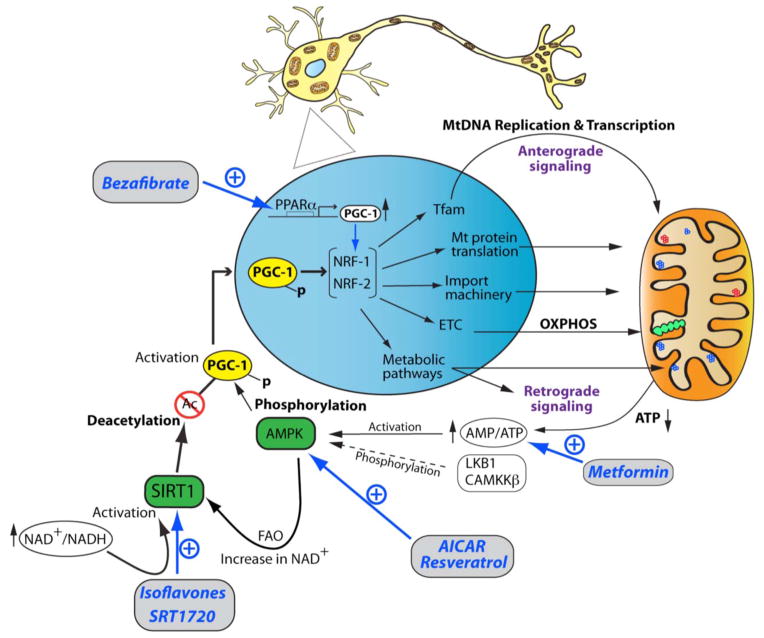
An integrated view of therapeutic strategies targeting the transcriptional network and signaling pathways promoting neuronal mitochondrial biogenesis. Diagrammed are the anterograde and retrograde signaling crosstalks between the nucleus (blue) and mitochondria (orange). The OXPHOS system is depicted with green circles, while wild type and mutated mtDNA molecules are illustrated with blue and red circles, respectively. The signaling and transcriptional cascades are limited to the PGC-1α-NRF-1-NRF-2 axis, given its important regulatory role for neuronal mitochondrial biogenesis. Pharmacological manipulations of key regulators for mitochondrial biogenesis and bioenergetics are illustrated in blue in the diagrammatic summary. PGC-1α expression can be pharmacologically enhanced by bezafibrate, an agonist of PPARα, which leads to increased expression of the NRF-1 and NRF-2 genes. In addition, PGC-1α directly stimulates the transcriptional activity of the NRF-1 and NRF-2 transcription factors via protein-protein interactions. Consequently, PGC-1α-mediated increased expression levels and activity of NRF-1 and NRF-2 lead to stimulation of gene expression relevant to mtDNA replication via the TFAM protein, OXPHOS activity (ETC), import of nuclear-encoded proteins, the mitochondrial translation machinery, and diverse mitochondrial and cellular metabolic pathways. The major retrograde signaling pathway is under the control of the AMP/ATP ratio, which augments upon decreased ATP levels. Increased AMP/ATP ratio activates AMPK, which subsequently phosphorylates the PGC-1α protein. In neuronal cells, activation of AMPK is also under the control of the LKB1 and CAMMKβ kinase. Phosphorylated PGC-1α migrates to the nucleus, where it stimulates the expression levels of the NRF-1 and NRF-2 genes as well as their transcriptional activities. In a neuronal context, AMPK activity can be modulated via several pharmacological means, such as AICAR, resveratrol, and metformin, which are depicted in blue in the diagrammatic summary. AMPK also influences the activity of the NAD+-dependent deacetylase SIRT1 via fatty acid oxidation (FAO), resulting in increased NAD+ levels. Subsequently, SIRT1 is activated via phosphorylation, which can occur independently of AMPK upon increase of the NAD+/NADH ratio. Isoflavones and the pharmacological agent SRT1720 also activate SIRT1, which in turn deacetylate PGC-1α, thereby linking the cellular metabolic status to a network of gene expression relevant for mitochondrial biogenesis.
Fig. 3
Fig. 3
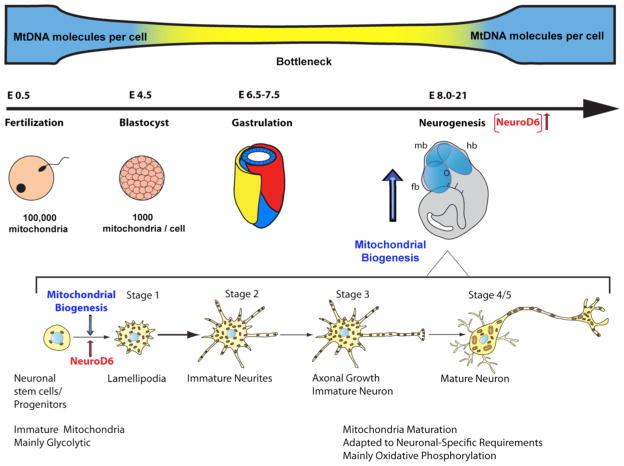
Timing of mitochondrial biogenesis during embryogenesis and neuronal differentiation. Depicted are key developmental stages during embryogenesis during which the mitochondrial genetic bottleneck occurs. Initiation of mitochondrial biogenesis coincides with increased expression of NeuroD6 and precedes neurogenesis as indicated by a blue or red arrow, respectively. The early stages of neuronal differentiation are illustrated as defined by Dotti et al., 1988. Onset of mitochondrial biogenesis coincides with the transition from neural/progenitor cells to the lamellipodial stage. The degree of mitochondrial maturity and metabolism is indicated throughout neuronal differentiation. (fb) forebrain; (mb) midbrain; (hb) hindbrain.

References

    1. Calvo SE, Mootha VK. The mitochondrial proteome and human disease. Annu Rev Genomics Hum Genet. 2010;11:25–44. - PMC - PubMed
    1. Mootha VK, Bunkenborg J, Olsen JV, et al. Integrated analysis of protein composition, tissue diversity, and gene regulation in mouse mitochondria. Cell. 2003;115:629–40. - PubMed
    1. Pagliarini DJ, Calvo SE, Chang B, et al. A mitochondrial protein compedium elucidates complex I disease biology. Cell. 2008;134:112–23. - PMC - PubMed
    1. DiMauro S. A history of mitochondrial diseases. J Inherit Metab Dis. 2011;34:261–76. - PubMed
    1. De Castro IP, Martins ML, Tufi R. Mitochondrial quality control and neurological disease: an emerging connection. Expert Rev Mol Med. 2010;12:e12. - PMC - PubMed

Publication types

MeSH terms

Substances