. 2014 Mar 7;33(1):25.
doi: 10.1186/1756-9966-33-25.

The expression and role of tyrosine kinase ETK/BMX in renal cell carcinoma

Affiliations

The expression and role of tyrosine kinase ETK/BMX in renal cell carcinoma

Jintao Zhuang et al. J Exp Clin Cancer Res. .

Abstract

Background: Expression of the non-receptor tyrosine kinase ETK/BMX has been reported in several solid tumors, but the underlying molecular mechanisms and its clinical significance in renal cell carcinoma (RCC) remain to be elucidated.

Methods: ETK expression in 90 human RCC and 30 human normal renal tissue samples was examined by immunohistochemistry and compared with several clinicopathologic parameters. To further demonstrate the biological function of ETK in RCC, Western blot was used to test the expression level of ETK protein in RCC cell lines. Subsequent to the downregulation of ETK by small interfering RNA, the effects of ETK on RCC cell growth, apoptosis, migration and invasion were assessed by methyl thiazol tetrazolium assay, flow cytometry and transwell assay. And the varying expression of VEGF, STAT3 and phosphorylated STAT3 (p-STAT3) in RCC were evaluated by Western blot.

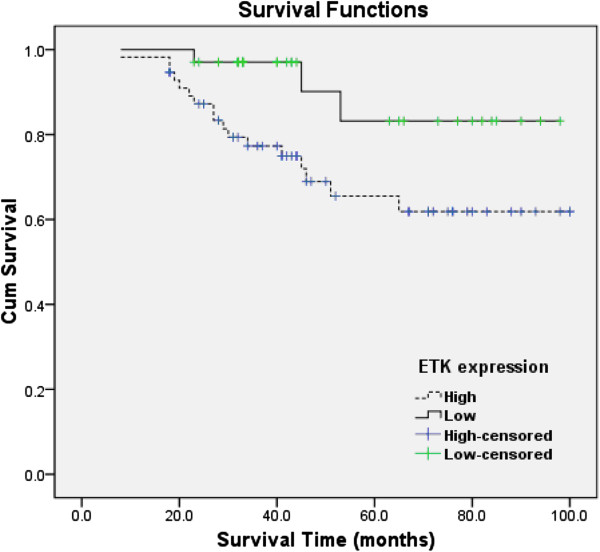
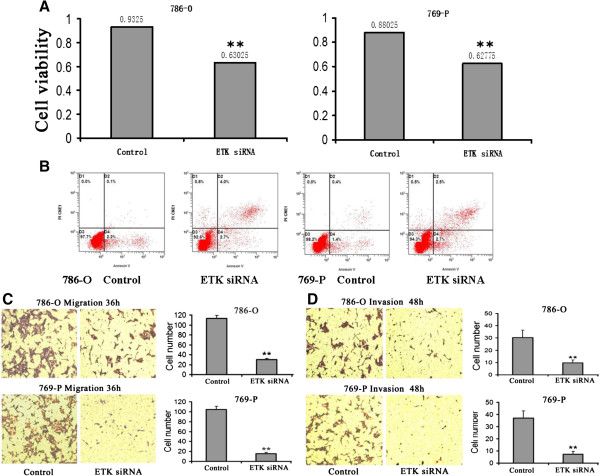
Results: Immunohistochemistry analysis showed that ETK expression was highly increased in RCC and was positively correlated with clinical stage, grade and metastasis. Simultaneously, the overall survival time in patients with higher ETK expression was obviously shorter than that in patients with lower ETK expression. ETK was also detected in RCC cell lines. Moreover, the down-regulating ETK significantly inhibited RCC cell growth, migration, invasion and promoted apoptosis. The expression of VEGF and p-STAT3 were also decreased.

Conclusions: Our study suggests that the overexpression of ETK is associated with the malignancy and disease progression of RCC. Since ETK is also involved in RCC cell biological function and VEGF-ETK-STAT3 loop, ETK may be used as a potential therapeutic target for RCC.


Figures
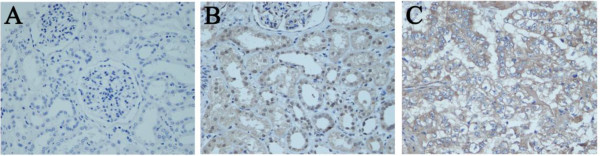
Figure 1
Figure 1
Immunohistochemical staining of ETK protein in tissue microarray. A Minimal expression of ETK in paracancerous normal renal tissue (×400), B Low expression of ETK in paracancerous normal renal tissue (×400), C High expression of ETK in RCC tissue (×400).
Figure 2
Figure 2
Correlation of ETK expression with overall survival. Kaplan-Meier curves with univariate analyses (log-rank) between RCC patients with high ETK expression (dotted line) and low ETK expression (thick line) (*P<0.05).
Figure 3
Figure 3
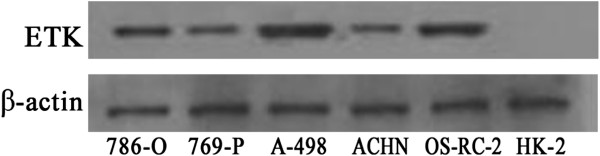
Expression of ETK in RCC cell lines. Western blot shows that ETK is highly expressed in all five RCC cell lines, but hardly expressed in the normal renal proximal tubular cell HK-2. β-actin is the loading control.
Figure 4
Figure 4
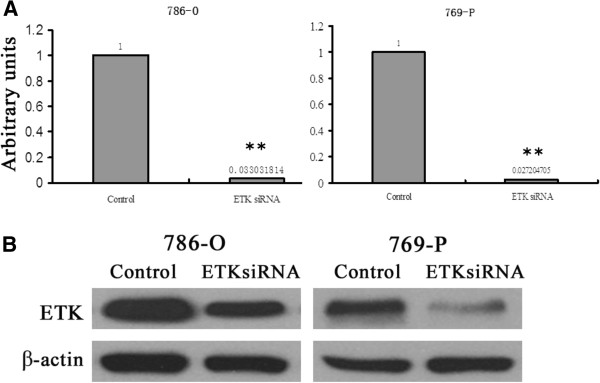
Expression spectrum of ETK in ETK-siRNA-transfected and control-siRNA-tranfected RCC cells (786-O and 769-P). (A) real-time PCR The average ratios of ETK mRNA expression in siRNA group and control group. Expression intensity of ETK was normalized by β-actin. Data were from three parallel experiments. (B) Western blot ETK expression in protein level in siRNA group and control group. Protein concentrations were 8 μg/ml. β-actin is the loading control. (**, P<0.01).
Figure 5
Figure 5
Effects of ETK on cell proliferation, apoptosis, migration and invasion of RCC cells 786-O and 769-P. Comparing ETK siRNA group with negative control siRNA group, (A) Cell proliferation was significantly inhibited after ETK siRNA transfection at 48 h. (B) Flow cytometry indicated that cell apoptosis increased after ETK siRNA transfection at 48 h. (C) Cell migration was significantly inhibited after ETK siRNA transfection at 36 h. (D) Transwell matrigel invasion assay showed a significant decrease of invaded cells after ETK siRNA transfection at 48 h. (**, P<0.01).
Figure 6
Figure 6
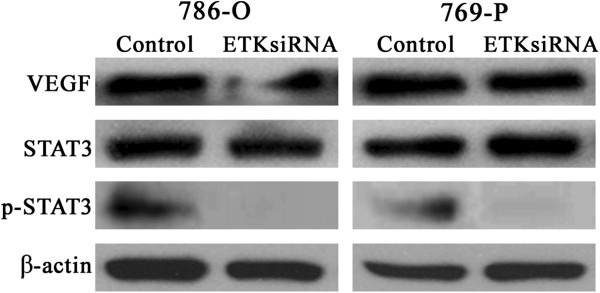
Expression of VEGF and STAT3 after ETK knockdown. Western blot showed that the expression of VEGF and p-STAT3 were decreased, especially the expression of p-STAT3 (P<0.01). While the unactivated STAT3 protein remained invariable (P>0.05). Protein concentrations were 8 μg/ml. β-actin is the loading control.

References

    1. Siegel R, DeSantis C, Virgo K, Stein K, Mariotto A, Smith T, Cooper D, Gansler T, Lerro C, Fedewa S, Lin C, Leach C, Cannady RS, Cho H, Scoppa S, Hachey M, Kirch R, Jemal A, Ward E. Cancer treatment and survivorship statistics, 2012. CA Cancer J Clin. 2012;62:220–241. doi: 10.3322/caac.21149. - DOI - PubMed
    1. Escudier B, Eisen T, Porta C, Patard JJ, Khoo V, Algaba F, Mulders P, Kataja V. ESMO guidelines working group. Renal cell carcinoma: ESMO clinical practice guidelines for diagnosis, treatment and follow-up. Ann Oncol. 2012;23(Suppl 7):vii65–vii71. - PubMed
    1. Ljungberg B, Cowan NC, Hanbury DC, Hora M, Kuczyk MA, Merseburger AS, Patard JJ, Mulders PF, Sinescu IC. European association of urology guideline group. EAU guidelines on renal cell carcinoma: the 2010 update. Eur Urol. 2010;58:398–406. doi: 10.1016/j.eururo.2010.06.032. - DOI - PubMed
    1. Tunuguntla HS, Jorda M. Diagnostic and prognostic molecular markers in renal cell carcinoma. J Urol. 2008;179:2096–2102. doi: 10.1016/j.juro.2008.01.083. - DOI - PubMed
    1. Eichelberg C, Junker K, Ljungberg B, Moch H. Diagnostic and prognostic molecular markers for renal cell carcinoma: a critical appraisal of the current state of research and clinical applicability. Eur Urol. 2009;55:851–863. doi: 10.1016/j.eururo.2009.01.003. - DOI - PubMed

Publication types

MeSH terms