


Long interspersed element-1 protein expression is a hallmark of many human cancers
- PMID: 24607009
- PMCID: PMC4005969
- DOI: 10.1016/j.ajpath.2014.01.007
Long interspersed element-1 protein expression is a hallmark of many human cancers
Abstract
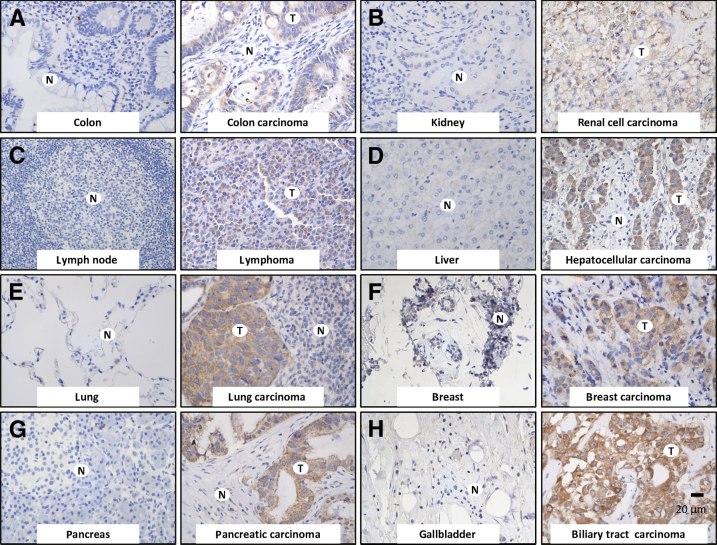
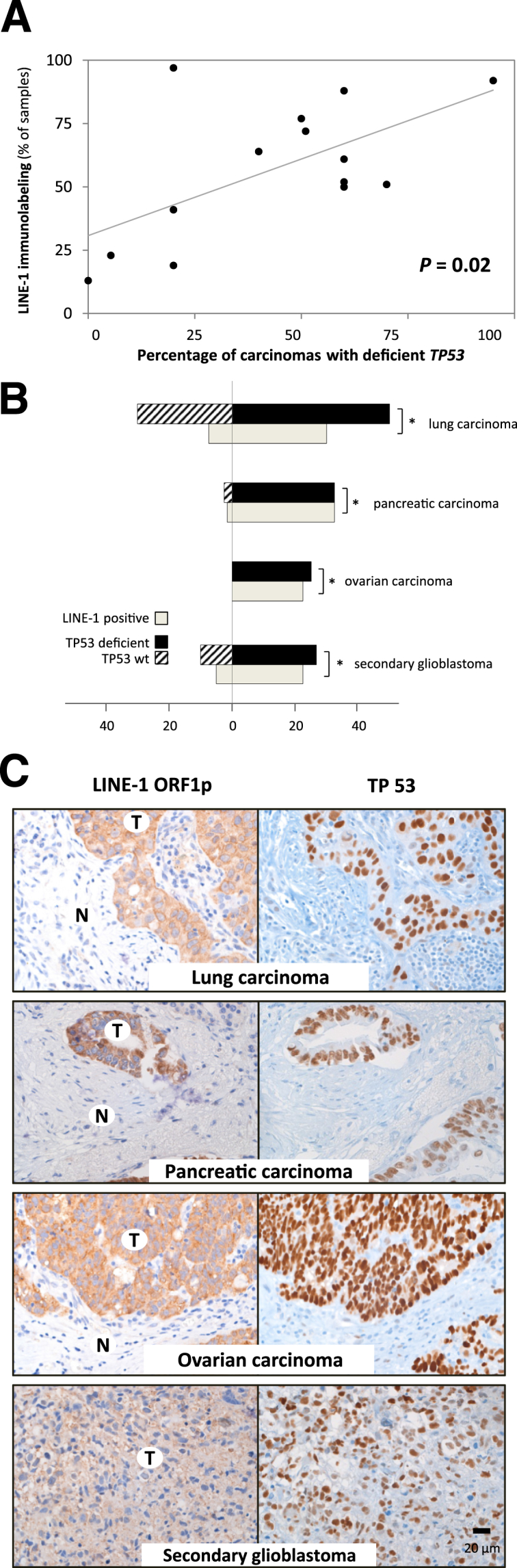
Cancers comprise a heterogeneous group of human diseases. Unifying characteristics include unchecked abilities of tumor cells to proliferate and spread anatomically, and the presence of clonal advantageous genetic changes. However, universal and highly specific tumor markers are unknown. Herein, we report widespread long interspersed element-1 (LINE-1) repeat expression in human cancers. We show that nearly half of all human cancers are immunoreactive for a LINE-1-encoded protein. LINE-1 protein expression is a common feature of many types of high-grade malignant cancers, is rarely detected in early stages of tumorigenesis, and is absent from normal somatic tissues. Studies have shown that LINE-1 contributes to genetic changes in cancers, with somatic LINE-1 insertions seen in selected types of human cancers, particularly colon cancer. We sought to correlate this observation with expression of the LINE-1-encoded protein, open reading frame 1 protein, and found that LINE-1 open reading frame 1 protein is a surprisingly broad, yet highly tumor-specific, antigen.
Copyright © 2014 American Society for Investigative Pathology. Published by Elsevier Inc. All rights reserved.
Figures

References
-
- Feinberg A.P., Vogelstein B. Hypomethylation distinguishes genes of some human cancers from their normal counterparts. Nature. 1983;301:89–92. - PubMed
-
- Ting D.T., Lipson D., Paul S., Brannigan B.W., Akhavanfard S., Coffman E.J., Contino G., Deshpande V., Iafrate A.J., Letovsky S., Rivera M.N., Bardeesy N., Maheswaran S., Haber D.A. Aberrant overexpression of satellite repeats in pancreatic and other epithelial cancers. Science. 2011;331:593–596. - PMC - PubMed
-
- Lee E., Iskow R., Yang L., Gokcumen O., Hanseley P., Luquette L.J., Lohr J.G., Harris C.C., Ding L., Wilson R.K., Wheeler D.A., Gibbs R.A., Kucherlapati R., Lee C., Kharchenko P.V., Park P.J., Network TCGAR Landscape of somatic retrotransposition in human cancers. Science. 2012;337:967–971. - PMC - PubMed
-
- Solyom S., Ewing A.D., Rahrmann E.P., Doucet T., Nelson H.H., Burns M.B., Harris R.S., Sigmon D.F., Casella A., Erlanger B., Wheelan S., Upton K.R., Shukla R., Faulkner G.J., Largaespada D.A., Kazazian H.H., Jr. Extensive somatic L1 retrotransposition in colorectal tumors. Genome Res. 2012;22:2328–2338. - PMC - PubMed
Publication types
MeSH terms
Substances
Grants and funding
- R01 CA163705/CA/NCI NIH HHS/United States
- T32 CA130840/CA/NCI NIH HHS/United States
- R01CA161210/CA/NCI NIH HHS/United States
- P50 GM107632/GM/NIGMS NIH HHS/United States
- R01CA163705/CA/NCI NIH HHS/United States
- K08CA134746/CA/NCI NIH HHS/United States
- T32 GM007309/GM/NIGMS NIH HHS/United States
- P50 CA058236/CA/NCI NIH HHS/United States
- HHMI/Howard Hughes Medical Institute/United States
- P30 DK089502/DK/NIDDK NIH HHS/United States
- R01 GM103999/GM/NIGMS NIH HHS/United States
- P50CA58236/CA/NCI NIH HHS/United States
- K08 CA134746/CA/NCI NIH HHS/United States
- R01 CA161210/CA/NCI NIH HHS/United States
LinkOut - more resources
Full Text Sources
Other Literature Sources
