. 2014 May;13(5):1299-317.
doi: 10.1074/mcp.M113.029538. Epub 2014 Mar 8.

Quantitative proteomics of the Neisseria gonorrhoeae cell envelope and membrane vesicles for the discovery of potential therapeutic targets

Affiliations

Quantitative proteomics of the Neisseria gonorrhoeae cell envelope and membrane vesicles for the discovery of potential therapeutic targets

Ryszard A Zielke et al. Mol Cell Proteomics. 2014 May.

Abstract

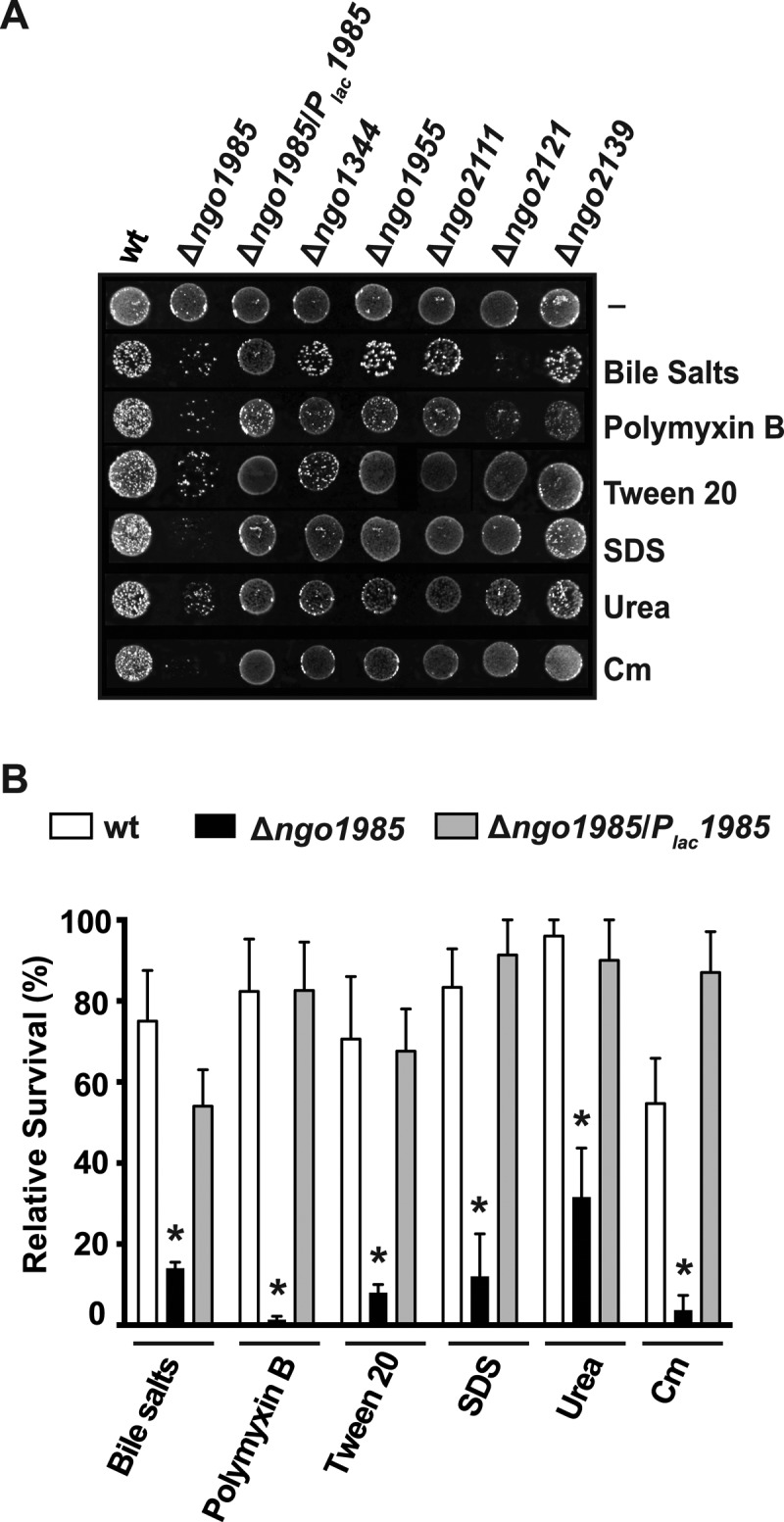
Neisseria gonorrhoeae (GC) is a human-specific pathogen, and the agent of a sexually transmitted disease, gonorrhea. There is a critical need for new approaches to study and treat GC infections because of the growing threat of multidrug-resistant isolates and the lack of a vaccine. Despite the implied role of the GC cell envelope and membrane vesicles in colonization and infection of human tissues and cell lines, comprehensive studies have not been undertaken to elucidate their constituents. Accordingly, in pursuit of novel molecular therapeutic targets, we have applied isobaric tagging for absolute quantification coupled with liquid chromatography and mass spectrometry for proteome quantitative analyses. Mining the proteome of cell envelopes and native membrane vesicles revealed 533 and 168 common proteins, respectively, in analyzed GC strains FA1090, F62, MS11, and 1291. A total of 22 differentially abundant proteins were discovered including previously unknown proteins. Among those proteins that displayed similar abundance in four GC strains, 34 were found in both cell envelopes and membrane vesicles fractions. Focusing on one of them, a homolog of an outer membrane protein LptD, we demonstrated that its depletion caused loss of GC viability. In addition, we selected for initial characterization six predicted outer membrane proteins with unknown function, which were identified as ubiquitous in the cell envelopes derived from examined GC isolates. These studies entitled a construction of deletion mutants and analyses of their resistance to different chemical probes. Loss of NGO1985, in particular, resulted in dramatically decreased GC viability upon treatment with detergents, polymyxin B, and chloramphenicol, suggesting that this protein functions in the maintenance of the cell envelope permeability barrier. Together, these findings underscore the concept that the cell envelope and membrane vesicles contain crucial, yet under-explored determinants of GC physiology, which may represent promising targets for designing new therapeutic interventions.


Figures
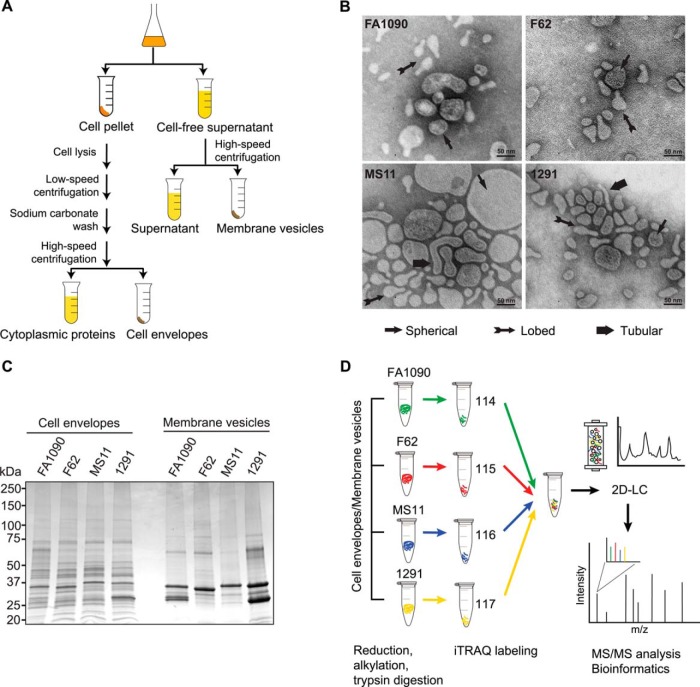
Fig. 1.
Fig. 1.
Flowchart describing the proteomic strategy for a discovery of potential therapeutic targets in GC. A, Workflow of preparation cell envelopes and MVs from GC strains: FA1090, F62, MS11, and 1291. Strains were cultured aerobically in GCBL medium at 37 °C to reach OD600 = 0.8. Bacterial cells and culture supernatants were separated by low-speed centrifugation. Subsequently, cells were lysed and the crude membrane fractions were obtained by cold sodium carbonate extraction at high alkaline pH and ultracentrifugation steps. Cell-free culture supernatants were subjected to high-speed centrifugation at 210,000 × g for 3 h to pellet MVs. B, Native MVs purified from strains FA1090, F62, MS11, and 1291 were negatively stained, and visualized by transmission electron microscopy. The different morphological classes of MVs, indicated by arrows, included spherical, lobed, and tubular. C, Profiles of isolated GC cell envelopes and MVs proteins. Cell envelopes and MVs fractions were prepared from aerobically grown cultures of strains FA1090, F62, MS11, and 1291. Samples were normalized by the total protein concentration and 15 μg were loaded per lane of 1D SDS-PAGE 4–20% Tris-glycine gel. Proteins were visualized by staining with Colloidal Coomassie Blue G250. The migration of molecular weight markers and their masses in kilodaltons (kDa) are indicated on the left. D, Outline of four-plex iTRAQ labeling coupled with 2D-LC/MS/MS. The total amounts of 100- and 40-μg of the cell envelope and MVs proteins, respectively, were reduced, alkylated, and trypsinized. The following iTRAQ tags were used to subsequently label peptides derived from respective GC strains: 114 for FA1090, 115 for F62, 116 for MS11, and 117 for 1291. After labeling the samples were pooled and subjected to SCX fractionation followed by a reversed-phase separation (2D-LC) and protein identification, and quantification using MALDI-TOF MS/MS. Integrated bioinformatics and statistical analyses were applied including ProteinPilot software.
Fig. 2.
Fig. 2.
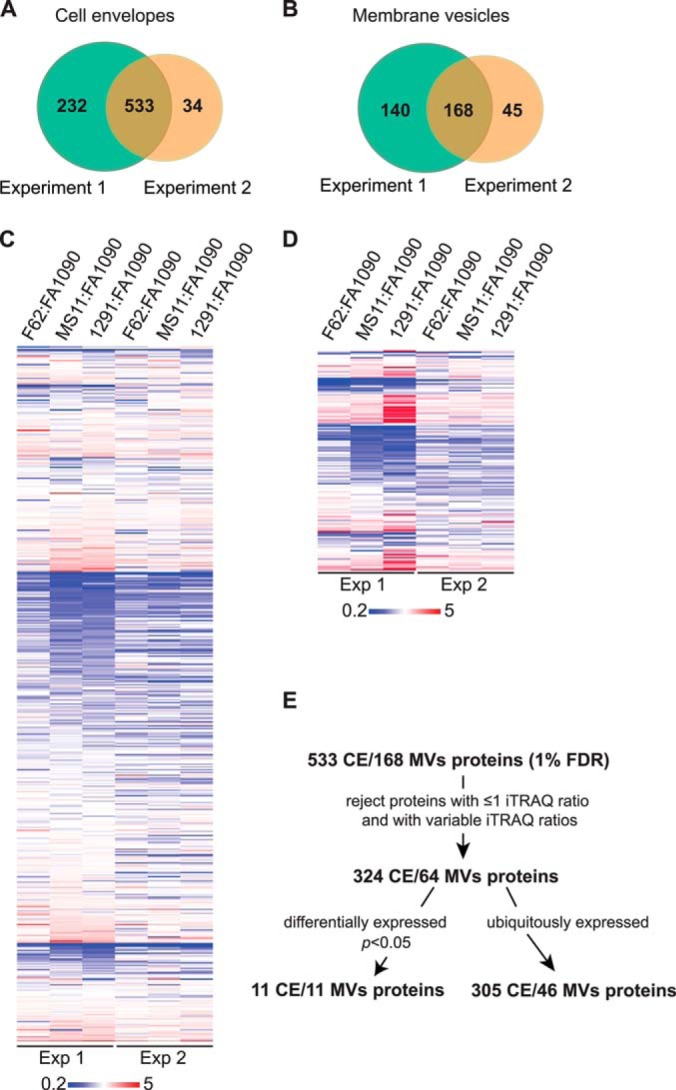
Quantitative proteomics profiling of the cell envelopes and MVs isolated from GC strains FA1090, MS11, F62, and 1291. A, Venn diagram of proteins identified in the cell envelopes in biological replicate experiments. A total of 765 and 567 individual protein species was identified in Experiment 1 and 2, respectively. B, Distribution of proteins identified in MVs in two independent experiments (Experiments 1 and 2). A total number of 308 and 213 proteins was identified, respectively. C, and D, Heat maps illustrating the relative abundance of common proteins identified in both biological experiments in the cell envelopes and MVs, respectively. To quantify the abundance of the proteins, strain FA1090 was arbitrarily chosen as the reference strain. The color scale covers fivefold down-regulation (blue), via no change (white), to fivefold up-regulation (red). E, Flowchart outlining the strategy for rigorous analysis of data obtained during proteomic profiling of the GC cell envelopes (CE) and MVs.
Fig. 3.
Fig. 3.
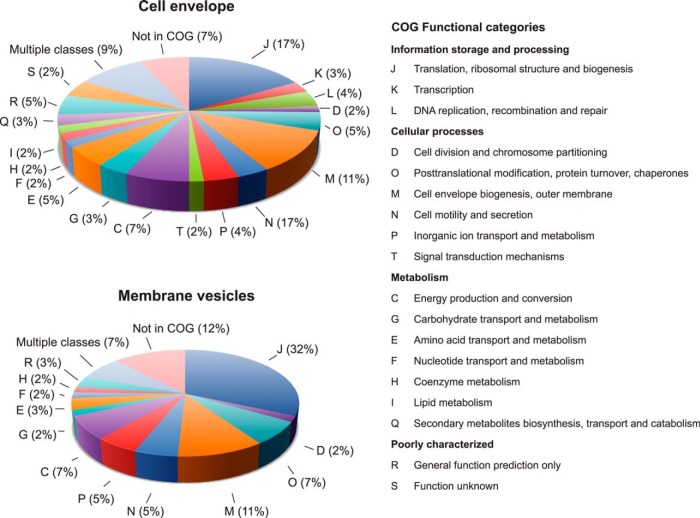
Functional classification of proteins identified in GC cell envelope and MVs according to clusters of orthologous groups (COGs). The pie chart illustrates the percentages of identified proteins in each COG cluster. COG functional categories are listed on the right.
Fig. 4.
Fig. 4.
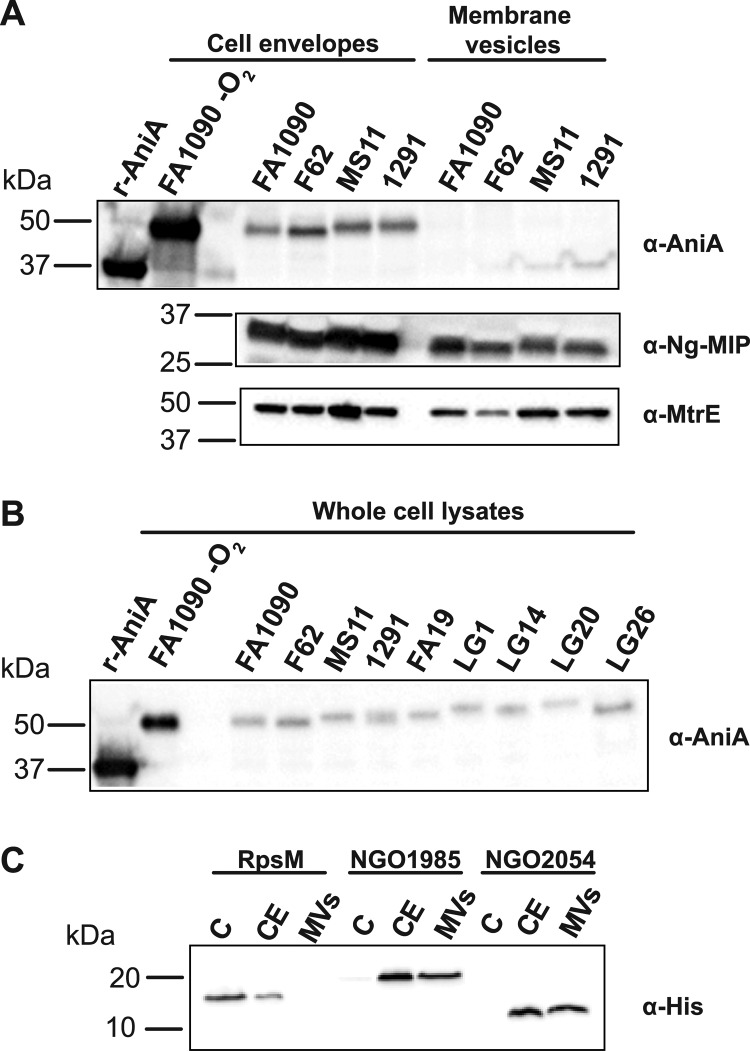
Immunoblotting analyses confirmed iTRAQ data. A, Immunoblots, probed with either anti-AniA, anti-Ng-MIP, or anti-MtrE antiserum, of the cell envelopes and MVs extracted from different GC strains (as indicated above the panel). The total amounts of 15 μg of cell envelope and MVs proteins were loaded into individual wells and separated by SDS-PAGE on a 4–20% Tris-glycine gel. B, Whole-cell lysates derived from different GC isolates were resolved in a 4–20% Tris-glycine gel, transferred, and immunoblotting analysis was performed using rabbit antiserum against recombinant AniA. Samples containing whole-cell lysates were matched by equivalent OD600 units. Purified recombinant truncated version of AniA (250 ng, rAniA) and either cell envelope proteins (15 μg) or whole cell lysate from strain FA1090 grown anaerobically (-O2) were used as positive controls. The designations of the strains are indicated at the top of the immunoblot. C, The subcellular distribution of RpsM, NGO1985, and NGO2054. Liquid cultures of GC FA1090 carrying either chromosomally expressed C-terminal-6×His-tagged RpsM, NGO1985, or NGO2054, were harvested, and subjected to the fractionation procedures. The total amounts of 15 μg of cytoplasmic (C), cell envelopes (CE), and MVs proteins were separated by SDS-PAGE on a 4–20% Tris-glycine gel, and probed with monoclonal anti-His antisera. The migration of molecular weight markers and their masses in kilodaltons (kDa) are indicated on the left.
Fig. 5.
Fig. 5.
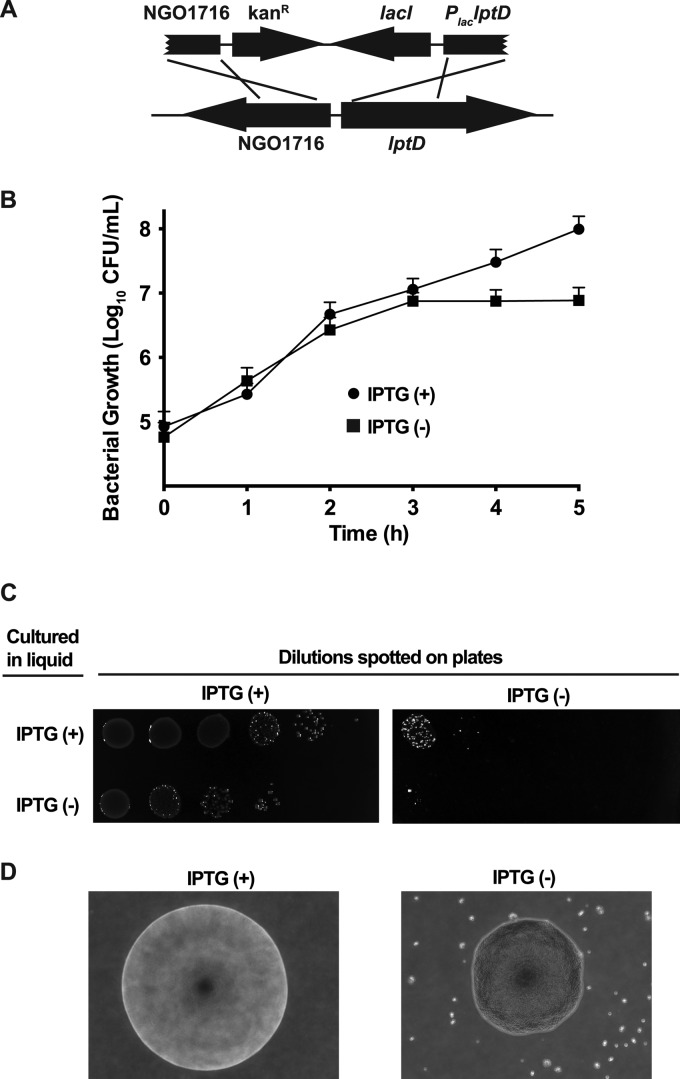
Effect of LptD depletion in GC. A, Construction of an lptD conditional knockout in GC strain FA1090 was achieved by allelic replacement of the native lptD promoter with a DNA fragment containing IPTG-inducible promoter (Plac), lacI gene, and a nonpolar antibiotic resistance cassette apha3 (kanR). B, FA1090 cells carrying chromosomal PlaclptD were grown in the presence of 100 μm IPTG on GCB agar plates for 18 h. The bacteria were collected from plates, washed, divided, and growth was continued in the presence or absence of IPTG as indicated. Cell viability was monitored every hour by spotting serial dilutions onto GCB agar plates with (+) or without (-) IPTG, as indicated. Experiments were performed in biological quadruplicates and means and S.E. of colony forming units calculated per ml of bacterial cultures (CFU/ml) are presented. C, Representative experiments showing CFU's of strains spotted after 5 h onto GCB agar plates with or without IPTG. D, Representative micrographs illustrating the colony morphology of FA1090 PlaclptD expressing LptD (+ IPTG) and upon depletion of LptD (− IPTG). GC colonies were visualized with a Zeiss AxioObserver.D1 microscope at A-Plan 10× magnification 0.25 Phase Contrast 1.
Fig. 6.
Fig. 6.
The GC cell envelope permeability barrier is compromised upon lack of NGO1985. A, GC wild-type strain, FA1090 (wt), isogenic knockouts Δngo1985, Δngo1344, Δngo1955, Δngo2111, Δngo2121, Δngo2139, and complemented strain Δngo1985/Plac1985 were tested for sensitivity phenotypes to various compounds. All strains were suspended to 5 × 10⁵ CFUs/ml, serially diluted, and plated on GCB agar either without (-) or with different compounds including bile salts (0.05%), polymyxin B (800 U), Tween 20 (0.005%), SDS (0.001%), urea (200 mm), chloramphenicol (0.2 μg/ml). Plates were inspected after 22 h of incubation in 5% CO2 atmosphere at 37 °C. B, Experiments were performed as described above. The relative survival of parent strain, FA1090, Δngo1985, and complemented mutant, Δngo1985/Plac1985, was calculated by comparing CFUs/ml on solid media containing the tested compound (as indicated) to the CFUs/ml on GCB agar. Experiments were performed on three separate occasions and the bars represent means with calculated S.E.. Statistically significant differences (p < 0.05) are indicated (*).

References

    1. Lusti-Narasimhan M., Ndowa F. (2011) Emergence and spread of multi-drug resistant Neisseria gonorrhoeae. J. Sex. Med. 8, 253
    1. McNabb S. J., Jajosky R. A., Hall-Baker P. A., Adams D. A., Sharp P., Worshams C., Anderson W. J., Javier A. J., Jones G. J., Nitschke D. A., Rey A., Wodajo M. S. (2008) Summary of notifiable diseases–United States, 2006. MMWR Morb. Mortal. Wkly Rep. 55, 1–92 - PubMed
    1. Edwards J. L., Apicella M. A. (2004) The molecular mechanisms used by Neisseria gonorrhoeae to initiate infection differ between men and women. Clin. Microbiol. Rev. 17, 965–981 - PMC - PubMed
    1. Fleming D. T., Wasserheit J. N. (1999) From epidemiological synergy to public health policy and practice: the contribution of other sexually transmitted diseases to sexual transmission of HIV infection. Sex. Transm. Infect. 75, 3–17 - PMC - PubMed
    1. Workowski K. A., Berman S. (2010) Sexually transmitted diseases treatment guidelines, 2010. MMWR Recomm. Rep. 59, 1–110 - PubMed

Publication types

MeSH terms