


Efficacy and safety of NEPA, an oral combination of netupitant and palonosetron, for prevention of chemotherapy-induced nausea and vomiting following highly emetogenic chemotherapy: a randomized dose-ranging pivotal study
- PMID: 24608196
- PMCID: PMC4071755
- DOI: 10.1093/annonc/mdu110
Efficacy and safety of NEPA, an oral combination of netupitant and palonosetron, for prevention of chemotherapy-induced nausea and vomiting following highly emetogenic chemotherapy: a randomized dose-ranging pivotal study
Abstract
Background: NEPA is a novel oral fixed-dose combination of netupitant (NETU), a new highly selective neurokinin-1 (NK1) receptor antagonist (RA) and palonosetron (PALO), a pharmacologically and clinically distinct 5-hydroxytryptamine type 3 (5-HT3) RA. This study was designed to determine the appropriate clinical dose of NETU to combine with PALO for evaluation in the phase 3 NEPA program.
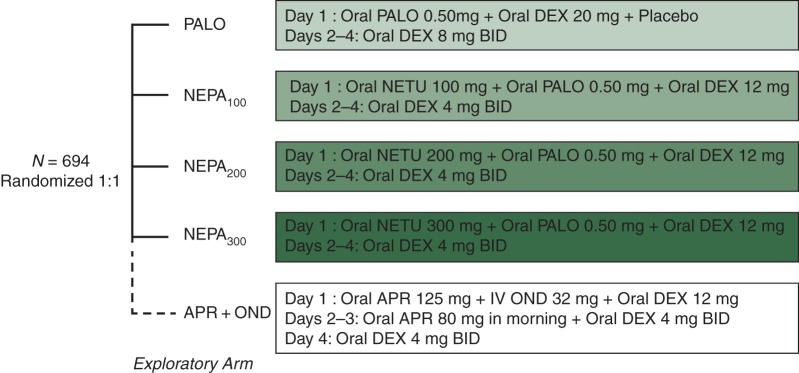
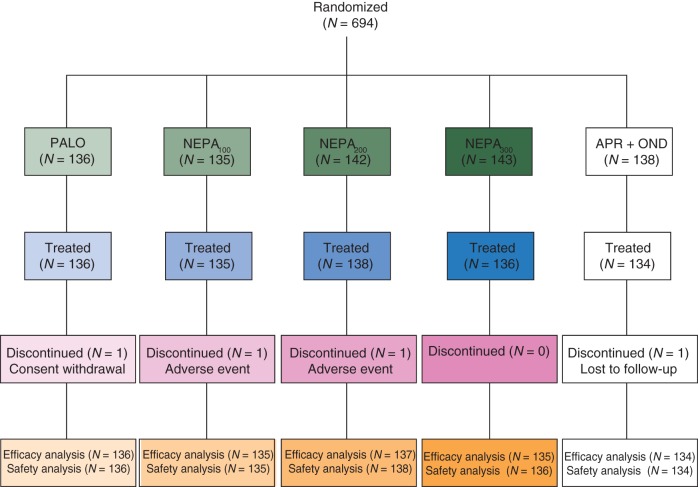
Patients and methods: This randomized, double-blind, parallel group study in 694 chemotherapy naïve patients undergoing cisplatin-based chemotherapy for solid tumors compared three different oral doses of NETU (100, 200, and 300 mg) + PALO 0.50 mg with oral PALO 0.50 mg, all given on day 1. A standard 3-day aprepitant (APR) + IV ondansetron (OND) 32 mg regimen was included as an exploratory arm. All patients received oral dexamethasone on days 1-4. The primary efficacy endpoint was complete response (CR: no emesis, no rescue medication) during the overall (0-120 h) phase.
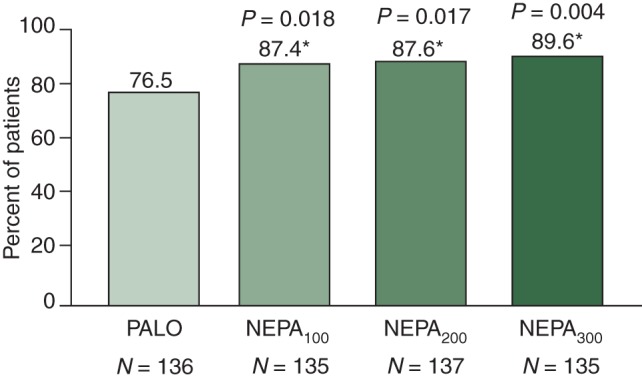
Results: All NEPA doses showed superior overall CR rates compared with PALO (87.4%, 87.6%, and 89.6% for NEPA100, NEPA200, and NEPA300, respectively versus 76.5% PALO; P < 0.050) with the highest NEPA300 dose studied showing an incremental benefit over lower NEPA doses for all efficacy endpoints. NEPA300 was significantly more effective than PALO and numerically better than APR + OND for all secondary efficacy endpoints of no emesis, no significant nausea, and complete protection (CR plus no significant nausea) rates during the acute (0-24 h), delayed (25-120 h), and overall phases. Adverse events were comparable across groups with no dose response. The percent of patients developing electrocardiogram changes was also comparable.
Conclusions: Each NEPA dose provided superior prevention of chemotherapy-induced nausea and vomiting (CINV) compared with PALO following highly emetogenic chemotherapy; however, NEPA300 was the best dose studied, with an advantage over lower doses for all efficacy endpoints. The combination of NETU and PALO was well tolerated with a similar safety profile to PALO and APR + OND.
Keywords: CINV; NEPA; highly emetogenic; netupitant; neurokinin-1 receptor antagonist; palonosetron.
© The Author 2014. Published by Oxford University Press on behalf of the European Society for Medical Oncology.
Figures
Comment in
-
Chemotherapy: NEPA-a single oral dose providing effective prevention of chemotherapy-induced nausea and vomiting.Nat Rev Clin Oncol. 2014 Jul;11(7):377. doi: 10.1038/nrclinonc.2014.92. Epub 2014 Jun 3. Nat Rev Clin Oncol. 2014. PMID: 24889769 No abstract available.
References
-
- Feyer P, Jordan K. Update and new trends in antiemetic therapy: the continuing need for novel therapies. Ann Oncol. 2011;22:30–38. - PubMed
-
- Rojas C, Slusher BS. Pharmacological mechanism of 5-HT3 and tachykinin NK-1 receptor antagonism to prevent chemotherapy-induced nausea and vomiting. Eur J Pharmacol. 2012;684:1–7. - PubMed
-
- Gralla R, Lichinitser M, Van Der Vegt S, et al. Palonosetron improves prevention of chemotherapy-induced nausea and vomiting following moderately emetogenic chemotherapy: results of a double-blind randomized phase III trial comparing single doses of palonosetron with ondansetron. Ann Oncol. 2003;14:1570–1577. - PubMed
-
- Saito M, Aogi K, Sekine I, et al. Palonosetron plus dexamethasone versus granisetron plus dexamethasone for prevention of nausea and vomiting during chemotherapy: a double-blind, double-dummy randomized, comparative phase III trial. Lancet Oncol. 2009;10:115–124. - PubMed
-
- Aapro MS, Grunberg SM, Manikhas GM, et al. A phase III, double-blind, randomized trial of palonosetron compared with ondansetron in preventing chemotherapy-induced nausea and vomiting following highly emetogenic chemotherapy. Ann Oncol. 2006;17:1441–1449. - PubMed
Publication types
MeSH terms
Substances
LinkOut - more resources
Full Text Sources
Other Literature Sources
Medical
Miscellaneous
