


Clinical manifestations and survival among adults with (SLE) according to age at diagnosis
- PMID: 24608964
- PMCID: PMC4157121
- DOI: 10.1177/0961203314526291
Clinical manifestations and survival among adults with (SLE) according to age at diagnosis
Abstract
Objectives: The objective of this paper is to determine the effect of clinical and laboratory manifestations, and medication prescribing, on survival according to patient age at diagnosis in a large academic systemic lupus erythematosus (SLE) cohort.
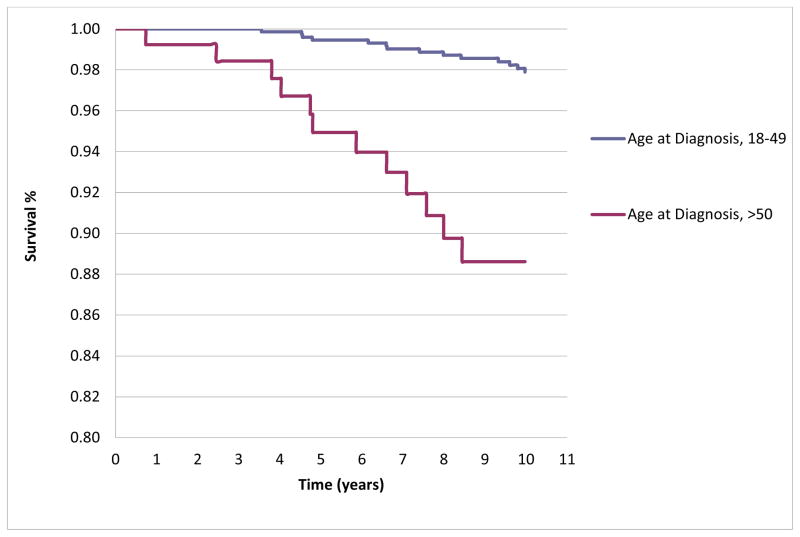
Methods: We identified SLE patients with a diagnosis at age ≥18, seen between 1970 through 2011, and with more than two visits to our lupus center. Data collection included SLE manifestations, serologies, other laboratory tests, medications, dates, and causes of death. We examined characteristics of those diagnosed before age 50 (adult onset) compared to those diagnosed at or after age 50 (late onset) using descriptive statistics. We used Kaplan-Meier curves with log rank tests to estimate five- and 10-year survival in age-stratified cohorts. Predictors of 10-year survival were assessed using Cox regression models, adjusted for calendar year, race/ethnicity, sex, lupus nephritis, and medication use.
Results: Of 928 SLE patients, the mean age at diagnosis was 35. Among the adult-onset group, there was significantly higher prevalence of malar rashes and lupus nephritis. Glucocorticoids, azathioprine, mycophenolate, and cyclophosphamide use were also more frequent in the adult-onset group compared to the late-onset group. Five-year survival rates were 99.5% and 94.9% and 10-year survival rates were 97.8% and 89.5%, among those diagnosed before and at or after age 50. In the entire cohort, increasing age at diagnosis, male sex, and black race were statistically significant predictors of reduced 10-year survival. Compared to those diagnosed before age 50, the late-onset group had a multivariable-adjusted hazard ratio for 10-year risk of death of 4.96 (95% CI 1.75-14.08). The most frequent cause of known death was a lupus manifestation, followed by cardiovascular disease and infection.
Conclusions: In our cohort, several demographic features, SLE manifestations, and medication prescribing differed between those with adult-onset and late-onset SLE. Ten-year survival rates were high for both groups, but relatively lower among late-onset patients. A lupus manifestation as the cause of death was more common among adult-onset compared with late-onset patients.
Keywords: SLE (systemic lupus erythematosus); age; male; mortality; outcomes; survival.
© The Author(s) 2014 Reprints and permissions: sagepub.co.uk/journalsPermissions.nav.
Conflict of interest statement
None of the authors listed have financial disclosures relevant to this manuscript. None of the authors report any other, or relevant conflicts of interest related to this publication.
Figures
References
-
- Urowitz MB, Gladman DD, Tom BD, Ibanez D, Farewell VT. Changing patterns in mortality and disease outcomes for patients with systemic lupus erythematosus. J Rheumatol. 2008;35(11):2152–8. Epub 2008/09/17. - PubMed
-
- Urowitz MB, Gladman DD, Abu-Shakra M, Farewell VT. Mortality studies in systemic lupus erythematosus. Results from a single center. III. Improved survival over 24 years. J Rheumatol. 1997;24(6):1061–5. Epub 1997/06/01. - PubMed
-
- Abu-Shakra M, Urowitz MB, Gladman DD, Gough J. Mortality studies in systemic lupus erythematosus. Results from a single center. I. Causes of death. J Rheumatol. 1995;22(7):1259–64. Epub 1995/07/01. - PubMed
-
- Abu-Shakra M, Urowitz MB, Gladman DD, Gough J. Mortality studies in systemic lupus erythematosus. Results from a single center. II. Predictor variables for mortality. J Rheumatol. 1995;22(7):1265–70. Epub 1995/07/01. - PubMed
Publication types
MeSH terms
Grants and funding
LinkOut - more resources
Full Text Sources
Other Literature Sources
Medical
