


HbA1c variability as an independent risk factor for diabetic retinopathy in type 1 diabetes: a German/Austrian multicenter analysis on 35,891 patients
- PMID: 24609115
- PMCID: PMC3946653
- DOI: 10.1371/journal.pone.0091137
HbA1c variability as an independent risk factor for diabetic retinopathy in type 1 diabetes: a German/Austrian multicenter analysis on 35,891 patients
Abstract
Objective: This study aimed to analyze the effect of HbA1c variability on the occurrence of diabetic retinopathy in type 1 diabetes patients.
Patients and methods: 35,891 patients with childhood, adolescent or adult onset of type 1 diabetes from a large multicentre survey, the German/Austrian prospective documentation system (DPV), were analysed. Cox proportional hazard models were used to examine whether intra-individual HbA1c variability expressed as variation coefficient is an independent risk factor for the occurrence of diabetic retinopathy.
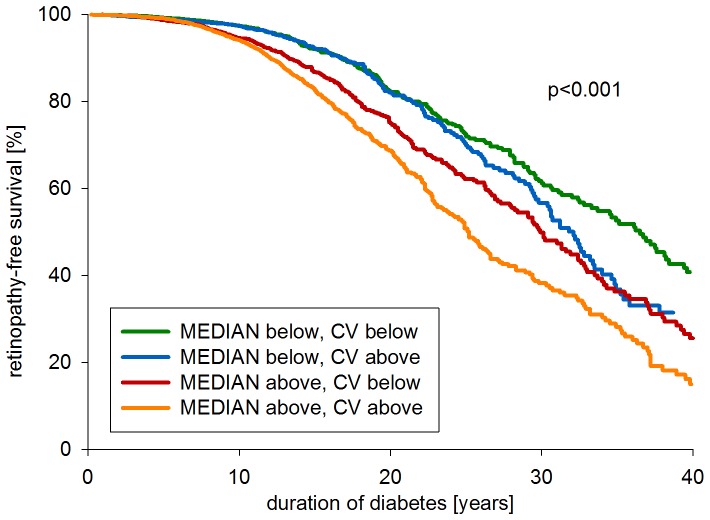
Results: Kaplan-Meier curves stratified by median HbA1c and variation coefficient revealed that retinopathy-free survival probability is lower when both median HbA1c and HbA1c variability are above the 50th percentile. Cox regression models confirmed this finding: After adjustment for age at diabetes onset, gender and median HbA1c, HbA1c variability was independently associated with the occurrence of diabetic retinopathy. Time-covariate interactions used to model non-proportionality indicated an effect decreasing with duration of diabetes for both median HbA1c and HbA1c variability. Predictive accuracy increased significantly when adding HbA1c variability to the Cox regression model.
Conclusions: In patients with type 1 diabetes, HbA1c variability adds to the risk of diabetic retinopathy independently of average metabolic control.
Conflict of interest statement
Figures
References
-
- Lachin JM, Genuth S, Nathan DM, Zinman B, Rutledge BN, et al. (2008) Effect of glycemic exposure on the risk of microvascular complications in the diabetes control and complications trial - revisited. Diabetes 57(4): 995–1001. - PubMed
-
- Dawson AJ, Sathyapalan T, Atkin SL, Kilpatrick ES (2013) Biological variation of cardiovascular risk factors in patients with diabetes. Diabet Med 30(10): 1172–1180. - PubMed
-
- Kilpatrick ES, Rigby AS, Atkin SL (2006) The effect of glucose variability on the risk of microvascular complications in type 1 diabetes. Diabetes Care 29(7): 1486–1490. - PubMed
-
- Hietala K, Wadén J, Forsblom C, Harjutsalo V, Kytö J, et al. (2013) HbA1c variability is associated with an increased risk of retinopathy requiring laser treatment in type 1 diabetes. Diabetologia 56(4): 737–745. - PubMed
Publication types
MeSH terms
Substances
LinkOut - more resources
Full Text Sources
Other Literature Sources
Medical
