Case Reports
. 2014 Apr;34(3):272-6.
doi: 10.1007/s10875-014-0012-9. Epub 2014 Mar 8.

Mutations in PIK3CD can cause hyper IgM syndrome (HIGM) associated with increased cancer susceptibility

Affiliations
Case Reports

Mutations in PIK3CD can cause hyper IgM syndrome (HIGM) associated with increased cancer susceptibility

M C Crank et al. J Clin Immunol. 2014 Apr.

Abstract

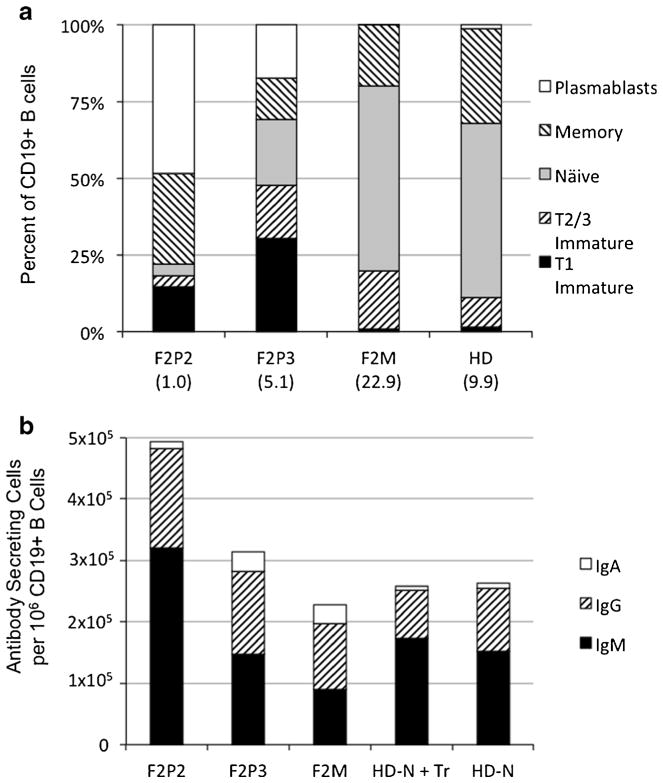
Autosomal dominant gain of function mutations in the gene encoding PI3K p110δ were recently associated with a novel combined immune deficiency characterized by recurrent sinopulmonary infections, CD4 lymphopenia, reduced class-switched memory B cells, lymphadenopathy, CMV and/or EBV viremia and EBV-related lymphoma. A subset of affected patients also had elevated serum IgM. Here we describe three patients in two families who were diagnosed with HIGM at a young age and were recently found to carry heterozygous mutations in PIK3CD. These patients had an abnormal circulating B cell distribution featuring a preponderance of early transitional (T1) B cells and plasmablasts. When stimulated in vitro, PIK3CD mutated B cells were able to secrete class-switched immunoglobulins. This finding implies that the patients' elevated serum IgM levels were unlikely a product of an intrinsic B cell functional inability to class switch. All three patients developed malignant lymphoproliferative syndromes that were not associated with EBV. Thus, we identified a novel subset of patients with PIK3CD mutations associated with HIGM, despite indications of preserved in vitro B cell class switch recombination, as well as susceptibility to non-EBV-associated malignancies.


Figures

Fig. 1
Fig. 1
Family trees and characteristic pathology: a Family 1 and b Family 2 – gray color indicates an affected individual. c Lymph node biopsy on patient F1P1 showing effacement of the nodal architecture due to a diffuse proliferation of large atypical lymphoid cells with abundant cytoplasm, large nuclei with prominent central nucleolus (H&E 400×); also negative for EBV by in situ hybridization using EBER probe (inset). d Colon biopsy on patient F2P3 showing diffuse proliferation of small to medium atypical lymphoid cells with evidence of lymphoepithelial lesions involving the lamina propria of the colon (H&E 200×); in situ hybridization for EBV using EBER probe (inset) was negative
Fig. 2
Fig. 2
B cell Phenotype: a Peripheral blood B cell subtypes in affected patients (F2P2 and F2P3) and unaffected mother (F2M) versus healthy donor (HD) controls as measured using flow cytometry of isolated peripheral blood mononuclear cells (PBMCs). Numbers in parenthesis represent the percentage of CD19+ B cells out of total PBMCs. B cell subsets were defined using cell surface markers as specified by Moir, et. al. (2013) [10]. b Number of antibody-secreting cells measured by ELISPOT (spots per 106 CD19+ B cells). PBMCs from Patients (F2P2 and F2P3) and unaffected mother (F2M) were stimulated in vitro with S. aureus Cowan strain I (SAC), CpG, IL-21 and pokeweed mitogen (PWM) for 4 days. CD19-depleted PBMCs from a healthy donor (HD) reconstituted with naïve (N) or naïve and transitional (N + Tr) B cells (CD27/IgG-negative fraction of CD10-depleted or CD10-containing B cells respectively of a donor whose CD10+ transitional B cells represented 20 % of total B cells) were included. Results for healthy donor cells were representative of three independent replicates

References

    1. Davies EG, Thrasher AJ. Update on the hyper immunoglobulin M syndromes. Br J Haematol. 2010;149(2):167–80. - PMC - PubMed
    1. Notarangelo LD, Duse M, Ugazio AG. Immunodeficiency with hyper-IgM (HIM) Immunodefic Rev. 1992;3(2):101–21. - PubMed
    1. Angulo I, Vadas O, Garcon F, et al. Phosphoinositide 3-kinase delta gene mutation predisposes to respiratory infection and airway damage. Science. 2013;342(6160):866–71. - PMC - PubMed
    1. Lucas CL, Kuehn HS, Zhao F, et al. Dominant-activating germline mutations in the gene encoding the PI(3)K catalytic subunit p110delta result in T cell senescence and human immunodeficiency. Nat Immunol. 2013;15(1):88–97. - PMC - PubMed
    1. Kotlarz D, Zietara N, Uzel G, et al. Loss-of-function mutations in the IL-21 receptor gene cause a primary immunodeficiency syndrome. J Exp Med. 2013;210(3):433–43. - PMC - PubMed

Publication types

Substances