. 2014 May;140(5):757-67.
doi: 10.1007/s00432-014-1623-5. Epub 2014 Mar 8.

Transglutaminase 2 inhibitor abrogates renal cell carcinoma in xenograft models

Affiliations

Transglutaminase 2 inhibitor abrogates renal cell carcinoma in xenograft models

Bo Mi Ku et al. J Cancer Res Clin Oncol. 2014 May.

Abstract

Purpose: To test whether transglutaminase 2 (TGase 2) inhibitor GK921 alone reverses renal cell carcinoma (RCC) tumor growth. RCC is resistant to both radiation and chemotherapy, and the prognosis remains poor. Despite the recent therapeutic success of vascular endothelial growth factor inhibition in RCC, approximately one-third of RCC patients develop metastatic disease. The expression of TGase 2 is markedly increased in most RCC cell lines, as well as in clinical samples.

Methods: Previously, we introduced the quinoxaline derivative GK13 as a lead compound for TGase 2 inhibitor. The inhibitory effect of GK13 on TGase 2 was improved in GK921 (3-(phenylethynyl)-2-(2-(pyridin-2-yl)ethoxy)pyrido[3,2-b]pyrazine). GK921 efficacy was tested using sulforhodamine in vitro as well as a xenograft tumor models using ACHN and CAKI-1 RCC cells.

Results: GK921 showed cytotoxicity to RCC (average GI50 in eight RCC cell lines: 0.905 μM). A single treatment with GK921 almost completely reduced tumor growth by stabilizing p53 in the ACHN and CAKI-1 preclinical xenograft tumor models.

Conclusion: TGase 2 inhibitor GK921 abrogates RCC growth in xenograft tumor models, suggesting the possibility of a new therapeutic approach to RCC.


Conflict of interest statement

The authors declare no conflict of interest.

Figures

Fig. 1
Fig. 1
Expression changes for transglutaminase 2 gene. a Differences in expression of transglutaminase (TGase) 2 gene in 23 normal kidney tissue samples and 23 clear cell renal cell carcinoma (ccRCC) samples (on a log2 scale). The statistical significance of the difference between normal kidneys and ccRCCs had a p value of 7.83e−10. b Distribution of the expression between normal kidney group and 26 clear cell renal cell carcinoma samples (on a log2 scale). The statistical significance of the difference between normal kidneys and ccRCCs had a p value of 1.71e−9
Fig. 2
Fig. 2
GK921 inhibits TGase 2 in vitro and in cancer cells. a GK921 was tested for specific TGase 2 inhibition in vitro. The GK921 IC50 was 7.71 μM using human recombinant TGase 2 and putrescine as a substrate, which resulted in an approximately twofold increase in efficacy as compared with GK13 (IC50: 16.4 μM). b, c Western analysis of results of competition assay demonstrating inhibition of TGase 2-mediated I-κBα (b) and p53 (c) polymerization by GK921. Data represent three independent experiments
Fig. 3
Fig. 3
Inhibition of TGase 2 promotes cell death in RCC. a Results of sulforhodamine B (SRB) assay of GK921 cytotoxicity in human RCC cells exposed to the indicated concentrations. b Cells were exposed to 1 μM GK921 for 12 h. Annexin V/propidium iodide staining was analyzed by flow cytometry. The percentages of gated cells in quadrants corresponding to early and late apoptosis are shown. c Cells exposed to GK921 for 12 h were subjected to TUNEL assay to detect apoptosis. Bar graph shows the percentage (mean ± SE) of apoptotic cells in at least three randomly selected fields of view (*p < 0.05, **p < 0.01)
Fig. 4
Fig. 4
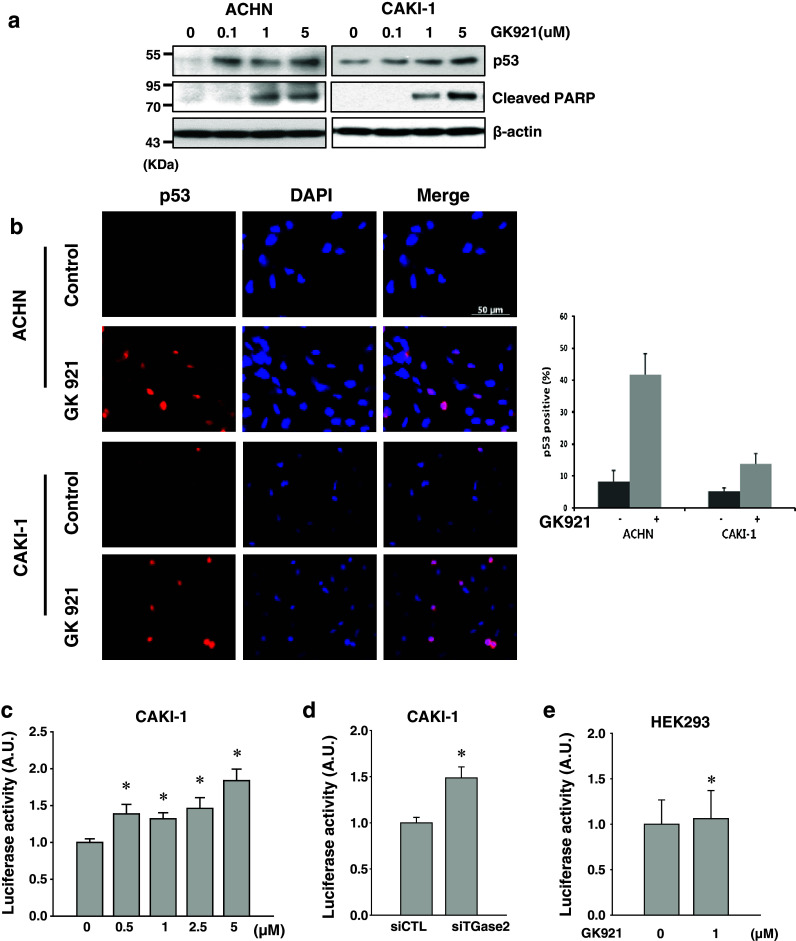
Inhibition of TGase 2 with GK921 induces apoptosis in RCC through transcriptional activation of p53. a Apoptotic effect of GK921 in ACHN and CAKI-1 cells was analyzed by immunoblotting with antibodies to p53, poly(ADP-ribose) polymerase (PARP), and β-actin. The blots shown are representative of more than three independent experiments. b Expression of p53 increased in ACHN and CAKI-1 cells exposed to GK921 (1 μM) for 4 h. Cells were analyzed by immunocytochemistry using anti-p53 primary antibody and fluorophore-conjugated anti-rabbit immunoglobulin secondary antibody and counterstained with DAPI to visualize nuclei. Scale bar 50 μm. c CAKI-1 cells were transfected with BAX luciferase reporter construct and then exposed to GK921. Lysates were subjected to luciferase assay. d Caki-1 cells were transfected with control siRNA or TGase 2 siRNA together with BAX luciferase reporter construct. e HEK293 cells were transfected with BAX luciferase reporter construct and then exposed to GK921 (1 μM). A.U., arbitrary units; values represent mean ± SE; *p < 0.05
Fig. 5
Fig. 5
Inhibition of TGase 2 suppressed RCC tumor growth in vivo. a, b ACHN (a) and CAKI-1 (b) cell suspensions were injected subcutaneously into 6–8-week-old female nude BALB/c mice. When tumors reached a volume of 100 mm3, treatment with GK921 was started. c Renal cell tumors harvested from nude BALB/c mice were analyzed by immunohistochemical staining with BrdU and p53 antibodies. After treatment with GK921, 0.1 mL BrdU (10 mg/mL) in sterile DPBS was injected intraperitoneally. 2 h later, the animals were anesthetized, perfused with PBS, and killed. The RCC tumors were then excised. *p < 0.05, GK921-treated group versus normal control

References

    1. Barrett T, Wilhite SE, Ledoux P, Evangelista C, Kim IF, Tomashevsky M, Marshall KA, Phillippy KH, Sherman PM, Holko M, Yefanov A, Lee H, Zhang N, Robertson CL, Serova N, Davis S, Soboleva A (2013) NCBI GEO: archive for functional genomics data sets-update. Nucl Acids Res 41(Database issue):D991–D995. doi:10.1093/nar/gks1193 - PMC - PubMed
    1. Berglind H, Pawitan Y, Kato S, Ishioka C, Soussi T (2008) Analysis of p53 mutation status in human cancer cell lines: a paradigm for cell line cross-contamination. Cancer Biol Ther 7(5):699–708. doi:10.4161/cbt.7.5.5712 - PubMed
    1. Choueiri TK (2011) VEGF inhibitors in metastatic renal cell carcinoma: current therapies and future perspective. Curr Clin Pharmacol 6(3):164–168 - PubMed
    1. Delhase M, Kim SY, Lee H, Naiki-Ito A, Chen Y, Ahn ER, Murata K, Kim SJ, Lautsch N, Kobayashi KS, Shirai T, Karin M, Nakanishi M (2012) TANK-binding kinase 1 (TBK1) controls cell survival through PAI-2/serpinB2 and transglutaminase 2. Proc Natl Acad Sci USA 109(4):E177–E186. doi:10.1073/pnas.1119296109 - PMC - PubMed
    1. Gong YD, Lee T (2010) Combinatorial syntheses of five-membered ring heterocycles using carbon disulfide and a solid support. J Comb Chem 12(4):393–409. doi:10.1021/cc100049u - PubMed

Publication types

MeSH terms

Substances

LinkOut - more resources