


Integrating social contact and environmental data in evaluating tuberculosis transmission in a South African township
- PMID: 24610874
- PMCID: PMC4133578
- DOI: 10.1093/infdis/jiu138
Integrating social contact and environmental data in evaluating tuberculosis transmission in a South African township
Abstract
Background: Population models of tuberculosis transmission have not accounted for social contact structure and the role of the environment in which tuberculosis is transmitted.
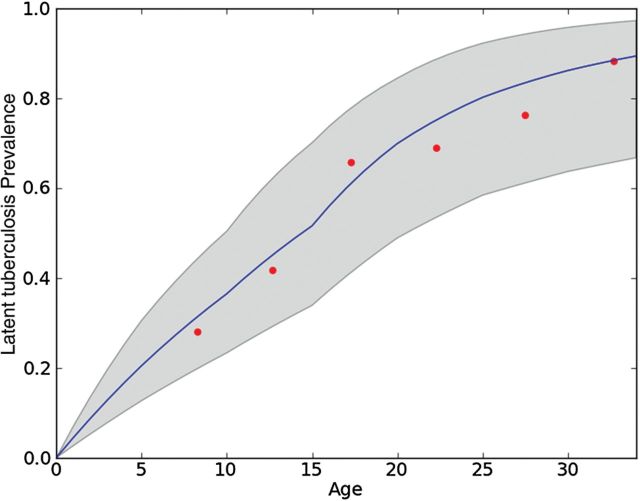
Methods: We utilized extensions to the Wells-Riley model of tuberculosis transmission, using exhaled carbon dioxide as a tracer gas, to describe transmission patterns in an endemic community. Drawing upon social interaction data and carbon dioxide measurements from a South African township, we created an age-structured model of tuberculosis transmission in households, public transit, schools, and workplaces. We fit the model to local data on latent tuberculosis prevalence by age.
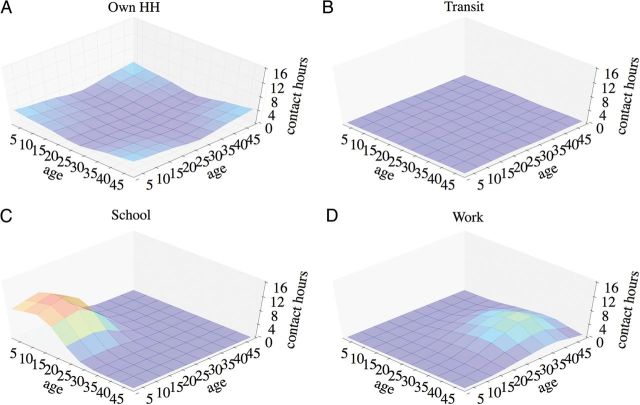
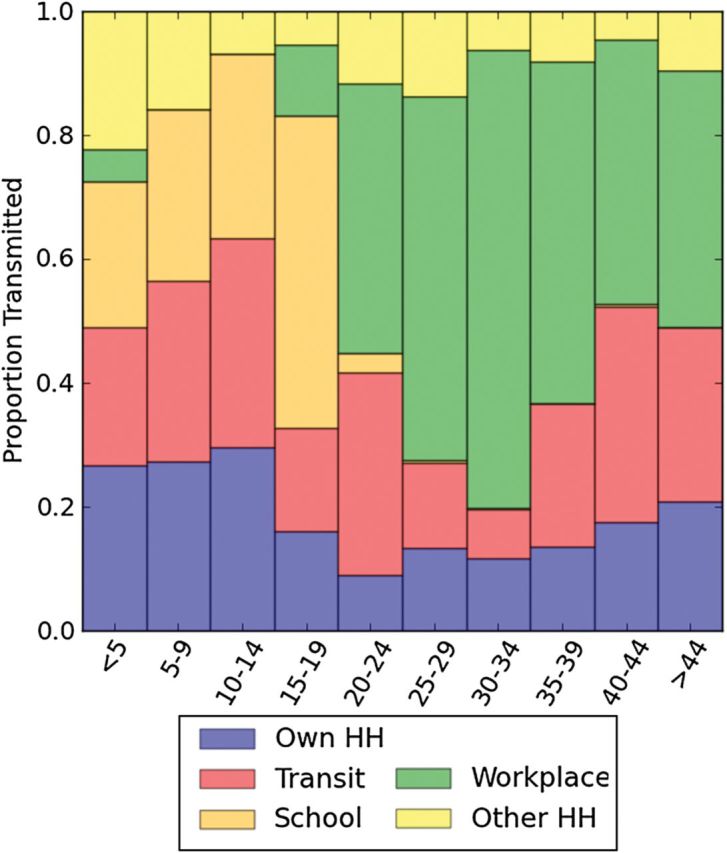
Results: Most tuberculosis infections (84%) were estimated to occur outside of one's own household. Fifty percent of infections among young adults (ages 15-19) occurred in schools, due to high contact rates and poor ventilation. Despite lower numbers of contacts in workplaces, assortative mixing among adults with high rates of smear-positive tuberculosis contributed to transmission in this environment. Households and public transit were important sites of transmission between age groups.
Conclusions: Consistent with molecular epidemiologic estimates, a minority of tuberculosis transmission was estimated to occur within households, which may limit the impact of contact investigations. Further work is needed to investigate the role of schools in tuberculosis transmission.
Keywords: environment; epidemiology; mathematical models; social contacts; tuberculosis.
© The Author 2014. Published by Oxford University Press on behalf of the Infectious Diseases Society of America. All rights reserved. For Permissions, please e-mail: journals.permissions@oup.com.
Figures
References
-
- Blower SM, McLean AR, Porco TC, et al. The intrinsic transmission dynamics of tuberculosis epidemics. Nat Med. 1995;1:815–21. - PubMed
-
- Dye C, Garnett GP, Sleeman K, Williams BG. Prospects for worldwide tuberculosis control under the WHO DOTS strategy. Directly observed short-course therapy. Lancet. 1998;352:1886–91. - PubMed
-
- Sepkowitz KA. How contagious is tuberculosis? Clin Infect Dis. 1996;23:954–62. - PubMed
-
- Sultan L, Nyka W, Mills C, O'Grady F, Wells W, Riley RL. Tuberculosis disseminators. A study of the variability of aerial infectivity of tuberculous patients. Am Rev Respir Dis. 1960;82:358–69. - PubMed
Publication types
MeSH terms
Grants and funding
LinkOut - more resources
Full Text Sources
Other Literature Sources
Medical
