


Immunoregulatory networks in human Chagas disease
- PMID: 24611805
- PMCID: PMC4143493
- DOI: 10.1111/pim.12107
Immunoregulatory networks in human Chagas disease
Abstract
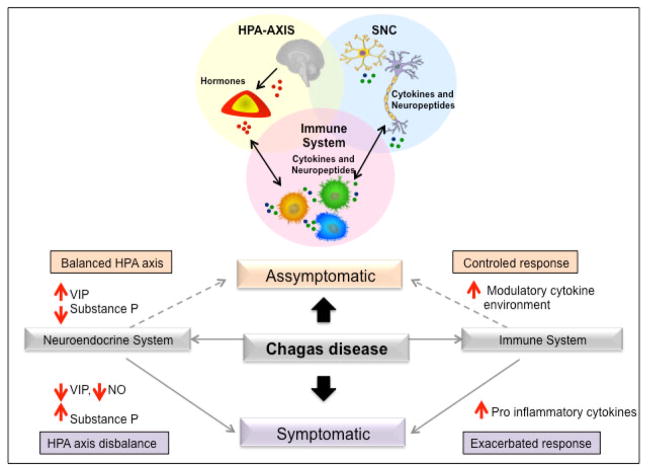
Chagas disease, caused by the infection with Trypanosoma cruzi, is endemic in all Latin America. Due to the increase in population migration, Chagas disease has spread worldwide and is now considered a health issue not only in endemic countries. While most chronically infected individuals remain asymptomatic, approximately 30% of the patients develop a potentially deadly cardiomyopathy. The exact mechanisms that underlie the establishment and maintenance of the cardiac pathology are not clear. However, there is consistent evidence that immunoregulatory cytokines are critical for orchestrating the immune response and thus influence disease development or control. While the asymptomatic (indeterminate) form represents a state of balance between the host and the parasite, the establishment of the cardiac form represents the loss of this balance. Analysis of data obtained from several studies has led to the hypothesis that the indeterminate form is associated with an anti-inflammatory cytokine profile, represented by high expression of IL-10, while cardiac form is associated with a high production of IFN-gamma and TNF-alpha in relation to IL-10, leading to an inflammatory profile. Here, we discuss the immunoregulatory events that might influence disease outcome, as well as the mechanisms that influence the establishment of these complex immunoregulatory networks.
Keywords: Chagas disease; Trypanosoma cruzi; cytokines; immunoregulation; neuroendocrine; pathology.
© 2014 John Wiley & Sons Ltd.
Figures

References
-
- Moncayo A, Ortiz Yanine MI. An update on Chagas disease (human American trypanosomiasis) Ann Trop Med Parasitol. 2006;100:663–677. - PubMed
-
- Coura JR, Vinas PA. Chagas disease: a new worldwide challenge. Nature. 2010;465:S6–7. - PubMed
-
- Sosa-Estani S, Segura EL. Etiological treatment in patients infected by Trypanosoma cruzi: experiences in Argentina. Curr Opin Infect Dis. 2006;19:583–587. - PubMed
-
- Rassi A, Luquetti AO, Rassi A, Jr, et al. Specific treatment for Trypanosoma cruzi: lack of efficacy of allopurinol in the human chronic phase of Chagas disease. Am J Trop Med Hyg. 2007;76:58–61. - PubMed
Publication types
MeSH terms
Substances
Grants and funding
LinkOut - more resources
Full Text Sources
Other Literature Sources
Medical
