


Lifestyle-induced decrease in fat mass improves adiponectin secretion in obese adults
- PMID: 24614337
- PMCID: PMC3991752
- DOI: 10.1249/MSS.0000000000000200
Lifestyle-induced decrease in fat mass improves adiponectin secretion in obese adults
Abstract
Purpose: Several studies have identified relationships between weight loss and adipokine levels; however, none have looked at the combined effect of aerobic exercise training with the consumption of a low- or a high-glycemic diet. We examined the effects of 12 wk of aerobic exercise combined with either a low-glycemic index diet (∼40 U) plus exercise (LoGIX) or a high-glycemic index diet (∼80 U) diet plus exercise (HiGIX) on plasma leptin and adiponectin (total and high molecular weight [HMW]) in 27 older obese adults (age = 65 ± 0.5 yr, body mass index = 34.5 ± 0.7 kg·m).
Methods: Insulin sensitivity was calculated from an oral glucose tolerance test. Fasting HMW adiponectin and leptin were quantified from plasma samples obtained before the insulin sensitivity index obtained from the oral glucose tolerance test. Glucose and insulin measures were obtained before and every 30 min during the test. Dual-energy x-ray absorptiometry and computerized tomography were used to determine body composition and to quantify subcutaneous and visceral abdominal adiposity, respectively.
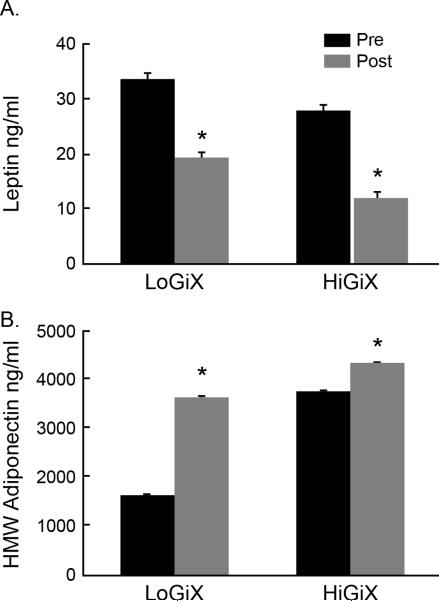
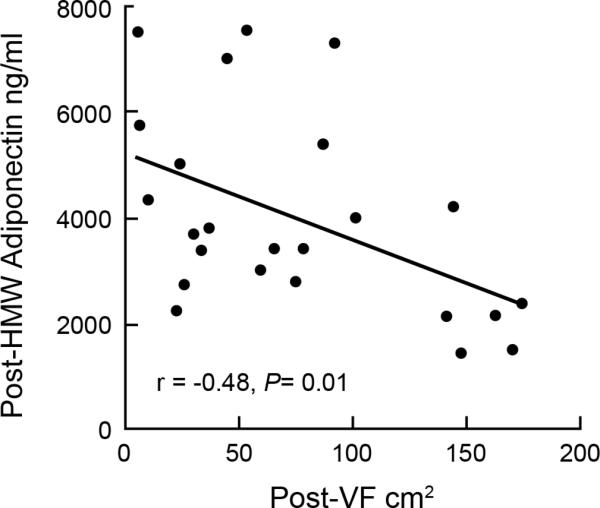
Results: Fasting leptin was significantly decreased in both groups (LoGIX: preintervention = 33.8 ± 4.7, postintervention = 19.2 ± 4.5; HiGIX: preintervention = 27.9 ± 4.2, postintervention = 11.9 ± 2.2 ng·mL; P = 0.004), and HMW adiponectin was significantly increased (LoGIX: preintervention = 1606.9 ± 34.6, postintervention = 3502.3 ± 57; HiGIX: preintervention = 3704.8 ± 38.1, postintervention = 4284.3 ± 52.8 pg·mL; P = 0.003) after the 12-wk intervention. Total body fat was reduced after both interventions. Visceral fat mass was inversely correlated with HMW adiponectin, whereas subcutaneous fat correlated with leptin.
Conclusions: The data suggest that exercise training, independent of dietary glycemic index, favorably alters HMW adiponectin and leptin secretion and that a reduction in visceral fat mass is a key factor regulating HMW adiponectin in older obese persons.
Figures
References
-
- Bays HE, Gonzalez-Campoy JM, Bray GA, Kitabchi AE, Bergman DA, Schorr AB, Rodbard HW, Henry RR. Pathogenic potential of adipose tissue and metabolic consequences of adipocyte hypertrophy and increased visceral adiposity. Expert Rev Cardiovasc Ther. 2008;6:343–368. - PubMed
-
- Bouche C, Rizkalla SW, Luo J, Vidal H, Veronese A, Pacher N, Fouquet C, Lang V, Slama G. Five-week, low-glycemic index diet decreases total fat mass and improves plasma lipid profile in moderately overweight nondiabetic men. Diabetes Care. 2002;25:822–828. - PubMed
-
- Brand-Miller J, Hayne S, Petocz P, Colagiuri S. Low-glycemic index diets in the management of diabetes: a meta-analysis of randomized controlled trials. Diabetes Care. 2003;26:2261–2267. - PubMed
Publication types
MeSH terms
Substances
Grants and funding
LinkOut - more resources
Full Text Sources
Other Literature Sources
Medical
