Five-week outcomes from a dosing trial of therapeutic massage for chronic neck pain
- PMID: 24615306
- PMCID: PMC3948757
- DOI: 10.1370/afm.1602
Five-week outcomes from a dosing trial of therapeutic massage for chronic neck pain
Abstract
Purpose: This trial was designed to evaluate the optimal dose of massage for individuals with chronic neck pain.
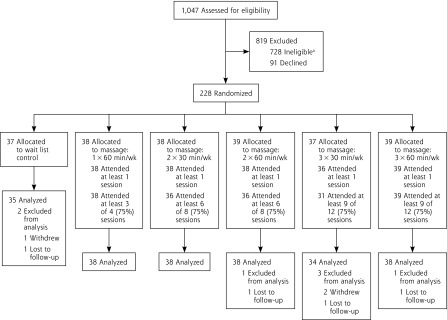
Methods: We recruited 228 individuals with chronic nonspecific neck pain from an integrated health care system and the general population, and randomized them to 5 groups receiving various doses of massage (a 4-week course consisting of 30-minute visits 2 or 3 times weekly or 60-minute visits 1, 2, or 3 times weekly) or to a single control group (a 4-week period on a wait list). We assessed neck-related dysfunction with the Neck Disability Index (range, 0-50 points) and pain intensity with a numerical rating scale (range, 0-10 points) at baseline and 5 weeks. We used log-linear regression to assess the likelihood of clinically meaningful improvement in neck-related dysfunction (≥5 points on Neck Disability Index) or pain intensity (≥30% improvement) by treatment group.
Results: After adjustment for baseline age, outcome measures, and imbalanced covariates, 30-minute treatments were not significantly better than the wait list control condition in terms of achieving a clinically meaningful improvement in neck dysfunction or pain, regardless of the frequency of treatments. In contrast, 60-minute treatments 2 and 3 times weekly significantly increased the likelihood of such improvement compared with the control condition in terms of both neck dysfunction (relative risk = 3.41 and 4.98, P = .04 and .005, respectively) and pain intensity (relative risk = 2.30 and 2.73; P = .007 and .001, respectively).
Conclusions: After 4 weeks of treatment, we found multiple 60-minute massages per week more effective than fewer or shorter sessions for individuals with chronic neck pain. Clinicians recommending massage and researchers studying this therapy should ensure that patients receive a likely effective dose of treatment.
Keywords: chronic neck pain; clinical trial; complementary and alternative medicine; disability; holistic medicine; massage; pain management.
Figures
References
-
- Hogg-Johnson S, van der Velde G, Carroll LJ, et al. The burden and determinants of neck pain in the general population: results of the Bone and Joint Decade 2000–2010 Task Force on Neck Pain and Its Associated Disorders. Spine (Phila Pa 1976). 2008;33(4 Suppl):S39–S51 - PubMed
-
- Riddle DL, Schappert SM. Volume and characteristics of inpatient and ambulatory medical care for neck pain in the United States: data from three national surveys. Spine (Phila Pa 1976). 2007;32(1):132–140; discussion 141 - PubMed
-
- Haldeman S, Dagenais S. What have we learned about the evidence-informed management of chronic low back pain? Spine J. 2008;8(1):266–277 - PubMed
-
- Carroll LJ, Hogg-Johnson S, Cote P, et al. Course and prognostic factors for neck pain in workers: results of the Bone and Joint Decade 2000–2010 Task Force on Neck Pain and Its Associated Disorders. Spine (Phila Pa 1976). 2008;33(4 Suppl):S93–100 - PubMed
-
- Murray CJ, Abraham J, Ali MK, et al. The State of US Health, 1990–2010: burden of diseases, injuries, and risk factors. JAMA. 2012;307(17):1809–1816 - PubMed
Publication types
MeSH terms
Grants and funding
LinkOut - more resources
Full Text Sources
Other Literature Sources
Medical