Azithromycin and levofloxacin use and increased risk of cardiac arrhythmia and death
- PMID: 24615307
- PMCID: PMC3948758
- DOI: 10.1370/afm.1601
Azithromycin and levofloxacin use and increased risk of cardiac arrhythmia and death
Abstract
Purpose: Azithromycin use has been associated with increased risk of death among patients at high baseline risk, but not for younger and middle-aged adults. The Food and Drug Administration issued a public warning on azithromycin, including a statement that the risks were similar for levofloxacin. We conducted a retrospective cohort study among US veterans to test the hypothesis that taking azithromycin or levofloxacin would increase the risk of cardiovascular death and cardiac arrhythmia compared with persons taking amoxicillin.
Methods: We studied a cohort of US veterans (mean age, 56.8 years) who received an exclusive outpatient dispensation of either amoxicillin (n = 979,380), azithromycin (n = 594,792), or levofloxacin (n = 201,798) at the Department of Veterans Affairs between September 1999 and April 2012. Azithromycin was dispensed mostly for 5 days, whereas amoxicillin and levofloxacin were dispensed mostly for at least 10 days.
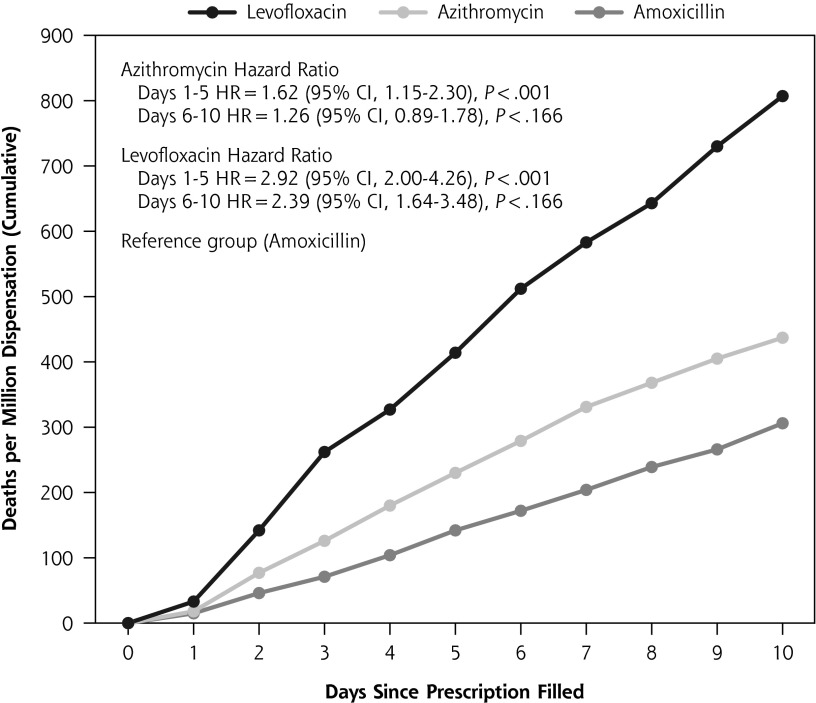
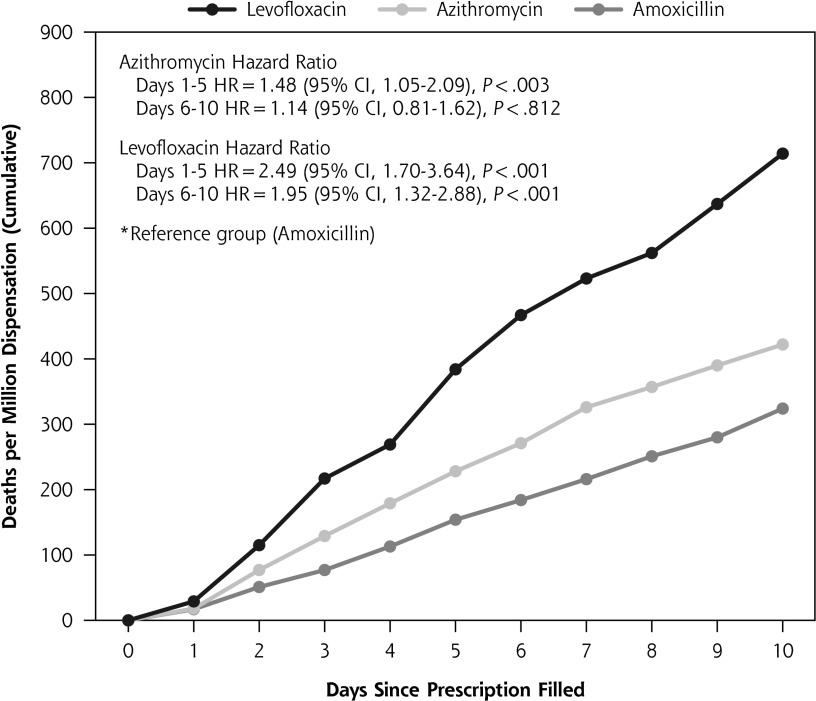
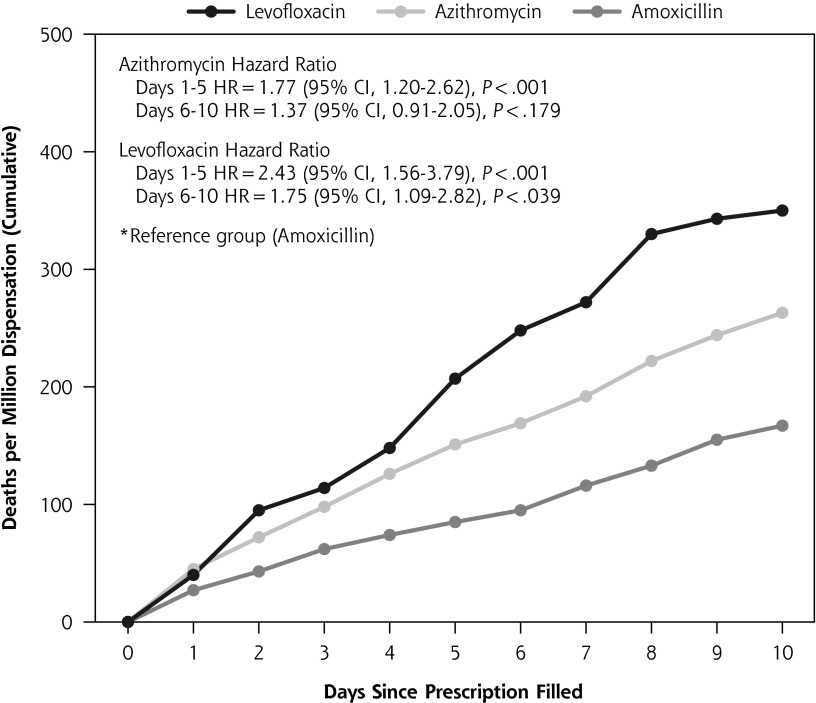
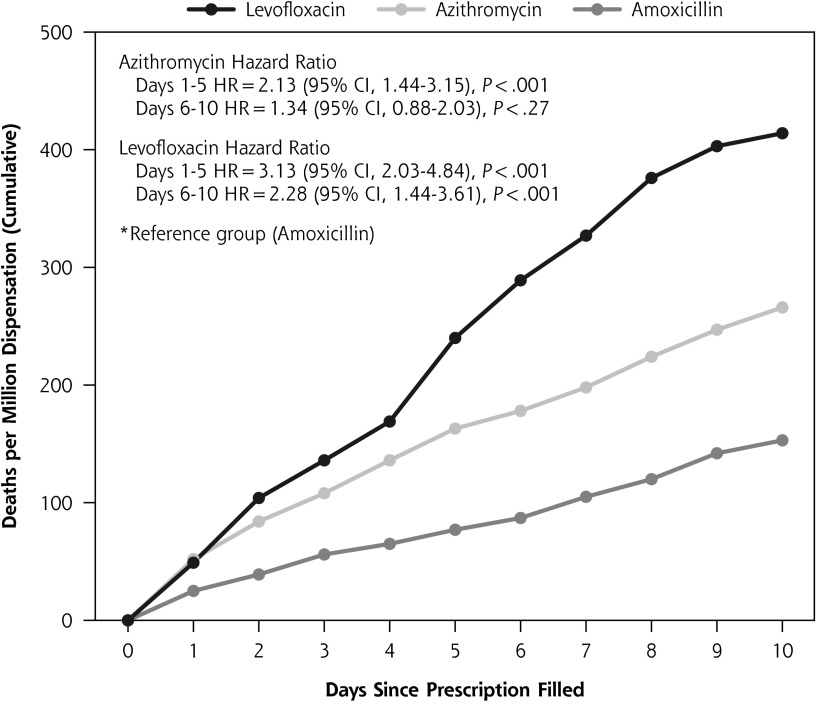
Results: During treatment days 1 to 5, patients receiving azithromycin had significantly increased risk of death (hazard ratio [HR] = 1.48; 95% CI, 1.05-2.09) and serious arrhythmia (HR = 1.77; 95% CI, 1.20-2.62) compared with patients receiving amoxicillin. On treatment days 6 to 10, risks were not statistically different. Compared with patients receiving amoxicillin, patients receiving levofloxacin for days 1 to 5 had a greater risk of death (HR = 2.49, 95% CI, 1.7-3.64) and serious cardiac arrhythmia (HR = 2.43, 95% CI, 1.56-3.79); this risk remained significantly different for days 6 to 10 for both death (HR = 1.95, 95% CI, 1.32-2.88) and arrhythmia (HR = 1.75; 95% CI, 1.09-2.82).
Conclusions: Compared with amoxicillin, azithromycin resulted in a statistically significant increase in mortality and arrhythmia risks on days 1 to 5, but not 6 to 10. Levofloxacin, which was predominantly dispensed for a minimum of 10 days, resulted in an increased risk throughout the 10-day period.
Keywords: amoxicillin; arrhythmia; azithromycin; cause of death; levofloxacin.
Figures
References
-
- Sanford Guide to Antimicrobial Therapy. 43rd ed Sperryville, VA: Antimicrobial Therapy, Inc; 2013
-
- Bril F, Gonzalez CD, Di Girolamo G. Antimicrobial agents-associated with QT interval prolongation. Curr Drug Saf. 2010;5(1):85–92 - PubMed
-
- Huang BH, Wu CH, Hsia CP, Yin Chen C. Azithromycin-induced torsade de pointes. Pacing Clin Electrophysiol. 2007;30(12):1579–1582 - PubMed
-
- Kezerashvili A, Khattak H, Barsky A, Nazari R, Fisher JD. Azithromycin as a cause of QT-interval prolongation and torsade de pointes in the absence of other known precipitating factors. J Interv Card Electrophysiol. 2007;18:243–246 - PubMed
-
- Matsunaga N, Oki Y, Prigollini A. A case of QT-interval prolongation precipitated by azithromycin. N Z Med J. 2003;116(1185):U666. - PubMed
MeSH terms
Substances
LinkOut - more resources
Full Text Sources
Other Literature Sources
Medical
Miscellaneous