. 2014 Apr 25;289(17):11630-11641.
doi: 10.1074/jbc.M114.555870. Epub 2014 Mar 10.

Identification of a novel protein binding motif within the T-synthase for the molecular chaperone Cosmc

Affiliations

Identification of a novel protein binding motif within the T-synthase for the molecular chaperone Cosmc

Rajindra P Aryal et al. J Biol Chem. .

Abstract

Prior studies suggested that the core 1 β3-galactosyltransferase (T-synthase) is a specific client of the endoplasmic reticulum chaperone Cosmc, whose function is required for T-synthase folding, activity, and consequent synthesis of normal O-glycans in all vertebrate cells. To explore whether the T-synthase encodes a specific recognition motif for Cosmc, we used deletion mutagenesis to identify a cryptic linear and relatively hydrophobic peptide in the N-terminal stem region of the T-synthase that is essential for binding to Cosmc (Cosmc binding region within T-synthase, or CBRT). Using this sequence information, we synthesized a peptide containing CBRT and found that it directly interacts with Cosmc and also inhibits Cosmc-assisted in vitro refolding of denatured T-synthase. Moreover, engineered T-synthase carrying mutations within CBRT exhibited diminished binding to Cosmc that resulted in the formation of inactive T-synthase. To confirm the general recognition of CBRT by Cosmc, we performed a domain swap experiment in which we inserted the stem region of the T-synthase into the human β4GalT1 and found that the CBRT element can confer Cosmc binding onto the β4GalT1 chimera. Thus, CBRT is a unique recognition motif for Cosmc to promote its regulation and formation of active T-synthase and represents the first sequence-specific chaperone recognition system in the ER/Golgi required for normal protein O-glycosylation.

Keywords: Cosmc; Endoplasmic Reticulum (ER); Glycobiology; Glycoprotein; Glycoprotein Biosynthesis; Glycosylation; Molecular Chaperone; Protein Folding; T-synthase.


Figures
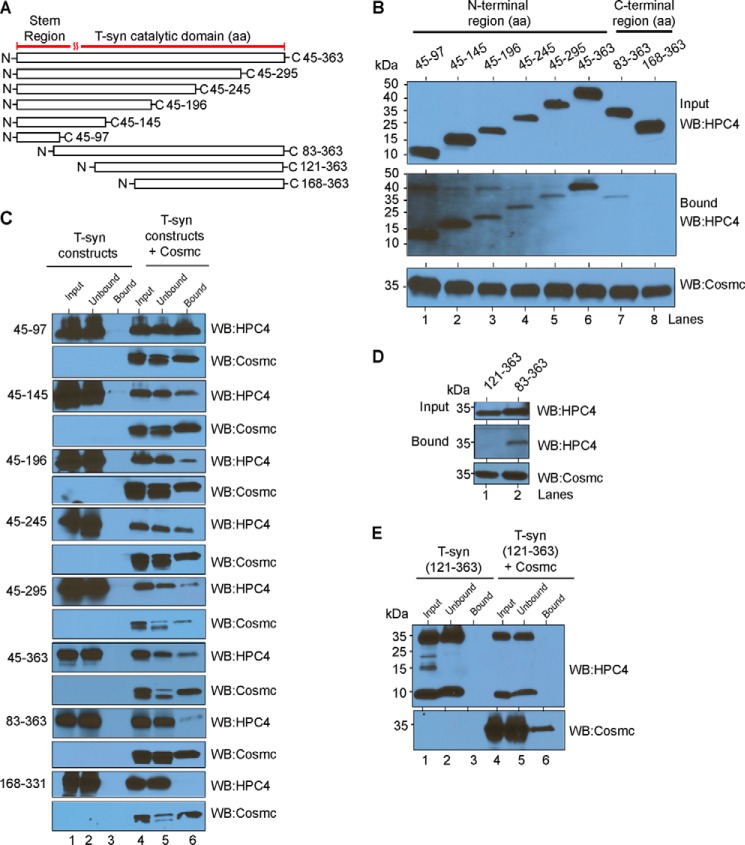
FIGURE 1.
FIGURE 1.
Identification and functional characterization of a novel Cosmc binding region in human T-synthase, the CBRT. A, schematics depicting the truncated soluble versions of HPC4-T-synthase. All constructs contain a signal sequence and HPC4 tag followed by different lengths of lumenal T-synthase as indicated. B and C, cosmc binds to the N-terminal stem region of T-synthase. B, input and bound fractions from the pulldown experiment were immunoblotted using monoclonal antibody against HPC4 for T-synthase, and the His-sCosmc used for pulldown was detected by monoclonal antibody against Cosmc. C, whole cell lysates from Hi-5 cells expressing various constructs of the human N-terminal HPC4 epitope-tagged soluble T-synthase (HPC4-sT-syn) expressed individually or co-expressed with human N-terminal His-tagged soluble Cosmc (His-sCosmc) were incubated with Ni-NTA beads followed by pulldown experiments. Input, unbound, and bound fractions were detected by antibody against HPC4 for T-synthase (top panels). Similarly, the amount of Cosmc used in the pulldown experiment was detected by antibody against Cosmc (bottom panels). D, pulldown experiment demonstrating that aa 83-121 in the N-terminal stem region of T-synthase are essential for binding to Cosmc. Input, bound, and amount of Cosmc used in the pulldown experiment were analyzed as described in B. E, pulldown experiment showing HPC4-sT-syn 121-363 does not bind to Cosmc or beads alone. A representative example of two independent experiments is shown. The data in B and D were repeated at least two independent times, and a representative example is shown. WB, Western blot.
FIGURE 2.
FIGURE 2.
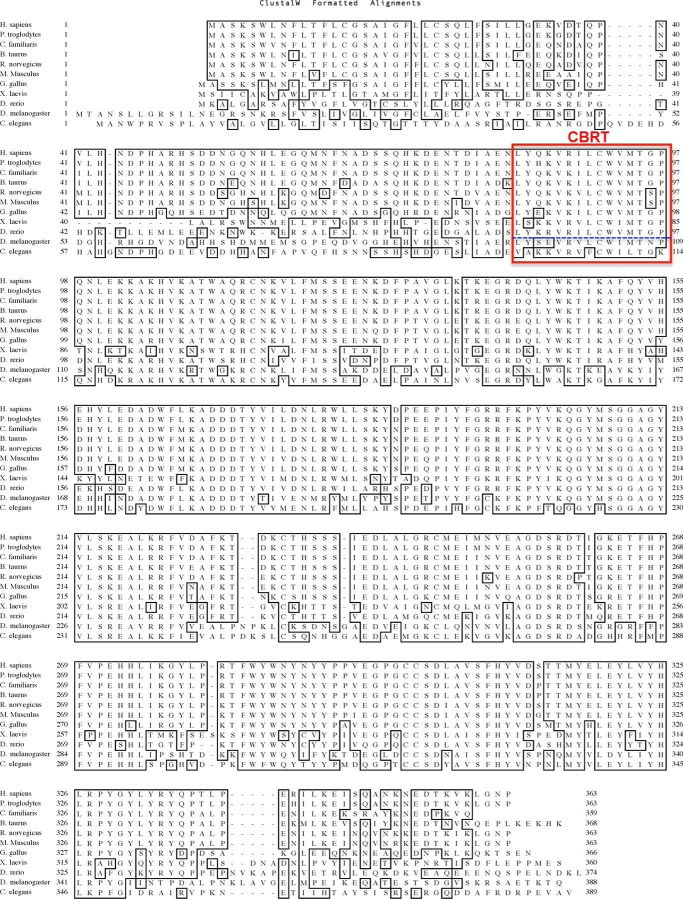
Comparison of amino acid sequences of T-synthase from different species showing CBRT within vertebrates is conserved (67). The CBRT region as determined in Fig. 1 is boxed in red, and vertebrate CBRT and invertebrate CBRT are separated by blue dashes. No significant homology of this CBRT region was found with other peptide sequences in other proteins upon BLAST searches.
FIGURE 3.
FIGURE 3.
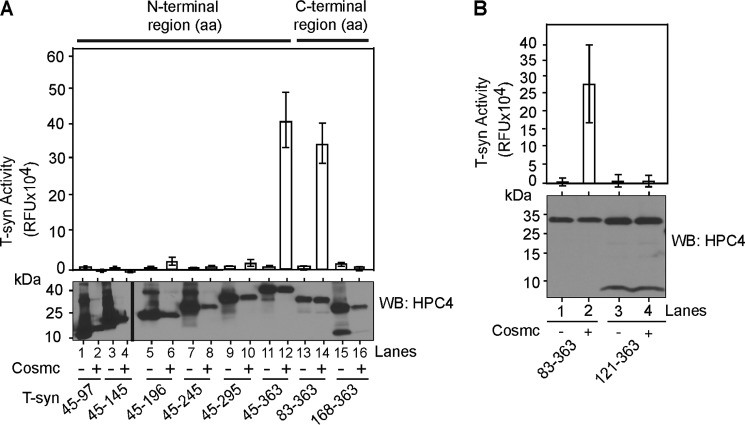
Cosmc binding to CBRT is necessary for T-synthase function. A, Cosmc binding to CBRT is necessary for T-synthase function. A portion of whole cell lysates from Hi-5 cells expressing various constructs of HPC4-sT-syn as depicted in Fig. 1A expressed individually or co-expressed with His-sCosmc were directly assayed for the activity (top panel). Half of the other portion of lysate was directly used to determine the amount HPC4-sT-syn expression (bottom panel), using mAb against HPC4 for T-synthase constructs. B, T-synthase activity demonstrating 83-121 aa is necessary for the biosynthesis of functional T-synthase. Similar to A, T-synthase activity assay (top panel) and the amount of T-synthase present in those samples were determined by Western blotting against HPC4-sT-syn. Each assay was performed in duplicate, three replicate experiments were performed, and the data represent the averages of all experiments. Error bars, ± S.D. from the average. WB, Western blot.
FIGURE 4.
FIGURE 4.
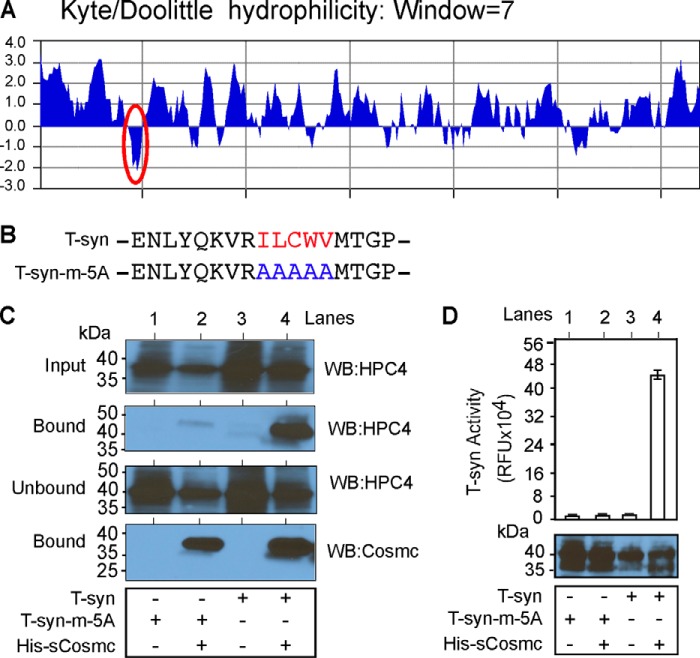
Cosmc binds to hydrophobic amino acids of CBRT to make functional T-synthase. A, Kyte/Doolittle hydrophobicity analysis of the lumenal domain of T-synthase. The hydrophobic area in the stem region is highlighted with a red oval. B, primary aa sequence showing clustered hydrophobic sequence (red) of HPC4-sT-syn (T-syn) and the primary aa sequence where the hydrophobic sequence is substituted by five alanines (blue) of HPC4-sT-syn-m-5A (T-syn-m-5A). C, the hydrophobic region of CBRT is important for Cosmc binding. Input, unbound, and bound fractions from the pulldown experiment were detected by monoclonal antibody against HPC4 for T-synthase. Similarly, the amount of Cosmc used in the pulldown experiment was detected by monoclonal antibody against Cosmc. D, the hydrophobic region of CBRT is important for T-synthase function. Whole cell lysates from Hi-5 cells expressing T-syn or Tsyn-m-5A individually or co-expressed with His-sCosmc were directly assayed for T-synthase activity and the level of T-synthase expression by Western blotting against HPC4. The data in C were repeated three independent times, and a representative example is shown. In D, each assay was performed in duplicate, three replicate experiments were performed, and the data represent the averages of all experiments. Error bars, ± S.D. from the average. WB, Western blot.
FIGURE 5.
FIGURE 5.
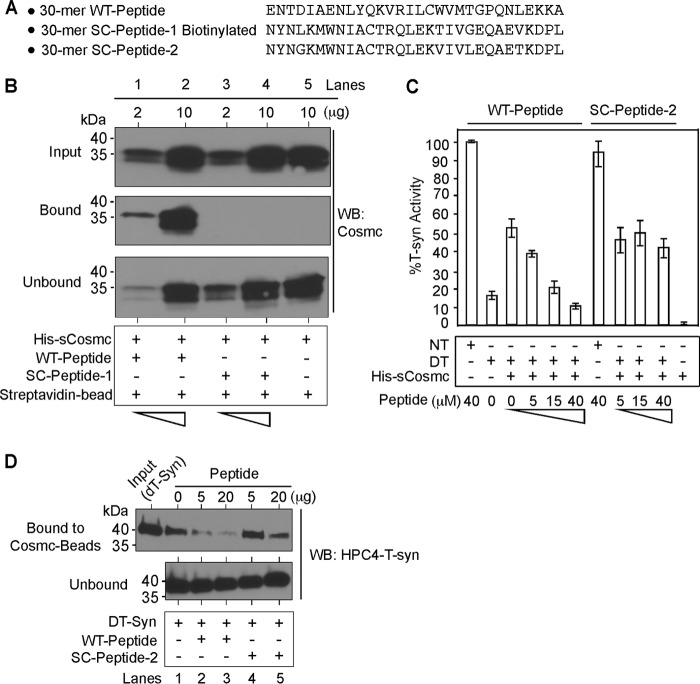
Cosmc directly associates with the CBRT to assist T-synthase folding. A, three peptides were synthesized representing aa of the CBRT region and designated as shown. B, synthetic biotinylated peptide containing CBRT directly interacts with Cosmc in a dose-dependent manner but not with scrambled biotinylated peptide. Approximately similar amounts of biotinylated CBRT-containing peptide (WT-Peptide) or scrambled peptide (SC-Peptide-1) were immobilized on streptavidin beads and incubated with varied concentrations of Cosmc as indicated followed by pulldown. Input, bound, and unbound materials were analyzed by Western blotting against Cosmc. C, the WT peptide, but not the SC peptide 2, inhibits His-sCosmc assisted refolding of heat-denatured T-synthase (DT-syn) in a dose-dependent manner. Reconstitution of heat-denatured HPC4-sT-syn, which was heated for 2 min at 55 °C, was initiated by the addition of His-sCosmc, and the percentage of restored T-synthase activity was determined in the presence of varied concentrations of WT peptide and SC-peptide. D, WT peptide, but not the SC peptide 2, significantly inhibits the formation of Cosmc-T-synthase complex in a dose-dependent manner. Input, bound, and unbound materials from the pulldown experiment were analyzed by Western blotting against HPC4. In B and D, the experiment was repeated three independent times, and a representative example is shown. Biotinylated CBRT-containing peptide (WT-Peptide) or biotinylated scrambled peptide (SC-Peptide-1) were only used in B, and nonbiotinylated forms were used in C and D. In C, the data show averages of three independent experiments. Error bars, ± S.D. from the average. DT, heat-denatured T-synthase; NT, native T-synthase; WB, Western blot.
FIGURE 6.
FIGURE 6.
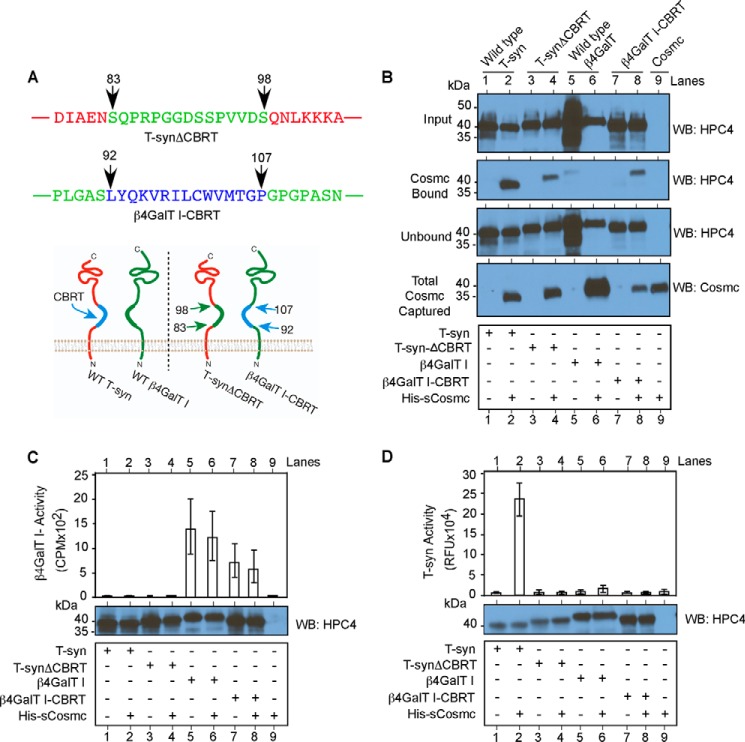
Characterization of domain swapped chimeric HPC4-sTsyn and HPC4-sβ4GalT1. A, primary aa sequence showing CBRT swapped HPC4-sTsyn (red) and HPC4-sβ4GalT1 (green) and schematic showing chimeric HPC4-sTsyn and HPC4-sβ4GalT1. B, pulldown experiment demonstrating significant loss of HPC4-sT-synΔCBRT binding to Cosmc and gain of HPC4-sβ4GalT1-CBRT binding to Cosmc. Input, unbound, and bound to Cosmc fractions from the pulldown experiment were analyzed by antibody against HPC4 for T-synthase/β4GalT1. Similarly, the amount of Cosmc used in the pulldown experiment was analyzed by monoclonal antibody against Cosmc (bottom panel). C, β4GalT1 activity was determined from whole cell lysates from Hi-5 cells expressing HPC4-sβ4GalT1 or HPC4-sT-syn or chimeric versions expressed individually or co-expressed with His-sCosmc (top panel). The data show averages of three independent experiments. Error bars, ± S.D. from the average. HPC4 containing either T-syn or β4GalT1 or their respective chimera were detected by Western blotting against HPC4 (bottom panel), and a representative Western blot from three is shown. D, similar to C, T-synthase activity and HPC4 containing proteins were determined. The data show averages of three independent experiments performed in duplicate. A representative Western blot from three independent analyses is shown. Error bars, ± S.D. from the average. WB, Western blot.
FIGURE 7.
FIGURE 7.
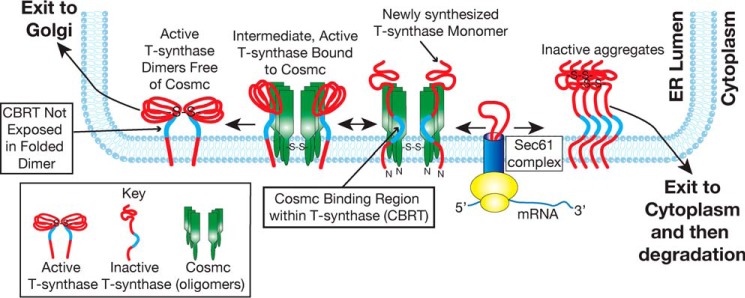
Proposed model of Cosmc function. In this model newly synthesized T-synthase co-translationally translocates into the lumen of the ER and directly interacts with Cosmc through the CBRT region (blue). Such interaction prevents the formation of an inactive oligomeric complex of T-synthase, which is removed to the cytoplasm and degraded. Binding of T-synthase to Cosmc promotes the formation of a transient complex, resulting in the folding of T-synthase. Active T-synthase is released from the complex when Cosmc interacts with other co-translationally translocated non-native T-synthase for another possible cycle of refolding (19). The CBRT region with the active and released T-synthase is no longer accessible to binding by Cosmc.

References

    1. Tian E., Ten Hagen K. G. (2009) Recent insights into the biological roles of mucin-type O-glycosylation. Glycoconj. J. 26, 325–334 - PMC - PubMed
    1. Steentoft C., Vakhrushev S. Y., Joshi H. J., Kong Y., Vester-Christensen M. B., Schjoldager K. T., Lavrsen K., Dabelsteen S., Pedersen N. B., Marcos-Silva L., Gupta R., Bennett E. P., Mandel U., Brunak S., Wandall H. H., Levery S. B., Clausen H. (2013) Precision mapping of the human O-GalNAc glycoproteome through SimpleCell technology. EMBO J. 32, 1478–1488 - PMC - PubMed
    1. Hang H. C., Bertozzi C. R. (2005) The chemistry and biology of mucin-type O-linked glycosylation. Bioorg. Med. Chem. 13, 5021–5034 - PubMed
    1. Wang Y., Jobe S. M., Ding X., Choo H., Archer D. R., Mi R., Ju T., Cummings R. D. (2012) Platelet biogenesis and functions require correct protein O-glycosylation. Proc. Natl. Acad. Sci. U.S.A. 109, 16143–16148 - PMC - PubMed
    1. Rosen S. D. (2004) Ligands for l-selectin: homing, inflammation, and beyond. Annu. Rev. Immunol. 22, 129–156 - PubMed

Publication types