


Sural sparing pattern discriminates Guillain-Barré syndrome from its mimics
- PMID: 24616124
- PMCID: PMC4431612
- DOI: 10.1002/mus.24226
Sural sparing pattern discriminates Guillain-Barré syndrome from its mimics
Abstract
Introduction: Electrodiagnostic features of demyelination are essential for establishing the diagnosis in demyelinating subtypes of Guillain-Barré syndrome (GBS), but they may also occur in disorders that mimic GBS clinically. Information about their frequency in GBS mimics is sparse.
Methods: Evaluation of electrodiagnostic features from 38 patients with suspected GBS in whom the diagnosis was later refuted (GBS mimics). Their diagnostic accuracy was analyzed by comparison with nerve conduction studies (NCS) from 73 confirmed GBS patients.
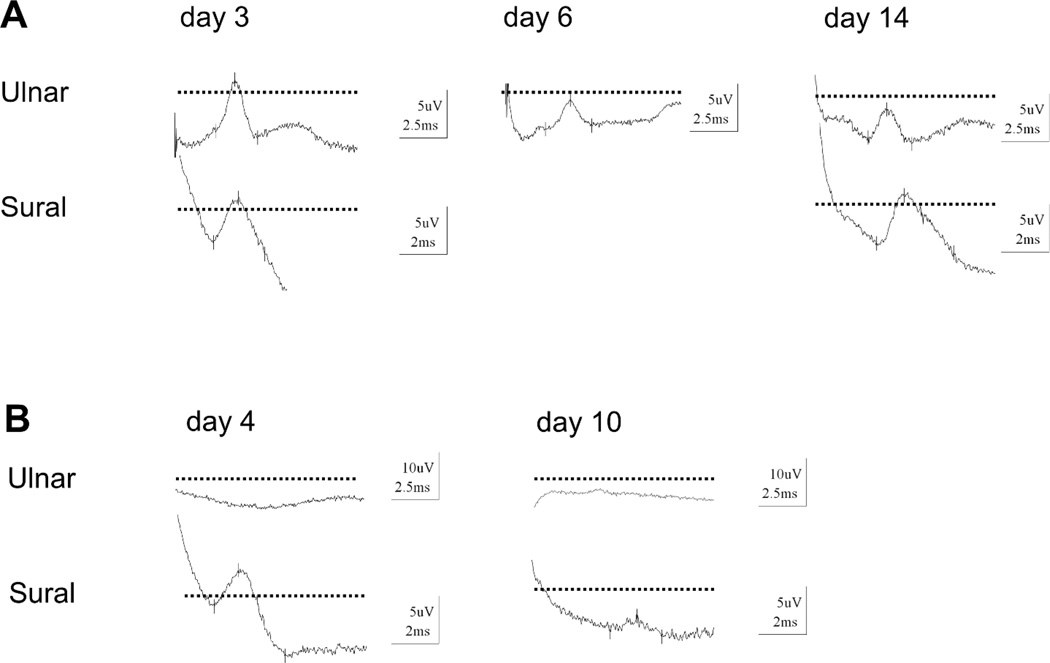
Results: Disorders that mimicked GBS clinically at the time of hospital admission included other inflammatory, metabolic, toxic, or infectious neuropathies and spinal cord disorders. The sural sparing pattern was the most specific electrodiagnostic feature for demyelinating GBS.
Conclusions: Common electrodiagnostic abnormalities in early demyelinating GBS do not usually exclude other rare differential diagnoses. An exception to this is the sural sparing pattern described here, which strongly supports the diagnosis of demyelinating GBS.
Keywords: GBS; Guillain-Barré syndrome; differential diagnosis; misdiagnosis; nerve conduction studies; peripheral neuropathy.
© 2014 Wiley Periodicals, Inc.
Figures
References
-
- Yuki N, Hartung HP. Guillain-Barré syndrome. N Engl J Med. 2012;366(24):2294–2304. - PubMed
-
- van Doorn PA, Ruts L, Jacobs BC. Clinical features, pathogenesis, and treatment of Guillain-Barre syndrome. Lancet Neurol. 2008;7(10):939–950. - PubMed
-
- Syme JA, Kelly JJ. Absent F-waves early in a case of transverse myelitis. Muscle Nerve. 1994;17(4):462–465. - PubMed
-
- Sejvar JJ, Kohl KS, Gidudu J, Amato A, Bakshi N, Baxter R, Burwen DR, Cornblath DR, Cleerbout J, Edwards KM, Heininger U, Hughes R, Khuri-Bulos N, Korinthenberg R, Law BJ, Munro U, Maltezou HC, Nell P, Oleske J, Sparks R, Velentgas P, Vermeer P, Wiznitzer M, Group BCGW. Guillain-Barré syndrome and Fisher syndrome: case definitions and guidelines for collection, analysis, and presentation of immunization safety data. Vaccine. 2011;29(3):599–612. - PubMed
-
- Hadden RD, Cornblath DR, Hughes RA, Zielasek J, Hartung HP, Toyka KV, Swan AV. Electrophysiological classification of Guillain-Barre syndrome: clinical associations and outcome. Plasma Exchange/Sandoglobulin Guillain-Barre Syndrome Trial Group. Ann Neurol. 1998;44(5):780–788. - PubMed
MeSH terms
Grants and funding
LinkOut - more resources
Full Text Sources
Other Literature Sources
Medical
