


Effects of active versus passive recovery on power output during repeated bouts of short term, high intensity exercise
- PMID: 24616610
- PMCID: PMC3938048
Effects of active versus passive recovery on power output during repeated bouts of short term, high intensity exercise
Abstract
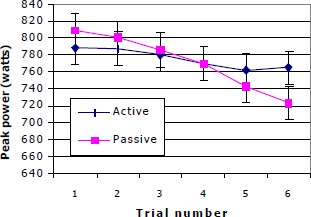
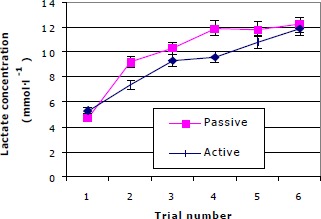
ATP repletion following exhaustive exercise is approximated to be 90-95% complete in 3 minutes, and is crucial in the performance of short duration, high intensity work. Few studies appear to have used this 3-minute interval in the investigation of recovery modes, blood lactate accumulation and power output. Thus, our aim was to investigate changes in peak power (PP), average power (AP) and blood lactate during repeated bouts of high intensity, short duration cycling, comprising active and passive recovery modes lasting 3 minutes. Seven male cyclists (age 21.8±3.3 yrs, mass 73.0±3.8kgs, height 177.3±3.4cm) performed both an active (3 min at 80rpm & 1kg resistance) and a passive recovery (no work between bouts) protocol. Following a warm-up, subjects performed six 15-second maximal sprints against a fixed workload of 5.5kg. Mean PP across the six trials was 775±11.2Watts (W) and 772±33.4W for active and passive protocols respectively; whereas mean AP was 671±26.4W and 664±10.0W, respectively. Neither was significantly different. There was a significant difference within trials for both peak power and average power (p<0.05), with both values decreasing over time. However, the decrease was significantly smaller for both PP and AP values during the active recovery protocol (p<0.05). In the current study, variation in power output cannot be explained by lactate values, as values did not differ between the active and passive protocol (p=0.37). Lactate values did differ significantly between trials within protocols (p<0.05). The results of this study suggest that an active recovery of 3 minutes between high intensity, short duration exercise bouts significantly increases PP and AP compared to a passive recovery, irrespective of changes in blood lactate levels.
Keywords: Anaerobic power; lactate; light exercise; power output.
Figures
References
-
- Ainsworth B.E., Serfass R.C., Leon A.S. (1993) Effects of recovery duration and blood lactate level on power output during cycling. Canadian Journal of Applied Physiology 18, 19-30 - PubMed
-
- Bangsbo J., Graham T., Johansen L., Saltin B. (1994) Muscle lactate metabolism in recovery from intense exhaustive exercise: impact of light exercise. Journal of Applied Physiology 77, 1890-1895 - PubMed
-
- Belcastro A.N., Bonen A. (1975) Lactic acid removal rates during controlled and uncontrolled recovery exercise. Journal of Applied Physiology 39, 932-936 - PubMed
-
- Bond V., Adams R.G., Tearney R.J., Gresham K., Ruff W. (1991) Effects of active and passive recovery on lactate removal and subsequent isokinetic muscle function. Journal of Sports Medicine and Physical Fitness 31, 357-361 - PubMed
-
- Brooks G.A. (1986) The lactate shuttle during exercise and recovery. Medicine and Science in Sports and Exercise 18, 360-368 - PubMed
LinkOut - more resources
Full Text Sources
Miscellaneous