


Noninvasive techniques for blood pressure measurement are not a reliable alternative to direct measurement: a randomized crossover trial in ICU
- PMID: 24616624
- PMCID: PMC3926274
- DOI: 10.1155/2014/353628
Noninvasive techniques for blood pressure measurement are not a reliable alternative to direct measurement: a randomized crossover trial in ICU
Abstract
Introduction: Noninvasive blood pressure (NIBP) monitoring methods are widely used in critically ill patients despite poor evidence of their accuracy. The erroneous interpretations of blood pressure (BP) may lead to clinical errors.
Objectives: To test the accuracy and reliability of aneroid (ABP) and oscillometric (OBP) devices compared to the invasive BP (IBP) monitoring in an ICU population.
Materials and methods: Fifty adult patients (200 comparisons) were included in a randomized crossover trial. BP was recorded simultaneously by IBP and either by ABP or by OBP, taking IBP as gold standard.
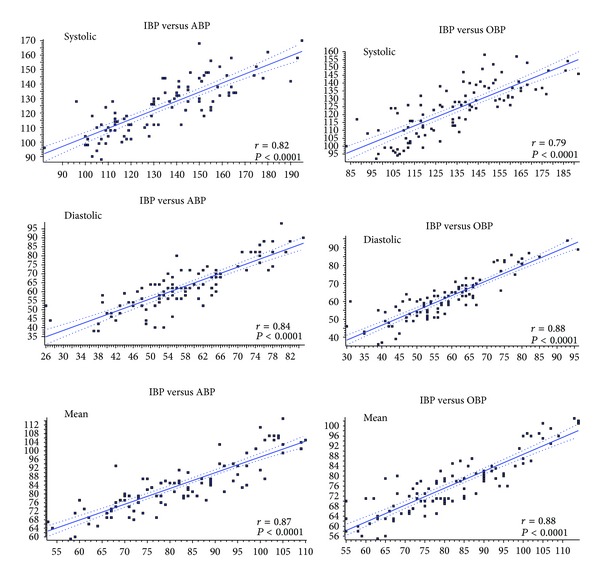
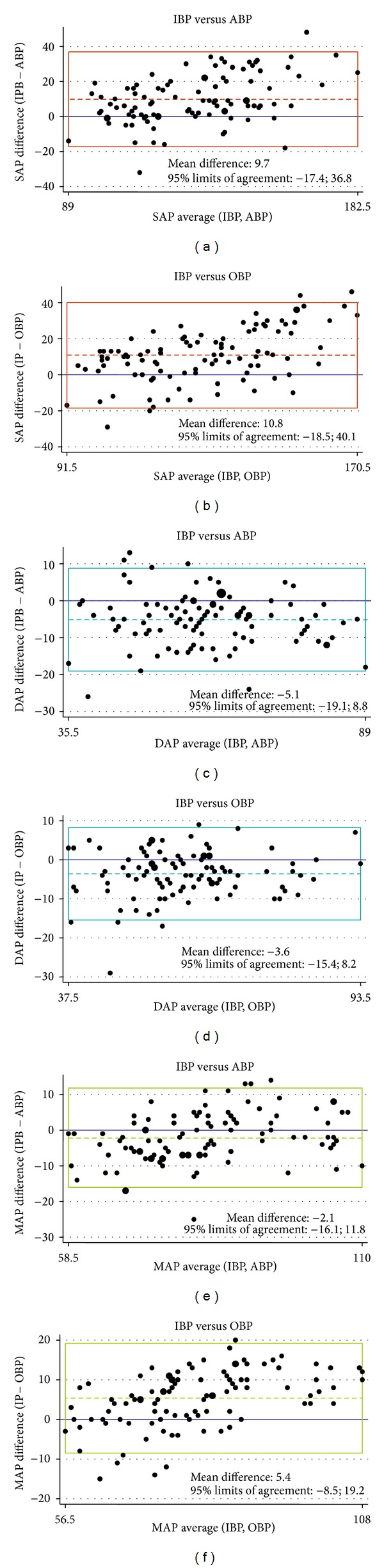
Results: Compared with ABP, IBP systolic values were significantly higher (mean difference ± standard deviation 9.74 ± 13.8; P < 0.0001). Both diastolic (-5.13 ± 7.1; P < 0.0001) and mean (-2.14 ± 7.1; P=0.0033) IBP were instead lower. Compared with OBP, systolic (10.80 ± 14.9; P < 0.0001) and mean (5.36 ± 7.1; P < 0.0001) IBP were higher, while diastolic IBP (-3.62 ± 6.0; P < 0.0001) was lower. Bland-Altman plots showed wide limits of agreement in both NIBP-IBP comparisons.
Conclusions: BP measurements with different devices produced significantly different results. Since in critically ill patients the importance of BP readings is often crucial, noninvasive techniques cannot be regarded as reliable alternatives to direct measurements.
Figures
References
-
- Pickering TG, Hall JE, Appel LJ, et al. Recommendations for blood pressure measurement in humans and experimental animals. Part 1: blood pressure measurement in humans: a statement for professionals from the subcommittee of professional and public education of the American Heart Association council on high blood pressure research. Hypertension. 2005;45(1):142–161. - PubMed
-
- Turner MJ, Speechly C, Bignell N. Sphygmomanometer calibration—why, how and how often? Australian Family Physician. 2007;36(10):834–838. - PubMed
-
- Schroeder RA, Barbeito A, Bar-Ypsef S, Mark JB. Cardiovascular monitoring. In: Miller RD, editor. Miller’s Anesthesia. 7th edition. Philadelphia, Pa, USA: Churchill Livingston Elsevier; 2010. pp. 1267–1328.
-
- Edmonds ZV, Mower WR, Lovato LM, Lomeli R. The reliability of vital sign measurements. Annals of Emergency Medicine. 2002;39(3):233–237. - PubMed
-
- Weiss BM, Pasch T. Measurement of systemic arterial pressure. Current Opinion in Anaesthesiology. 1997;10(6):459–466.
Publication types
MeSH terms
LinkOut - more resources
Full Text Sources
Other Literature Sources
Medical
