. 2014 Sep;16(9):1339-53.
doi: 10.1111/cmi.12290. Epub 2014 May 5.

The oxido-reductase enzyme glutathione peroxidase 4 (GPX4) governs Salmonella Typhimurium-induced neutrophil transepithelial migration

Affiliations
Free PMC article

The oxido-reductase enzyme glutathione peroxidase 4 (GPX4) governs Salmonella Typhimurium-induced neutrophil transepithelial migration

Terence A Agbor et al. Cell Microbiol. 2014 Sep.
Free PMC article

Abstract

Neutrophil (polymorphonuclear leucocytes; PMN) transmigration across mucosal surfaces contributes to dysfunction of epithelial barrier properties, a characteristic underlying many mucosal inflammatory diseases. Using Salmonella enterica serovar Typhimurium (S. Typhimurium) as a prototypic proinflammatory insult, we have previously reported that the eicosanoid hepoxilin A3 (HXA3 ), an endogenous product of 12-lipoxygenase (12-LOX) activity, is secreted from the apical surface of the intestinal epithelium to establish a chemotactic gradient that guides PMN across the epithelial surface. Since little is known regarding the molecular mechanisms that regulate 12-LOX during S. Typhimurium infection, we investigated this pathway. We found that expression of phospholipid glutathione peroxidase (GPX4), which is known to have an inhibitory effect on 12-LOX activity, is significantly decreased at both the mRNA and protein level during infection with S. Typhimurium. Moreover, employing intestinal epithelial cell monolayers expressing siRNA against GPX4 mRNA, S. Typhimurium-induced PMN migration was significantly increased compared with the non-specific siRNA control cells. Conversely, in cells engineered to overexpress GPX4, S. Typhimurium-induced PMN migration was significantly decreased, which is consistent with the finding that partial depletion of GPX4 by RNAi resulted in a significant increase in HXA3 secretion during S. Typhimurium infection. Mechanistically, although we found Salmonella entry not to be required for the induced decrease in GPX4, the secreted effector, SipA, which is known to induce epithelial responses leading to stimulation of HXA3 , governed the decrease in GPX4 in a process that does not lead to an overall increase in the levels of ROS. Taken together, these results suggest that S. Typhimurium induces apical secretion of HXA3 by decreasing the expression of phospholipid GPX, which in turn leads to an increase in 12-LOX activity, and hence HXA3 synthesis.


Figures

Figure 1
Figure 1
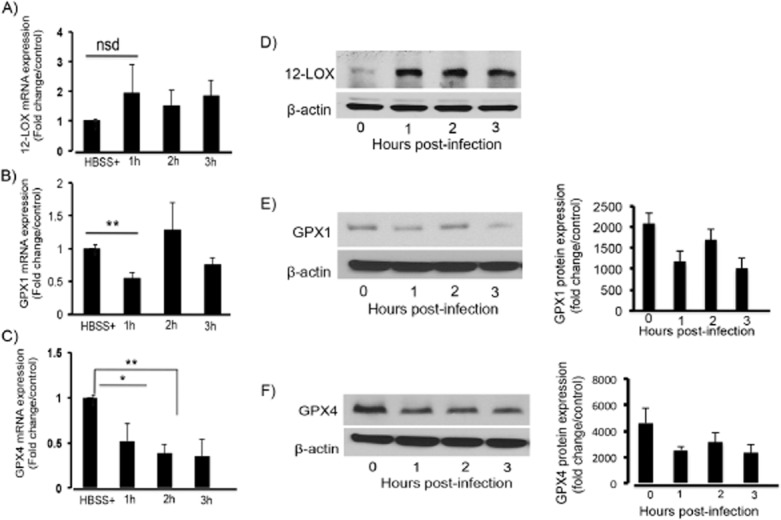
Salmonella Typhimurium infection decreases mRNA and protein expression of GPX 1 and GPX 4. T84 intestinal epithelial cells were infected apically with S. Typhimurium SL1344 for the indicated time points. RNA was extracted, reverse transcribed to cDNA and used for RT-PCR for (A) 12-LOX, (B) GPX1 and (C) GPX4. Results indicate that infection of cells with S. Typhimurium results in a significant decrease in the mRNA expression of GPX1 and GPX4 and an increase in 12-LOX mRNA expression. Gene expression was normalized against the 18S ribosomal subunit. Results are expressed as fold change relative to control. Whole cell lysates were also extracted, and the proteins normalized and Western blotted for (D) 12S-LOX, (E) GPX1 and (F) GPX4. Results indicate that infection of cells with S. Typhimurium results in a decrease in GPX1 and GPX4 protein expression and an increase in 12-LOX protein expression. Right panels are the densitometry following protein quantification of GPX 1 and GPX 4. Data shown are a representation of one of n = 3 (The symbols ‘*’ and ‘**’ indicate statistical significance, using the Student's t-test; P < 0.05, n = 3).
Figure 2
Figure 2
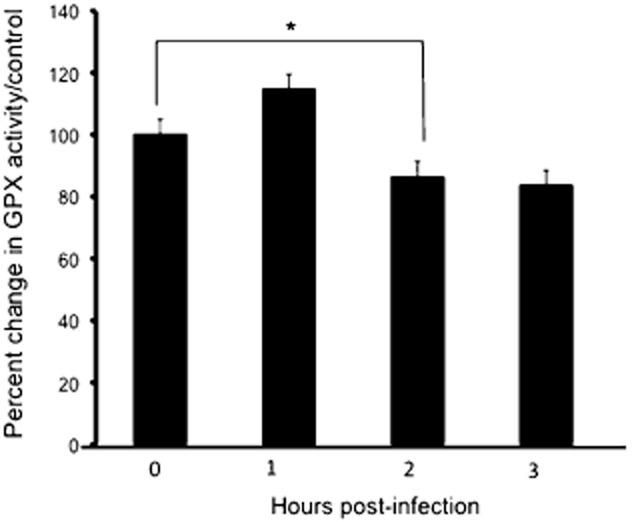
S. Typhimurium infection decreases total cell GPX activity. T84 intestinal epithelial cells maintained in 6 well plates were infected with S. Typhimurium SL1344 or left uninfected for the indicated time points. Cells were lysed with a GPX assay lysis buffer, and the cell lysates normalized and used in a GPX activity assay (Cayman Chemical Company). Results show that infection induces ∼ 20% decrease in total cell GPX activity 2 and 3 h after infection. Total GPX activity increases by ∼ 20% after the first hour of infection (The asterisk ‘*’ indicates statistical significance, using the Student's t-test; P < 0.05, n = 3).
Figure 3
Figure 3
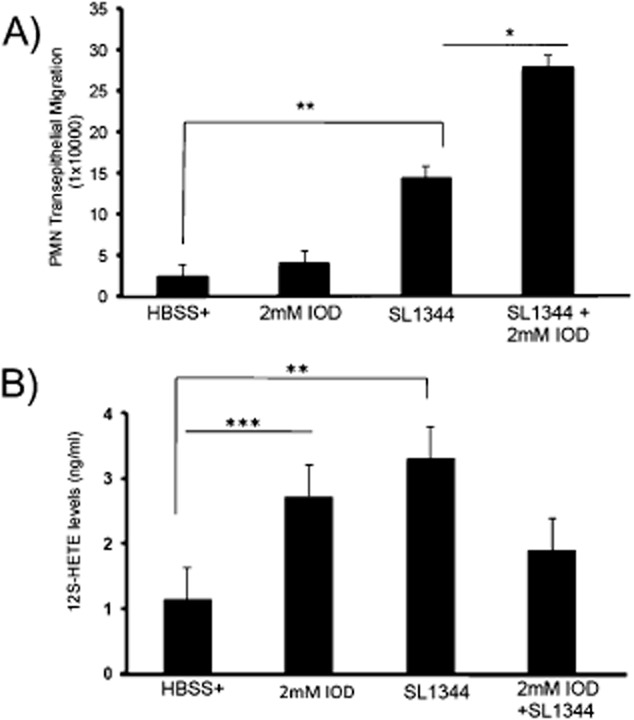
Inhibition of total cell GPX activity significantly augments transepithelial migration of PMNs. Intestinal epithelial cells maintained on transwells were treated with 2 mM of sodium iodoacetate (IOD; a pan GPX inhibitor) or HBSS+ (negative control) for 10 min, and then infected with S. Typhimurium SL1344 in the absence or presence of IOD, or treated with IOD alone or HBSS+. PMN transmigration was then performed and we show that inhibition of total cell GPX with IOD resulted in a significant increase in SL1344-induced PMN transmigration compared with SL1344 infection in the absence of IOD. (B). Cells were treated as above, supernatants were collected 4 h after infection, and lipids in the supernatants were semi-purified by column chromatography and eluted with methanol. Samples were dried, resuspended in 300 μl of HBSS+ and used to carry out 12S-HETE ELISA. Infection of cells with S. Typhimurium and IOD treatment resulted in a significant increase in 12S-HETE levels compared with uninfected cells (The symbols ‘*’, ‘**’ and ‘***’ indicate statistical significance, using the Student's t-test; P < 0.05, n = 3).
Figure 4
Figure 4
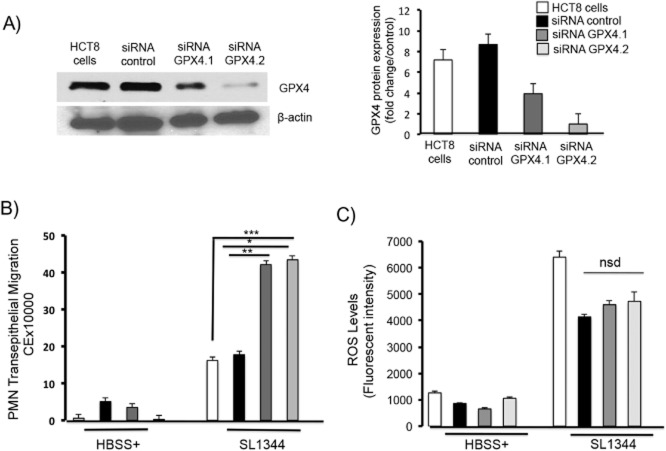
Partial knockdown of GPX4 with siRNA results in a significant increase in PMN transmigration during S. Typhmurium infection. A. HCT8 intestinal epithelial cells were stably transfected with two GPX4 siRNAs, which we generated and Western blotted for GPX4 expression. Results indicate that both GPX4 siRNAs induced a significant decrease in GPX4 expression relative to untransfected cells or vector control cells. Densitometry is indicated on the right hand side. B. The knockdown cells and control cells were maintained on transwells, then infected with S. Typhimurium SL1344 or left uninfected for 1h before being used for a PMN transmigration assay. Partial knockdown of GPX4 using siRNA resulted in a significant increase in transepithelial migration of neutrophils compared non-transfected and vector control cells. C. Salmonella infection induces a significant increase in reactive oxygen species (ROS) production in both non-transfected and vector control and in GPX4 knockdown cells. The levels of ROS production in control and GPX4 knockdown cells following SL1344 infection were not significantly different (The symbols ‘*’, ‘**’ and ‘***’ indicate statistical significance, using the Student's t-test; P < 0.05, n = 3). Key: white bars = untransfected cells, black bars = control siRNA, dark grey bars = siRNA GPX4.2, light grey bars = siRNA GPX4.1.
Figure 5
Figure 5
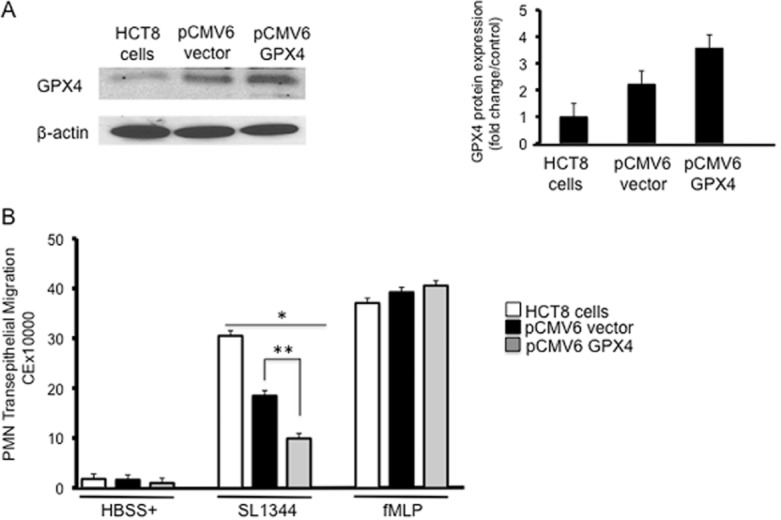
Overexpression of GPX4 decreases PMN transmigration relative to control cells. A. HCT8 cells were stably transfected with either empty vector pCMV6 or pCMV6-GPX4 and Western blotted for the expression of GPX4. Overexpression of GPX4 resulted in ∼ 30% increase in GPX4 protein expression, and pCMV6 vector also increased GPX4 expression relative to untransfected cells but less so than pCMV6-GPX4 transfected cells (densitometry on right panel). B. The cells were infected with S. Typhimurium SL1344, followed by PMN transmigration. Cells overexpressing GPX4 show a significant decrease in PMN transmigration compared with untransfected and pCMV6 control vector transfected cells. pCMV6 vector expressing cells which also express relatively higher levels of GPX4 compared with control cells show a significant decrease in PMN transmigration. fMLP was used as a positive control and GPX4 overexpression had no effects on fMLP-induced PMN transmigration (The symbols ‘*’ and ‘**’ indicate statistical significance, using the Student's t-test; P < 0.05, n = 3). Key: white bars = untransfected cells, black bars = pCMV6 vector, grey bars = pCMV6-GPX4
Figure 6
Figure 6
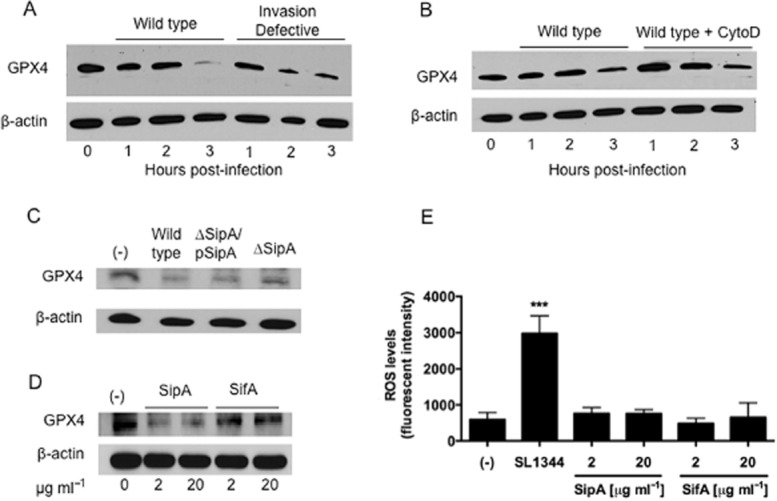
S. Typhimurium-induced decreased GPX4 expression is through the secreted effector SipA and does not require bacterial entry. A. HCT-8 intestinal epithelial cells were infected apically with wild-type S. Typhimurium SL1344 or the isogenic invasion-defective strain VV341 for the indicated time points. Whole cell lysates were then extracted and the proteins normalized and Western blotted for GPX4. B. HCT-8 cells were treated with 5 μg ml−1 of cytochalasin D or HBSS+ (negative control) for 45 min, infected with wild-type SL1344 for the indicated time points, and then analysed for GPX4 expression as above. C. HCT-8 cells were infected with wild-type SL1344, the isogenic SipA-deficient strain EE633 (ΔSipA) or the SipA-complemented strain AJK63 (ΔSipA/pSipA) for 1 h, and then analysed for GPX4 expression. D. HCT-8 cells were exposed on their apical surface to exogenous S. Typhimurium effectors SipA-HA or GST-SifA for 1 h, and then analysed for GPX4 expression. E. SipA does not induce an increase in overall levels of ROS. The levels of ROS production in untreated cells and cells exposed to SipA or SifA for 90 min were not significantly different (The symbol ‘***’ indicates statistical significance, using the Student's t-test; P < 0.01).
Figure 7
Figure 7
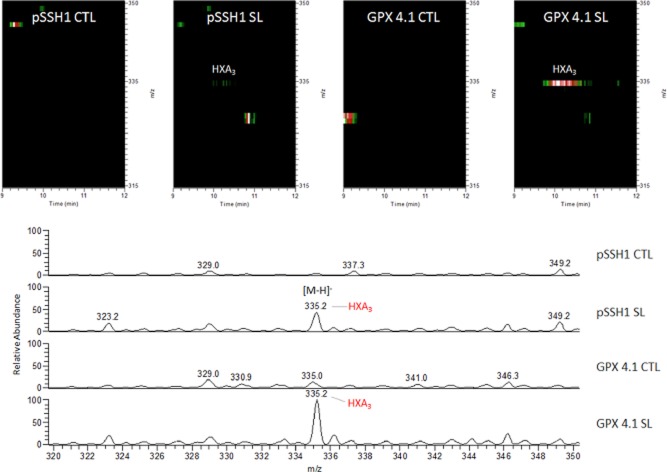
Hepoxilin A3 secretion is increased in Salmonella infected GPX knockdown cells. Extracted ion maps (A) depict the lipid ions detected in the mass-to-charge ratio (m/z) range from 315 to 350 m/z and time range from 9 to 12 min. Colours represent the relative abundance of the detected lipid signals: white equals 100%, red 80%, green 60%. Mass spectra (B) of the lipid ions detected in the m/z range from 333.5 to 335.5 m/z and time range ∼ 9.5 to 10.5 min. Mass spectra were normalized to the largest peak present across the samples. pSSH1 CTL: vector control transfected cells uninfected; pSSH1 SL: vector control transfected cells infected with Salmonella; GPX 4.1 CTL: GPX 4.1 knockdown cells control uninfected; GPX 4.1 SL: GPX 4.1 knockdown cells infected with Salmonella. LC/MS/MS analyses were done in negative ion mode with a mass accuracy of ± 0.1–0.2 atomic mass units (amu). Hepoxilin A3 (HXA3) identification and quantification was done as described in Experimental procedures. Data shown are a representation of one of n = 3.
Figure 8
Figure 8
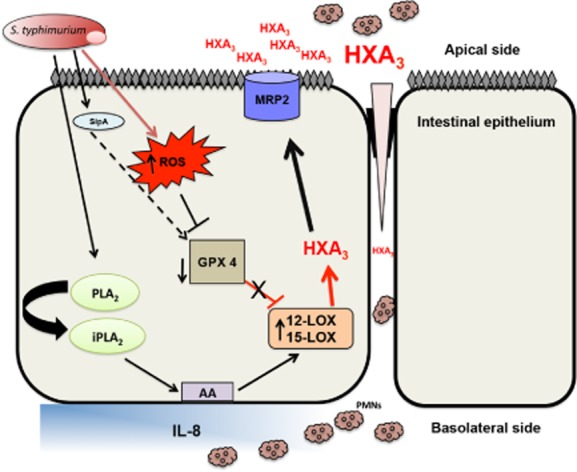
Working model of S. Typhimurium regulation of 12-LOX expression/activity and HXA3 synthesis during infection. Infection of intestinal epithelial cells with Salmonella Typhimurium induces an increase in reactive oxygen species (ROS) production, which induces a decrease in GPX4 expression and total cell GPX activity. Treatment of intestinal epithelial cells with the S. Typhimurium effector protein SipA also directly decreased GPX4 expression (dotted lines) through mechanisms yet to be elucidated. The decrease in GPX4 expression and activity results in the accumulation of phospholipid hydroperoxides thereby activating the 12-LOX pathway. Furthermore, S. Typhimurium infection also induces an increase in the expression of 12-LOX. These two events (decrease in GPX activity/expression and increase in 12-LOX expression) culminate in the activation of the 12-LOX pathway of arachidonic acid metabolism leading to the synthesis of HXA3. Synthesized HXA3 is then effluxed across the intestinal epithelial cell membrane by MRP2. Once in the lumen, HXA3 induces transepithelial migration of neutrophils. PLA2 is involved in the release of arachidonic acid from the cell membrane. AA = arachidonic acid, ROS = reactive oxygen species, PLA2 = phospholipase A2, HXA3 = hepoxilin A3, IL-8 = interleuken 8, MRP2 = multidrug resistant associated protein 2.

References

    1. Bernal-Bayard J, Ramos-Morales F. Salmonella type III secretion effector SlrP is an E3 ubiquitin ligase for mammalian thioredoxin. J Biol Chem. 2009;284:27587–27595. - PMC - PubMed
    1. Brigelius-Flohe R, Friedrichs B, Maurer S, Schultz M, Streicher R. Interleukin 1-induced nuclear factor kappa B activation is inhibited by overexpression of phospholipid hydroperoxide glutathione peroxidase in a human endothelial cell line. Biochem J. 1997;328:199–203. (Part 1) - PMC - PubMed
    1. Brummelkamp TR, Bernards R, Agami R. A system for stable expression of short interfering RNAs in mammalian cells. Science. 2002;296:550–553. - PubMed
    1. Casella JF, Flanagan MD, Lin S. Cytochalasin D inhibits actin polymerization and induces depolymerization of actin filaments formed during platelet shape change. Nature. 1981;293:302–305. - PubMed
    1. Day DW, Mandal BK, Morson BC. The rectal biopsy appearances in Salmonella colitis. Histopathology. 1978;2:117–131. - PubMed

MeSH terms

Substances

LinkOut - more resources