. 2013 Sep;3(3):611-21.
doi: 10.1086/674304. Epub 2013 Nov 18.

Subcutaneous treprostinil is well tolerated with infrequent site changes and analgesics

Affiliations

Subcutaneous treprostinil is well tolerated with infrequent site changes and analgesics

R James White et al. Pulm Circ. 2013 Sep.

Abstract

Abstract Continuous prostanoid infusions are recommended for patients with advanced pulmonary arterial hypertension. Infusion site pain has discouraged some physicians from considering subcutaneous (SQ) treprostinil therapy even though it has safety and convenience advantages over intravenous epoprostenol. We conducted a 1-year prospective study of patients utilizing SQ treprostinil. We provided counseling on infrequent site changes and a written analgesic protocol including narcotics. After placement of a new site, subjects recorded daily pain scores and analgesic use. Twenty-six of 29 patients consented, including 4 patients who had recently started therapy. They returned 203 diaries, and we captured every site change in a diary. Sixteen subjects returned 8 or fewer diaries during 12 months, and 20% of diaries documented only mild discomfort. The majority of diaries documented brief periods of severe pain, but this had generally abated by day 7. Contrary to published guidelines, infusion site pain was independent of treprostinil dose in a rigorous analysis. There were 3 significant local reactions but no systemic illness. No subject discontinued SQ treprostinil because of site discomfort. Subjects reported satisfaction with their treatment using a validated assessment, and quality-of-life scores were favorable. A strategy emphasizing infrequent site changes and early analgesia can facilitate use of SQ treprostinil. These data may allow physicians to consider treprostinil earlier in the treatment algorithm for this fatal disease.


Figures
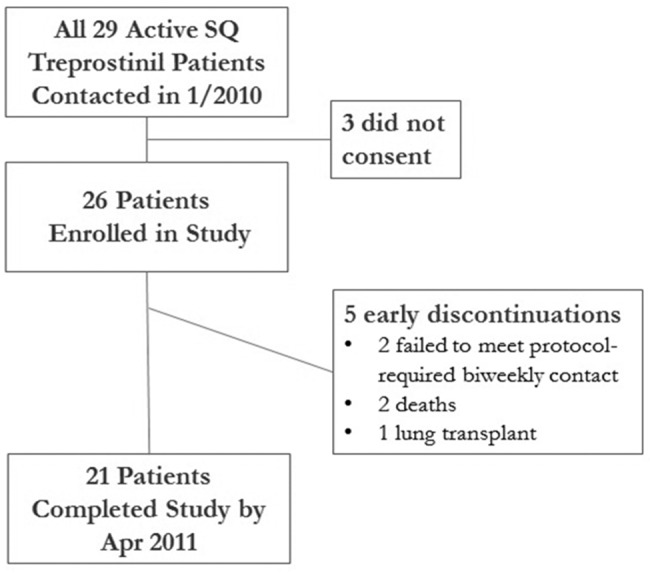
Figure 1
Figure 1
Study population and outcome. All 29 active treprostinil patients at our institution were approached, and most consented. Three did not consent, and all 3 were alive and on subcutaneous (SQ) treprostinil with infrequent site changes at study end. Of the 26 enrolled, 2 were excluded early because they failed to meet protocol-mandated contact with the site every other week; therefore, we could not ascertain appropriate completion of the diaries. They were alive on SQ treprostinil with infrequent site changes at study end. Eight months each of patient diary data were collected for the 2 patients who died and 11 months for the transplanted patient.
Figure 2
Figure 2
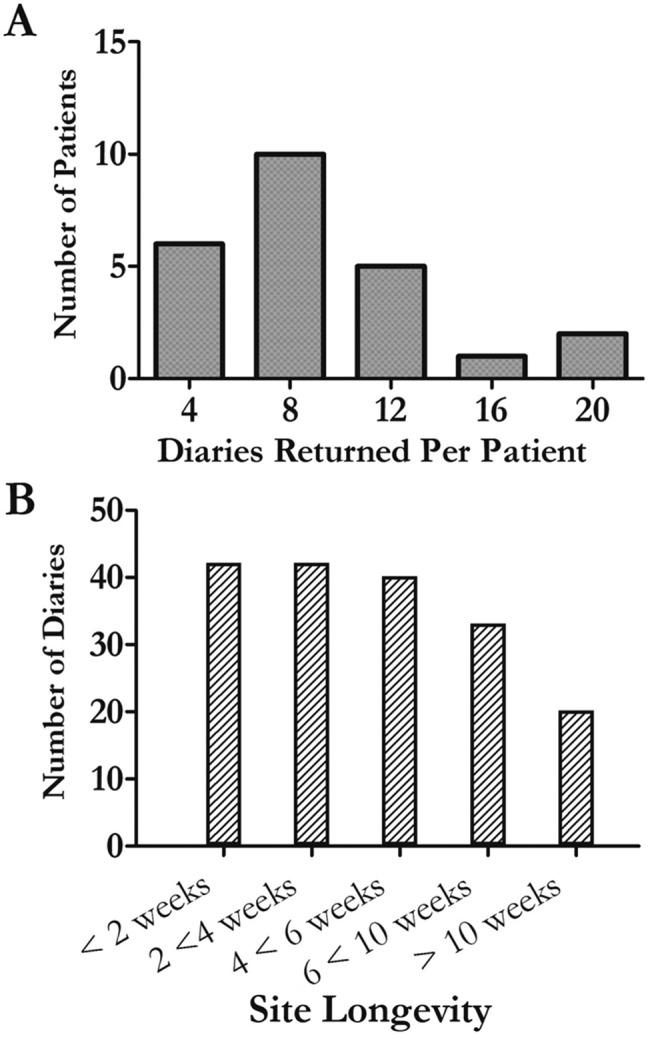
Treprostinil infusion sites can be maintained safely for months. In A, the histogram illustrates the number of diaries returned (no. site changes) per patient. In B, the histogram shows how long infusion sites remained active for the 179 site changes with firm start and end dates (by definition, the last diary returned for each patient would not have an “end date” for that infusion site). Note the large proportion of sites that lasted >4 weeks. A single patient had very little pain when she changed her infusion site, and she accounts for 12 of the diaries that lasted fewer than 14 days. Twelve patients maintained 16 infusion sites for longer than 3 months during the study period; the longest was 225 days. Unfortunately, in 28/203 site changes, the site was changed before 14 days because of bleeding or persistent and severe pain.
Figure 3
Figure 3
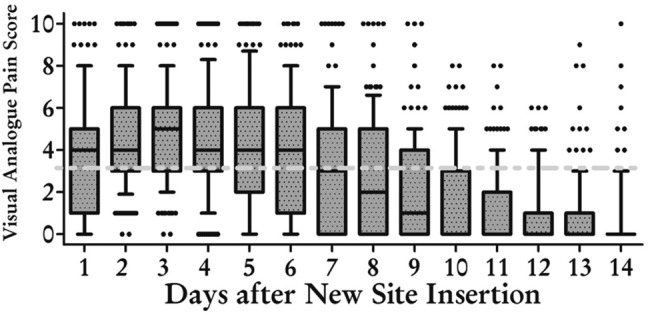
Even severe treprostinil infusion site pain was consistently short-lived. Of 203 diaries returned, 156 documented a pain score (on any day) ≥4. The graph shows the maximal pain rating for each day as a Tukey box-whiskers plot, with the box denoting the middle 50% of the data points and whiskers marking the 10th and 90th percentiles. Outliers are noted by filled circles. Note that most subjects had little if any pain (≤3, indicated at the dashed line) after day 7. For 28 of these 156 diaries, subjects recorded intense pain (sometimes associated with bleeding) and then started a new site within 14 days.
Figure 4
Figure 4
Treprostinil dose does not correlate with infusion site pain. A, We attempted to correlate the treprostinil dose with infusion site pain. We tested the hypothesis that dose might be related either to the total pain experience during a site change (area under the curve, the sum of all pain scores during the 14-day diary) or to the maximum intensity of site pain on any given day. There was clearly no correlation visually, and this was confirmed with a linear regression analysis (formula image, formula image for dose vs. total pain; formula image, formula image for maximum-intensity pain). B, A similar analysis for the volume of infusion and the pain was also negative. However, in the case of volume, there may have been a very loose relationship, and the statistical analyses left open this possibility (formula image, formula image for volume vs. total pain; formula image, formula image for maximum-intensity pain).
Figure 5
Figure 5
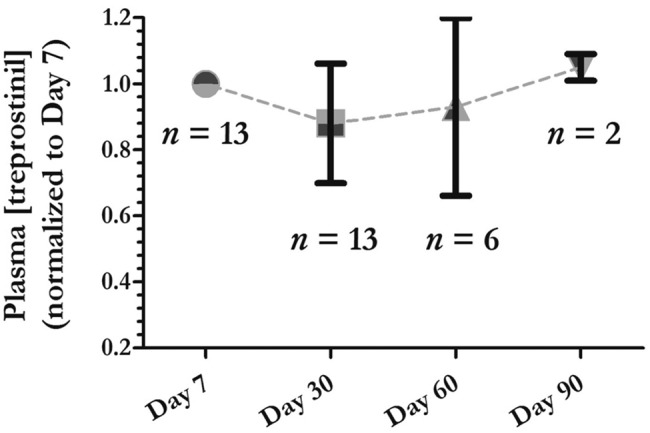
Plasma treprostinil levels were stable with prolonged infusion sites. We measured plasma treprostinil levels by liquid chromatography–tandem mass spectrometry methodology as previously described in a cohort of 6 patients proximal to the medical center for whom frequent blood draws were not a burden. For approximately 6 months, these patients had blood drawn at day 7 following the placement of a new site. Six different patients maintained 13 sites for 30 days and had blood drawn on days 7 and 30; 5 patients maintained 7 of those sites for 60 days and had blood redrawn. Two of those patients maintained 1 site each for 90 days, with a final blood draw on day 90. The data are represented as a normalized value compared to the baseline value on day 7; by definition, the plasma level was 1 on day 7, and the subsequent values are normalized to day 7 (mean ± SD, except for day 90, on which we had only 2 samples). In 5 of the 12 sets of data in which the dose was not increased during follow-up, the plasma treprostinil levels were higher at day 30, 60, or 90 than they were at day 7. The plots illustrate mean ± SD; formula image at day 7, formula image at day 30, formula image at day 60, formula image at day 90. The raw data with actual treprostinil levels and doses (range, 47–170 ng/kg/min) are provided in Table 2.
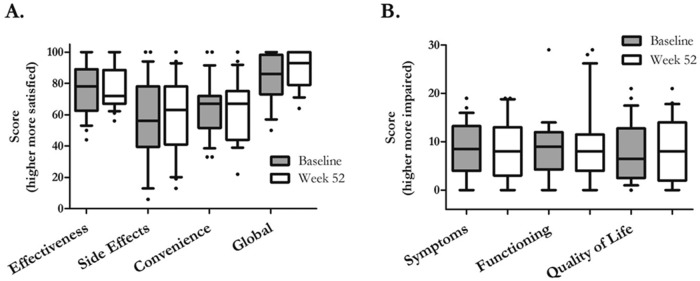
Figure 6
Figure 6
Treatment satisfaction and quality of life. Treatment satisfaction was measured at the beginning and end of the 52-week study using the Treatment Satisfaction Questionnaire for Medicine (TSQM) and quality of life by the Cambridge Pulmonary Hypertension Outcome Review (CAMPHOR). In A, patients scored subcutaneous treprostinil well for efficacy but less so for side effects and convenience. Interestingly, the global rating reflected efficacy more than side effects. In B, patients scored themselves reasonably well with regard to symptoms, physical functioning, and quality of life. There did not appear to be changes in either treatment satisfaction or quality-of-life dimensions during the 12-month period. formula image at baseline; formula image at week 52.
Figure 7
Figure 7
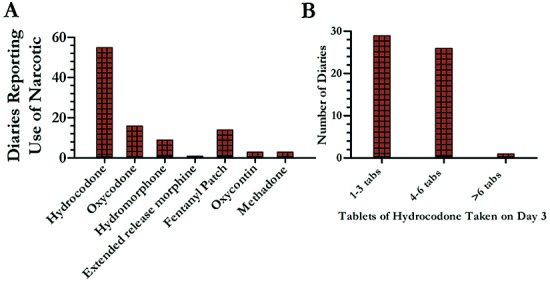
Narcotics use to control infusion site pain was modest. We asked patients to record the number of doses of any narcotic taken specifically for subcutaneous treprostinil infusion site pain; 16 subjects reported narcotics use in 103/203 diaries (conversely, 100 diaries did not document any narcotics use despite having access to a narcotics prescription). In A, the number of patients using any narcotic on day 3 (the day of worst pain as illustrated in Fig. 3) is shown. We routinely prescribe hydrocodone/acetaminophen 5 mg/500 mg, and thus, that is the drug whose use is most commonly documented. We further analyzed the number of hydrocodone tablets taken on day 3 (B). Most patients took 3 tablets or less on the day that was, on average, the most painful. The rigorous analysis described in the text shows that subjects recorded significantly more pain in the diaries for which they also recorded narcotics use.

References

    1. Kawut SM, Horn EM, Berekashvili KK, et al. New predictors of outcome in idiopathic pulmonary arterial hypertension. Am J Cardiol 2005;95:199–203. - PubMed
    1. Benza RL, Miller DP, Gomberg-Maitland M, et al. Predicting survival in pulmonary arterial hypertension: insights from the Registry to Evaluate Early and Long-Term Pulmonary Arterial Hypertension Disease Management (REVEAL). Circulation 2010;122:164–172. - PubMed
    1. Humbert M, Sitbon O, Yaici A, et al. Survival in incident and prevalent cohorts of patients with pulmonary arterial hypertension. Eur Respir J 2010;36:549–555. - PubMed
    1. Humbert M, Sitbon O, Chaouat A, et al. Survival in patients with idiopathic, familial, and anorexigen-associated pulmonary arterial hypertension in the modern management era. Circulation 2010;122:156–163. - PubMed
    1. Rubin LJ, Mendoza J, Hood M, et al. Treatment of primary pulmonary hypertension with continuous intravenous prostacyclin (epoprostenol): results of a randomized trial. Ann Int Med 1990;112:485–491. - PubMed

LinkOut - more resources