


The clinical utility of genetic testing in breast cancer kindreds: a prospective study in families without a demonstrable BRCA mutation
- PMID: 24619173
- PMCID: PMC3962741
- DOI: 10.1007/s10549-014-2902-1
The clinical utility of genetic testing in breast cancer kindreds: a prospective study in families without a demonstrable BRCA mutation
Abstract
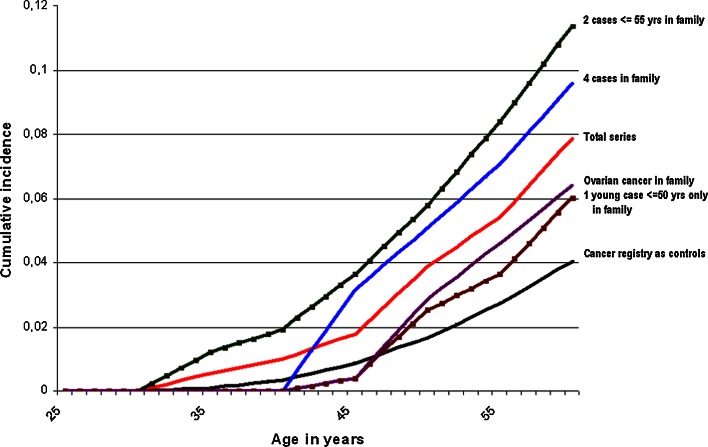
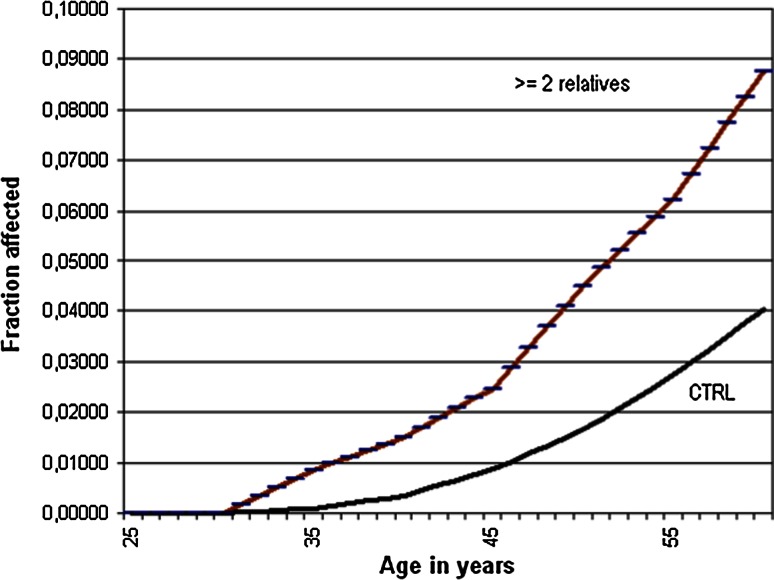
We report prospectively observed risk for breast cancer in breast cancer kindreds without a demonstrable BRCA1/2 mutation. According to family history, the optimal available member(s) of each breast cancer kindred attending our clinic was tested for BRCA mutations. Women in families without a demonstrable BRCA mutation were subjected to annual mammography. BRCA mutations were demonstrated in 496/2,118 (23 %) breast cancer kindreds. In families without a demonstrable BRCA mutation, a total of 3,161 healthy women aged 25-59 years were prospectively followed for 24,808 observation years. Sixty-four cancers were observed, compared to 34.0 expected (p < 0.01), arriving at a 7.9 % cumulative risk at age 60 compared to 4.0 % in the population [relative risk (RR) = 2.0]. Women with one mother or sister affected ≤50 years and with no other close relatives with breast cancer did not have increased risk (0 cancers observed and 0.6 expected at age 40, 11 cancers observed and 7.9 expected at age 60, p > 0.05). Excluding these, cumulative risk at 60 years was 8.8 % (RR = 2.2). The highest cumulative risk at 60 years was 11.4 %, found in families with two cases ≤55 years (RR = 2.8). In breast cancer kindreds without a demonstrable BRCA mutation, the risk for breast cancer in female first degree relatives was about twice the risk in the general population. Women with one early affected relative only did not have increased risk for early onset breast cancer, while those with more than one young affected relative had close to three times population risk.
Figures
References
-
- http://www.srl.cam.ac.uk/genepi/boadicea/boadicea_intro.html. Accessed 30 June 2013
-
- Saetersdal A, Dørum A, Heimdal K, et al. Inherited predisposition to breast carcinoma. Results of first round examination of 537 women at risk. Anticancer Res. 1996;16(4A):1989–1992. - PubMed
MeSH terms
LinkOut - more resources
Full Text Sources
Other Literature Sources
Medical
Miscellaneous
