


Sex and boldness explain individual differences in spatial learning in a lizard
- PMID: 24619443
- PMCID: PMC3973267
- DOI: 10.1098/rspb.2013.3275
Sex and boldness explain individual differences in spatial learning in a lizard
Abstract
Understanding individual differences in cognitive performance is a major challenge to animal behaviour and cognition studies. We used the Eastern water skink (Eulamprus quoyii) to examine associations between exploration, boldness and individual variability in spatial learning, a dimension of lizard cognition with important bearing on fitness. We show that males perform better than females in a biologically relevant spatial learning task. This is the first evidence for sex differences in learning in a reptile, and we argue that it is probably owing to sex-specific selective pressures that may be widespread in lizards. Across the sexes, we found a clear association between boldness after a simulated predatory attack and the probability of learning the spatial task. In contrast to previous studies, we found a nonlinear association between boldness and learning: both 'bold' and 'shy' behavioural types were more successful learners than intermediate males. Our results do not fit with recent predictions suggesting that individual differences in learning may be linked with behavioural types via high-low-risk/reward trade-offs. We suggest the possibility that differences in spatial cognitive performance may arise in lizards as a consequence of the distinct environmental variability and complexity experienced by individuals as a result of their sex and social tactics.
Keywords: alternative reproductive strategies; behavioural syndromes; cognition; lizards; social specialization; spatial learning.
Figures
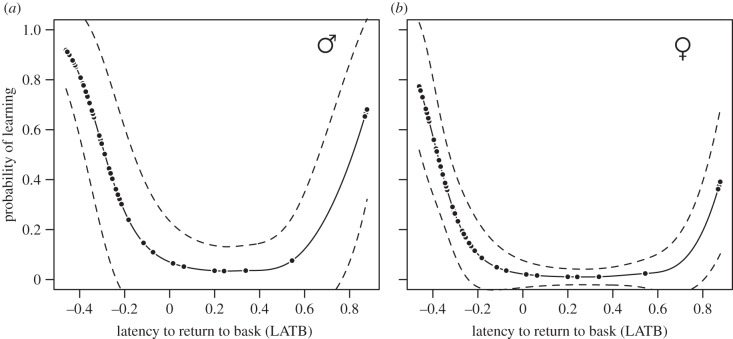
 We used our standardized input LATB variable to predict probabilities and fit a smoothed cubic spline function to the data. Dashed lines above and below fitted lines are the 95% CIs (predicted (p) ± 1.96 × s.e. of fit and smoothed with a cubic spline).
References
-
- Healy SD, Bacon IE, Haggis O, Harris AP, Kelley LA. 2008. Explanations for variation in cognitive ability: behavioural ecology meets comparative cognition. Behav. Process. 80, 288–294 (doi:10.1016/j.beproc.2008.10.002) - DOI - PubMed
-
- Raine NE, Chittka L. 2008. The correlation of learning speed and natural foraging success in bumble-bees. Proc. R. Soc. B 275, 803–808 (doi:10.1098/rspb.2007.1652) - DOI - PMC - PubMed
-
- Shettleworth S. 2010. Cognition, evolution and behavior. New York, NY: Oxford University Press
-
- Sih A, Del Guidice M. 2012. Linking behavioural syndromes and cognition: a behavioural ecology perspective. Phil. Trans. R. Soc. B 367, 2762–2772 (doi:10.1098/rstb.2012.0216) - DOI - PMC - PubMed
-
- Thornton A, Lukas D. 2012. Individual variation in cognitive performance: developmental and evolutionary perspectives. Phil. Trans. R. Soc. B 367, 2773–2783 (doi:10.1098/rstb.2012.0214) - DOI - PMC - PubMed
Publication types
MeSH terms
LinkOut - more resources
Full Text Sources
Other Literature Sources
