


Productivity costs in patients with refractory chronic rhinosinusitis
- PMID: 24619604
- PMCID: PMC4125547
- DOI: 10.1002/lary.24630
Productivity costs in patients with refractory chronic rhinosinusitis
Abstract
Objectives/hypothesis: Disease-specific reductions in patient productivity can lead to substantial economic losses to society. The purpose of this study was to: 1) define the annual productivity cost for a patient with refractory chronic rhinosinusitis (CRS) and 2) evaluate the relationship between degree of productivity cost and CRS-specific characteristics.
Study design: Prospective, multi-institutional, observational cohort study.
Methods: The human capital approach was used to define productivity costs. Annual absenteeism, presenteeism, and lost leisure time was quantified to define annual lost productive time (LPT). LPT was monetized using the annual daily wage rates obtained from the 2012 U.S. National Census and the 2013 U.S. Department of Labor statistics.
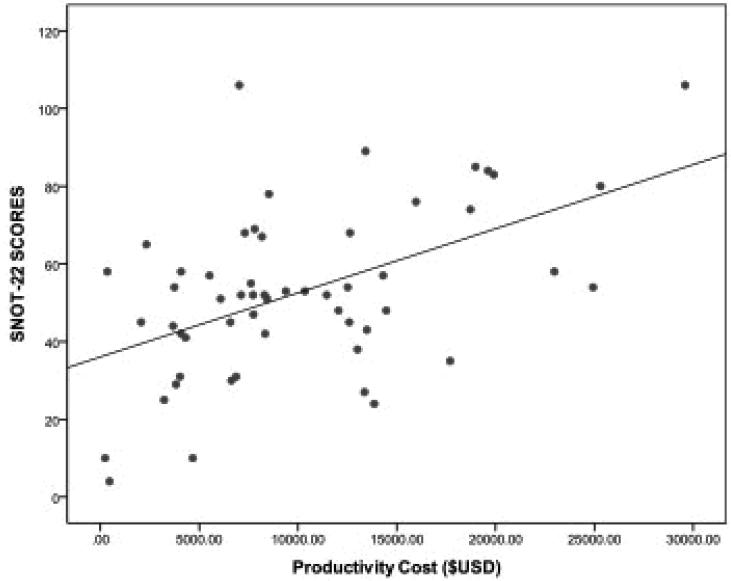
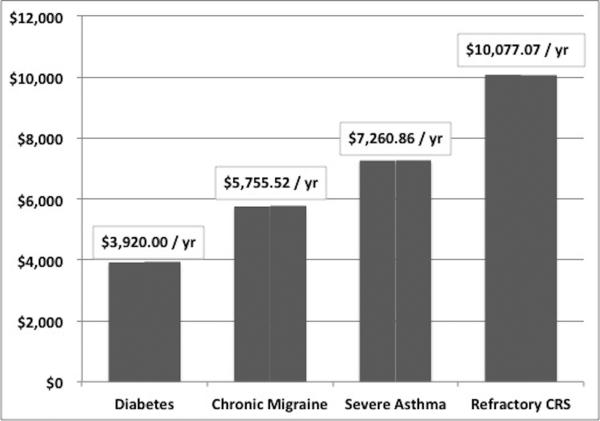
Results: A total of 55 patients with refractory CRS were enrolled. The mean work days lost related to absenteeism and presenteeism were 24.6 and 38.8 days per year, respectively. A total of 21.2 household days were lost per year related to daily sinus care requirements. The overall annual productivity cost was $10,077.07 per patient with refractory CRS. Productivity costs increased with worsening disease-specific QoL (r = 0.440; p = 0.001).
Conclusion: Results from this study have demonstrated that the annual productivity cost associated with refractory CRS is $10,077.07 per patient. This substantial cost to society provides a strong incentive to optimize current treatment protocols and continue evaluating novel clinical interventions to reduce this cost.
Keywords: Chronic rhinosinusitis; absenteeism; cost; economic; indirect cost; presenteeism; productivity; sinusitis.
© 2014 The American Laryngological, Rhinological and Otological Society, Inc.
Figures
References
-
- Cisternas MG, Blanc PD, Yen IH, et al. A comprehensive study of the direct and indirect costs of adult asthma. The Journal of allergy and clinical immunology. 2003;111:1212–8. - PubMed
-
- Serrano D, Manack AN, Reed ML, Buse DC, Varon SF, Lipton RB. Cost and predictors of lost productive time in chronic migraine and episodic migraine: results from the American Migraine Prevalence and Prevention (AMPP) Study. Value in health : the journal of the International Society for Pharmacoeconomics and Outcomes Research. 2013;16:31–8. - PubMed
-
- Munakata J, Hazard E, Serrano D, et al. Economic burden of transformed migraine: results from the American Migraine Prevalence and Prevention (AMPP) Study. Headache. 2009;49:498–508. - PubMed
-
- Rudmik L, Smith TL. Quality of life in patients with chronic rhinosinusitis. Current allergy and asthma reports. 2011;11:247–52. - PubMed
Publication types
MeSH terms
Grants and funding
LinkOut - more resources
Full Text Sources
Other Literature Sources
Medical
