


Prevalence of MERS-CoV nasal carriage and compliance with the Saudi health recommendations among pilgrims attending the 2013 Hajj
- PMID: 24620019
- PMCID: PMC7107361
- DOI: 10.1093/infdis/jiu150
Prevalence of MERS-CoV nasal carriage and compliance with the Saudi health recommendations among pilgrims attending the 2013 Hajj
Abstract
Background: Annually, Saudi Arabia is the host of the Hajj mass gathering. We aimed to determine the Middle East respiratory syndrome coronavirus (MERS-CoV) nasal carriage rate among pilgrims performing the 2013 Hajj and to describe the compliance with the Saudi Ministry of Health vaccine recommendations.
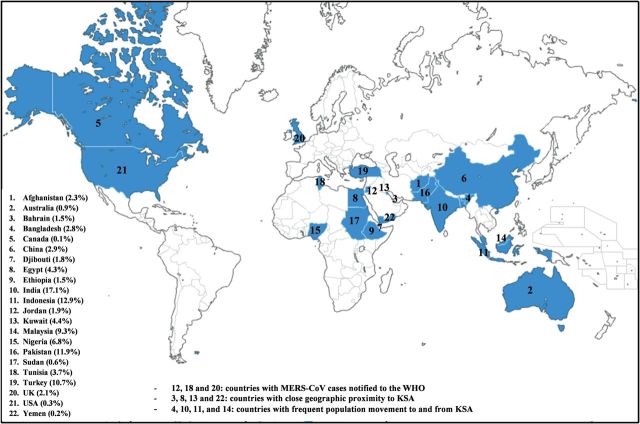
Method: Nasopharyngeal samples were collected from 5235 adult pilgrims from 22 countries and screened for MERS-CoV using reverse transcriptase-polymerase chain reaction. Information regarding the participants' age, gender, country of origin, medical conditions, and vaccination history were obtained.
Results: The mean age of the screened population was 51.8 years (range, 18-93 years) with a male/female ratio of 1.17:1. MERS-CoV was not detected in any of the samples tested (3210 pre-Hajj and 2025 post-Hajj screening). According to the vaccination documents, all participants had received meningococcal vaccination and the majority of those from at-risk countries were vaccinated against yellow fever and polio. Only 22% of the pilgrims (17.5% of those ≥65 years and 36.3% of diabetics) had flu vaccination, and 4.4% had pneumococcal vaccination.
Conclusion: There was no evidence of MERS-CoV nasal carriage among Hajj pilgrims. While rates of compulsory vaccinations uptake were high, uptake of pneumococcal and flu seasonal vaccinations were low, including among the high-risk population.
Keywords: Hajj pilgrimage; MERS-CoV; nasal carriage; screening; vaccination.
© The Author 2014. Published by Oxford University Press on behalf of the Infectious Diseases Society of America. All rights reserved. For Permissions, please e-mail: journals.permissions@oup.com.
Figures
Comment in
-
Is aerosol-based transmission of Middle East respiratory syndrome coronavirus possible?J Infect Dis. 2014 Nov 15;210(10):1680-1. doi: 10.1093/infdis/jiu301. Epub 2014 May 23. J Infect Dis. 2014. PMID: 24857845 Free PMC article. No abstract available.
-
Reply to Karagoz et al.J Infect Dis. 2014 Nov 15;210(10):1681-2. doi: 10.1093/infdis/jiu302. Epub 2014 May 23. J Infect Dis. 2014. PMID: 24857846 Free PMC article. No abstract available.
References
-
- Zaki AM, van Boheemen S, Bestebroer TM, Osterhaus AD, Fouchier RA. Isolation of a novel coronavirus from a man with pneumonia in Saudi Arabia. N Engl J Med. 2012;367:1814–20. - PubMed
-
- WHO. Middle East respiratory syndrome coronavirus (MERS-CoV)–update. 2014. http://www.who.int/csr/don/2014_01_27mers/en/index.html. Accessed 2 February 2014.
Publication types
MeSH terms
LinkOut - more resources
Full Text Sources
Other Literature Sources
