


Intermittent hemodialysis is superior to continuous veno-venous hemodialysis/hemodiafiltration to eliminate methanol and formate during treatment for methanol poisoning
- PMID: 24621917
- PMCID: PMC4080337
- DOI: 10.1038/ki.2014.60
Intermittent hemodialysis is superior to continuous veno-venous hemodialysis/hemodiafiltration to eliminate methanol and formate during treatment for methanol poisoning
Abstract
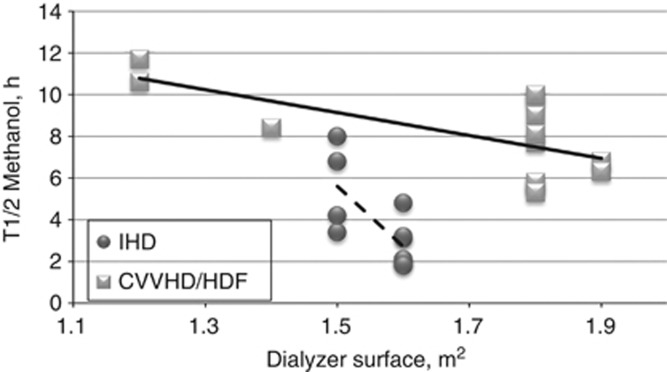
During an outbreak of methanol poisonings in the Czech Republic in 2012, we were able to study methanol and formate elimination half-lives during intermittent hemodialysis (IHD) and continuous veno-venous hemodialysis/hemodiafiltration (CVVHD/HDF) and the relative impact of dialysate and blood flow rates on elimination. Data were obtained from 11 IHD and 13 CVVHD/HDF patients. Serum methanol and formate concentrations were measured by gas chromatography and an enzymatic method. The groups were relatively comparable, but the CVVHD/HDF group was significantly more acidotic (mean pH 6.9 vs. 7.1 IHD). The mean elimination half-life of methanol was 3.7 and formate 1.6 h with IHD, versus 8.1 and 3.6 h, respectively, with CVVHD/HDF (both significant). The 54% greater reduction in methanol and 56% reduction in formate elimination half-life during IHD resulted from the higher blood and dialysate flow rates. Increased blood and dialysate flow on the CVVHD/HDF also increased elimination significantly. Thus, IHD is superior to CVVHD/HDF for more rapid methanol and formate elimination, and if CVVHD/HDF is the only treatment available then elimination is greater with greater blood and dialysate flow rates.
Figures


References
-
- Liesivuori J, Savolainen H. Methanol and formic-acid toxicity - biochemical-mechanisms. Pharmacol Toxicol. 1991;69:157–163. - PubMed
-
- Hovda KE, Hunderi OH, Rudberg N, et al. Anion and osmolal gaps in the diagnosis of methanol poisoning: clinical study in 28 patients. Intensive Care Med. 2004;30:1842–1846. - PubMed
-
- McMartin KE, Ambre JJ, Tephly TR. Methanol poisoning in human-subjects - role for formic-acid accumulation in the metabolic-acidosis. Am J Med. 1980;68:414–418. - PubMed
-
- Hovda KE, Andersson KS, Urdal P, et al. Methanol and formate kinetics during treatment with fomepizole. Clin Toxicol. 2005;43:221–227. - PubMed
-
- Jacobsen D, McMartin KE. Methanol and ethylene glycol poisonings. Mechanism of toxicity, clinical course, diagnosis and treatment. Med Toxicol. 1986;1:309–334. - PubMed
Publication types
MeSH terms
Substances
LinkOut - more resources
Full Text Sources
Other Literature Sources
