


CCNA2 is a prognostic biomarker for ER+ breast cancer and tamoxifen resistance
- PMID: 24622579
- PMCID: PMC3951414
- DOI: 10.1371/journal.pone.0091771
CCNA2 is a prognostic biomarker for ER+ breast cancer and tamoxifen resistance
Abstract
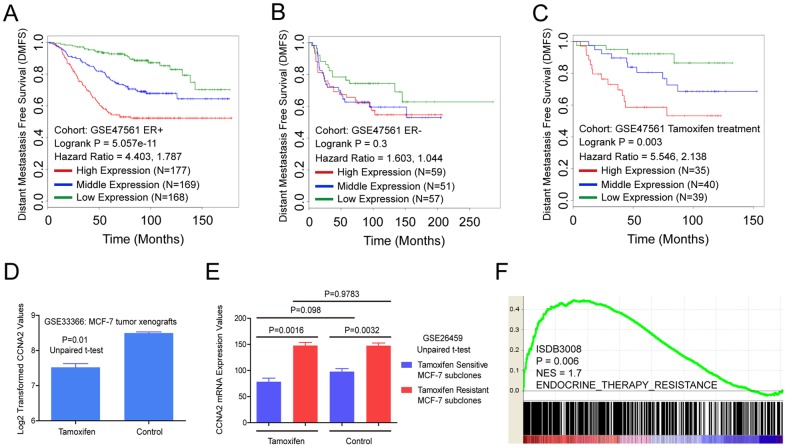
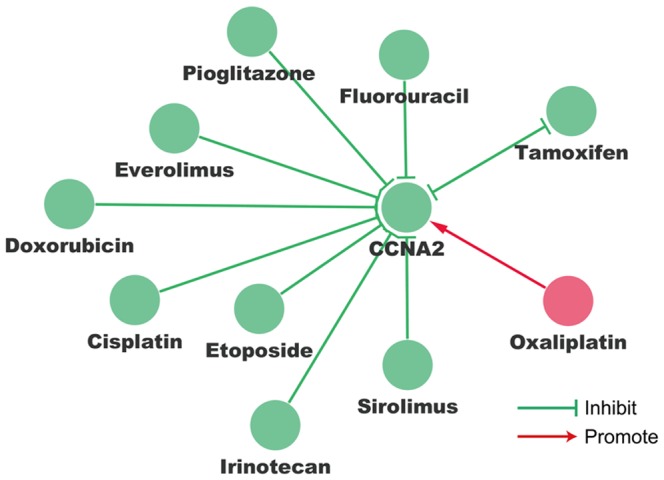
Identification of effective prognostic biomarkers and targets are of crucial importance to the management of estrogen receptor positive (ER+) breast cancer. CCNA2 (also known as CyclinA2) belongs to the highly conserved cyclin family and is significantly overexpressed in various cancer types. In this study, we demonstrated that CCNA2 had significant predictive power in distant metastasis free survival, disease free survival, recurrence free survival and overall survival of ER+ breast cancer patients. We also found that CCNA2 was closely associated with tamoxifen resistance. In addition, gene set enrichment analysis (GSEA) revealed that its expression was positively associated with genes overexpressed in endocrine therapy resistant samples. Finally, though CCNA2-Drug interaction network, we demonstrated the interactions between CCNA2 and several available cancer drugs. Overall, we suggest that CCNA2 is a biomarker for the prognosis of ER+ breast cancer and monitoring of tamoxifen efficacy. It's also a promising target for developing new strategies to prevent or even reverse tamoxifen resistance. Moreover, CCNA2 expression may help monitoring tamoxifen efficacy and directing personalized therapies. Nevertheless, in vivo and in vitro experiments and multi-center randomized controlled clinical trials are still needed before its application in clinical settings.
Conflict of interest statement
Figures
References
-
- Ferlay J, Shin HR, Bray F, Forman D, Mathers C, et al. (2010) Estimates of worldwide burden of cancer in 2008: GLOBOCAN 2008. Int J Cancer 127: 2893–2917. - PubMed
-
- Vendrell JA, Ghayad S, Ben-Larbi S, Dumontet C, Mechti N, et al.. (2007) A20/TNFAIP3, a new estrogen-regulated gene that confers tamoxifen resistance in breast cancer cells. Oncogene 26: 4656–4667. Epub 2007 Feb 4612. - PubMed
-
- Brenner H (2002) Long-term survival rates of cancer patients achieved by the end of the 20th century: a period analysis. Lancet 360: 1131–1135. - PubMed
-
- Goldhirsch A, Glick JH, Gelber RD, Coates AS, Senn HJ (2001) Meeting highlights: International Consensus Panel on the Treatment of Primary Breast Cancer. Seventh International Conference on Adjuvant Therapy of Primary Breast Cancer. J Clin Oncol 19: 3817–3827. - PubMed
-
- National Institutes of Health Consensus Development Panel (2001) National Institutes of Health Consensus Development Conference Statement: adjuvant therapy for breast cancer, November 1–3, 2000. J Natl Cancer Inst 93: 979–989. - PubMed
MeSH terms
Substances
LinkOut - more resources
Full Text Sources
Other Literature Sources
Medical
