Lung transplantation: a treatment option in end-stage lung disease
- PMID: 24622680
- PMCID: PMC3957052
- DOI: 10.3238/arztebl.2014.0107
Lung transplantation: a treatment option in end-stage lung disease
Abstract
Background: Lung transplantation is the final treatment option in the end stage of certain lung diseases, once all possible conservative treatments have been exhausted. Depending on the indication for which lung transplantation is performed, it can improve the patient's quality of life (e.g., in emphysema) and/ or prolong life expectancy (e.g., in cystic fibrosis, pulmonary fibrosis, and pulmonary arterial hypertension). The main selection criteria for transplant candidates, aside from the underlying pulmonary or cardiopulmonary disease, are age, degree of mobility, nutritional and muscular condition, and concurrent extrapulmonary disease. The pool of willing organ donors is shrinking, and every sixth candidate for lung transplantation now dies while on the waiting list.
Method: We reviewed pertinent articles (up to October 2013) retrieved by a selective search in Medline and other German and international databases, including those of the International Society for Heart and Lung Transplantation (ISHLT), Eurotransplant, the German Institute for Applied Quality Promotion and Research in Health-Care (Institut für angewandte Qualitätsförderung und Forschung im Gesundheitswesen, AQUA-Institut), and the German Foundation for Organ Transplantation (Deutsche Stiftung Organtransplantation, DSO).
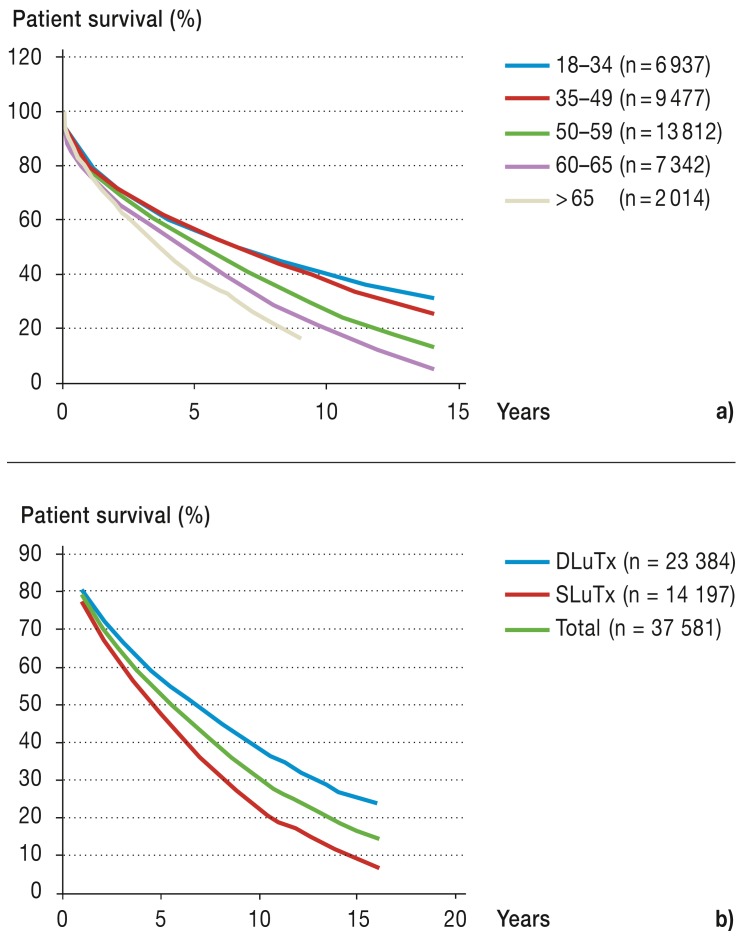
Results: The short- and long-term results have markedly improved in recent years: the 1-year survival rate has risen from 70.9% to 82.9%, and the 5-year survival rate from 46.9% to 59.6%. The 90-day mortality is 10.0%. The postoperative complications include acute (3.4%) and chronic (29.0%) transplant rejection, infections (38.0%), transplant failure (24.7%), airway complications (15.0%), malignant tumors (15.0%), cardiovascular events (10.9%), and other secondary extrapulmonary diseases (29.8%). Bilateral lung transplantation is superior to unilateral transplantation (5-year survival rate 57.3% versus 47.4%).
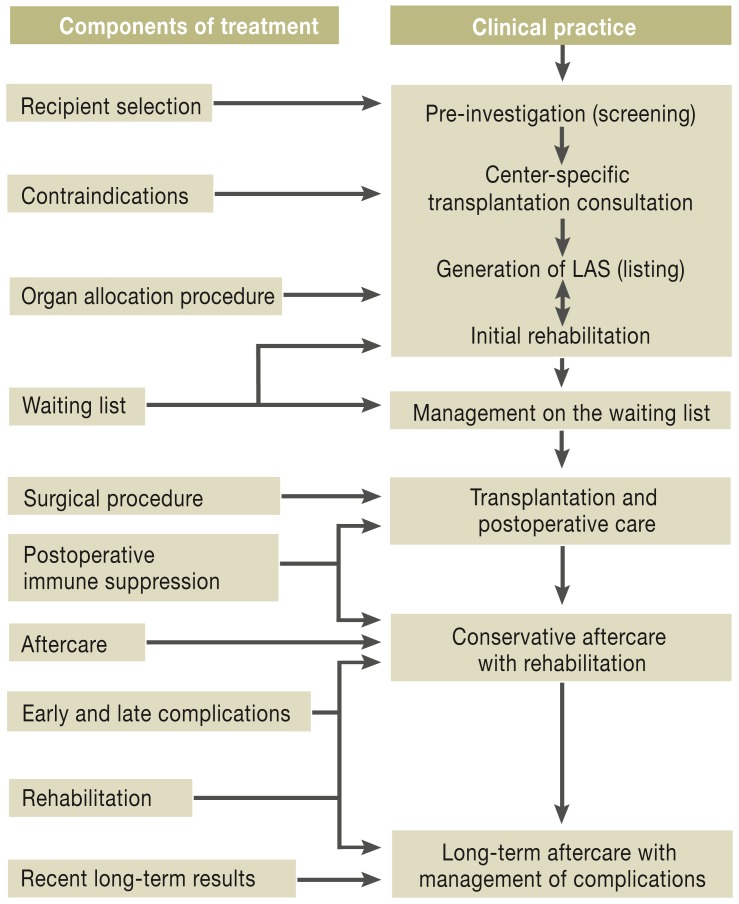
Conclusion: Seamless integration of the various components of treatment will be essential for further improvements in outcome. In particular, the follow-up care of transplant recipients should always be provided in close cooperation with the transplant center.
Figures
References
-
- Kugler C, Gottlieb J, Warnecke G, et al. Health-related quality of life after solid organ transplantation: A prospective, multiorgan cohort study. Transplantation. 2013;96:316–323. - PubMed
-
- Cooper JD, Pearson FG, Patterson GA, et al. Technique of successful lung transplantation in humans. J Thorac Cardiovasc Surg. 1987;93:173–181. - PubMed
-
- Patterson GA, Cooper JD, Goldman B, et al. Technique of successful clinical double-lung transplantation. Ann Thorac Surg. 1988;45:626–633. - PubMed
-
- Puri V, Patterson GA. Adult lung transplantation: technical considerations. Semin Thorac Cardiovasc Surg. 2008;20:152–164. - PubMed
Publication types
MeSH terms
LinkOut - more resources
Full Text Sources
Other Literature Sources
Medical