


Review
doi: 10.1128/JVI.03370-13.
Epub 2014 Mar 12.
Mechanisms of RIG-I-like receptor activation and manipulation by viral pathogens
Affiliations
- PMID: 24623415
- PMCID: PMC4019093
- DOI: 10.1128/JVI.03370-13
Item in Clipboard
Review
Mechanisms of RIG-I-like receptor activation and manipulation by viral pathogens
J Virol.
2014 May.
Abstract
RIG-I-like receptors (RLRs) play important roles in the host defense to numerous viral pathogens. Since they were discovered, much light has been shed on the molecular details of how these cytoplasmic viral RNA receptors sense viral infection and orchestrate antiviral innate immunity. Intriguingly, in addition to viral RNA binding, a series of posttranslational modifications (PTMs) is required for the rapid activation of RLRs and, inversely, for the prevention of aberrant innate immune signaling. Recent discoveries have shown that viruses manipulate the PTMs of RLRs to escape innate immune detection. This article highlights some of these recent findings in this fast-evolving field.
Figures
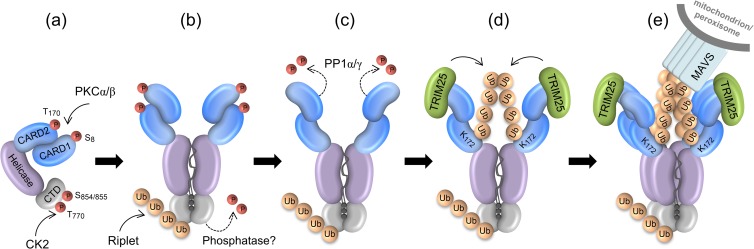
Current model of RLR regulation (depicted for RIG-I). (a) RIG-I (and MDA5) are kept inactive in uninfected cells by two mechanisms: a constitutive phosphorylation of their CARDs (Ser8 and Thr170 in RIG-I; Ser88 in MDA5) and the CTD (Thr770 and Ser854/855 in RIG-I) and a closed conformation. (b) Viral RNA binding to the CTD/helicase, together with CTD dephosphorylation and Lys63-linked ubiquitination by Riplet, induces RIG-I dimerization and a conformational change, exposing the N-terminal CARDs. (c) The exposed CARDs recruit the phosphatases PP1α/γ, which dephosphorylate Ser8 and Thr170 in RIG-I (and Ser88 in MDA5). Dephosphorylation possibly induces a structural rearrangement within the tandem CARD, which (d) allows TRIM25 to bind to CARD1 and to induce Lys63-linked ubiquitination of Lys172 in CARD2. (e) The ubiquitin-bound CARDs facilitate RIG-I oligomerization and binding to MAVS, ultimately inducing antiviral signaling. Ub, ubiquitin; P, phosphorylation.
References
-
- Weber M, Gawanbacht A, Habjan M, Rang A, Borner C, Schmidt AM, Veitinger S, Jacob R, Devignot S, Kochs G, Garcia-Sastre A, Weber F. 2013. Incoming RNA virus nucleocapsids containing a 5′-triphosphorylated genome activate RIG-I and antiviral signaling. Cell Host Microbe 13:336–346. 10.1016/j.chom.2013.01.012 - DOI - PMC - PubMed
Publication types
MeSH terms
Substances
Grants and funding
LinkOut - more resources
Full Text Sources
Other Literature Sources
Miscellaneous
