. 2014 May;13(5):1231-44.
doi: 10.1074/mcp.M113.034728. Epub 2014 Mar 12.

A novel secreted metalloprotease (CD2830) from Clostridium difficile cleaves specific proline sequences in LPXTG cell surface proteins

Affiliations

A novel secreted metalloprotease (CD2830) from Clostridium difficile cleaves specific proline sequences in LPXTG cell surface proteins

Paul J Hensbergen et al. Mol Cell Proteomics. 2014 May.

Abstract

Bacterial secreted proteins constitute a biologically important subset of proteins involved in key processes related to infection such as adhesion, colonization, and dissemination. Bacterial extracellular proteases, in particular, have attracted considerable attention, as they have been shown to be indispensable for bacterial virulence. Here, we analyzed the extracellular subproteome of Clostridium difficile and identified a hypothetical protein, CD2830, as a novel secreted metalloprotease. Following the identification of a CD2830 cleavage site in human HSP90β, a series of synthetic peptide substrates was used to identify the favorable CD2830 cleavage motif. This motif was characterized by a high prevalence of proline residues. Intriguingly, CD2830 has a preference for cleaving Pro-Pro bonds, unique among all hitherto described proteases. Strikingly, within the C. difficile proteome two putative adhesion molecules, CD2831 and CD3246, were identified that contain multiple CD2830 cleavage sites (13 in total). We subsequently found that CD2830 efficiently cleaves CD2831 between two prolines at all predicted cleavage sites. Moreover, native CD2830, secreted by live cells, cleaves endogenous CD2831 and CD3246. These findings highlight CD2830 as a highly specific endoproteinase with a preference for proline residues surrounding the scissile bond. Moreover, the efficient cleavage of two putative surface adhesion proteins points to a possible role of CD2830 in the regulation of C. difficile adhesion.


Figures
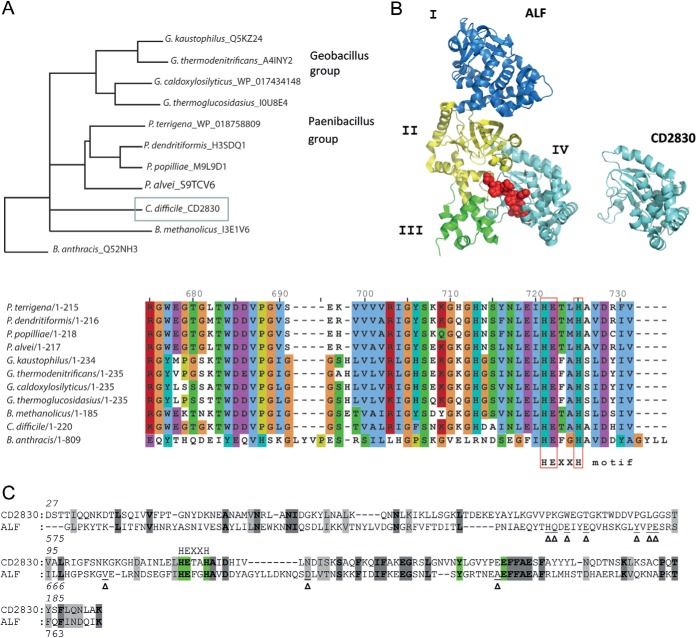
Fig. 1.
Fig. 1.
CD2830 from Clostridium difficile is a predicted metalloprotease with a fold similar to the anthrax lethal factor catalytic domain. A, neighbor-joining phylogenetic tree relating the C. difficile CD2830 protein with other closest related protein sequences. The closest related protein sequences were selected based on a CD2830 BLAST search of the database of non-redundant protein sequences, with the statistical significance (expected) threshold for reporting matches set at 1e-50. Species names are indicated, followed by UniProtKB accession numbers. The phylogenetic analysis was performed using Clustal Omega-Multiple Sequence Alignment, including Bacillus anthracis anthrax lethal factor protein. Protein alignment surrounding the conserved HExxH motif is shown in the lower panel. B, Three-dimensional stereo ribbon model of anthrax lethal factor (ALF) (left) and CD2830 predicted structure (right). ALF coloring and domain annotation are according to Pannifer et al. (19). The MAPKK target peptide is shown as a red ball-and-stick model. The ALF consists of four domains (I, II, III, and IV). The CD2830 consists of only a proteolytic domain with a fold similar to that of domain IV of ALF. C, amino acid sequence alignment of C. difficile CD2830 with ALF according to the Phyre2 protein structure prediction. Identical amino acids are shaded in dark gray, and similar residues shaded in gray. Zinc coordinating residues are highlighted in green. Arrowheads (Δ) point to ALF amino acids involved in peptide substrate recognition. The HEXXH metal binding site is indicated.
Fig. 2.
Fig. 2.
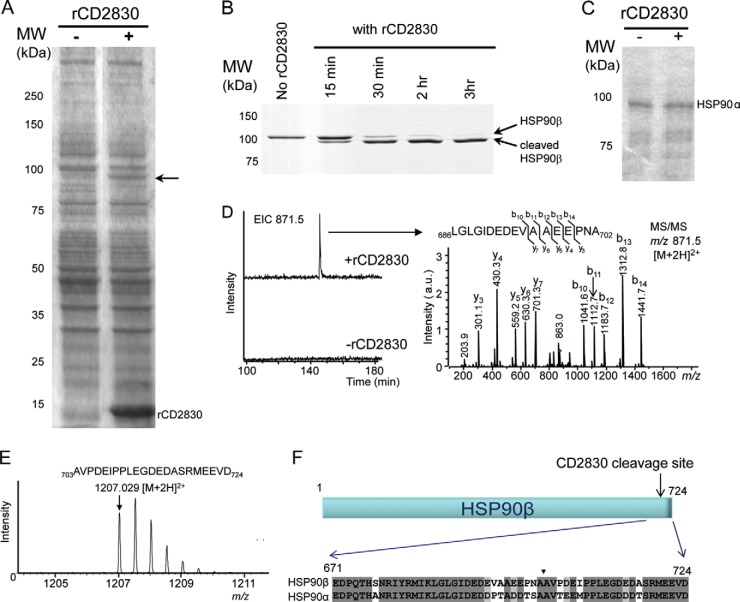
Proteolytic assays reveal that human HSP90β is a substrate of CD2830. A, Caco-2 whole cell lysates analyzed via SDS-PAGE before (−) and after (+) incubation with rCD2830. Arrow points at cleavage product. B, recombinant human HSP90β analyzed via SDS-PAGE after incubation with rCD2830 for different time periods. C, SDS-PAGE analysis of human HSP90α after 20 h of incubation with (+) or without (−) rCD2830. D, LC–ion trap MS(/MS) analysis of tryptic digests of HSP90β before and after cleavage with rCD2830. A specific semi-tryptic peptide of HSP90β was identified only in the run from the CD2830-cleaved HSP90β. MS/MS analysis of this peptide demonstrated that HSP90β was cleaved by CD2830 after Ala-702 (see F). E, Electrospray ionization Q-TOF-MS analysis of the C-terminally released HSP90β peptide after cleavage by rCD2830. F, identification of the rCD2830 cleavage site in human HSP90β and alignment of the C-terminal amino acid sequences of human HSP90β and HSP90α. Arrowhead indicates the CD2830 cleavage site between Ala-702 and Ala-703 of human HSP90β. MW, molecular weight in kilodaltons.
Fig. 3.
Fig. 3.
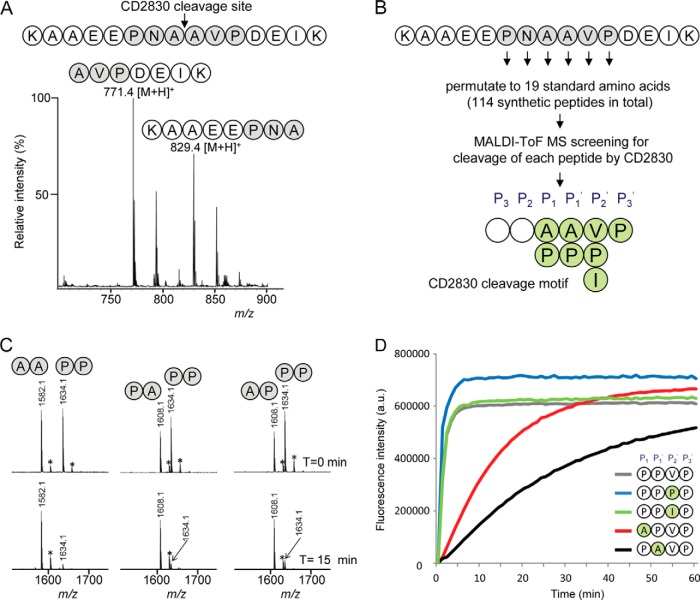
Identification of the CD2830 cleavage motif based on a peptide library screen reveals a preference for cleavage between proline residues. A, MALDI-TOF-MS spectrum of a synthetic peptide containing the HSP90β sequence AAEEPNAAVPDEI (amino acids 696–708) after 16 h of incubation with rCD2830. B, a synthetic peptide library was constructed in which all six positions surrounding the CD2830 scissile bond were permutated to the 19 standard amino acids within a core synthetic peptide (KAAEEPNAAVPDEIK), resulting in a total set of 114 peptides. Peptides were individually incubated with rCD2830, and cleavage was measured via MALDI-TOF-MS. The resulting CD2830 cleavage motif based on this peptide library screen is shown. C, binary mixtures of synthetic peptides with either a proline or an alanine at the P1 and P1′ positions in the core peptide (see above) were incubated with rCD2830 and analyzed via MALDI-TOF-MS after 15 min of incubation. After this short incubation, cleavage of the peptide containing a proline at both P1 and P1′ was more efficient than cleavage of the peptides containing one or two alanines. *+Na+. D, within a core synthetic FRET peptide (DabcylLys-EVNPPVPD-EdansGlu), permutations were introduced at the P1, P1′, and P2′ (PPV) positions. All peptides (50 μm) were incubated with rCD2830, and the formation of cleavage products was followed in time using fluorescence detection (see “Experimental Procedures” for details).
Fig. 4.
Fig. 4.
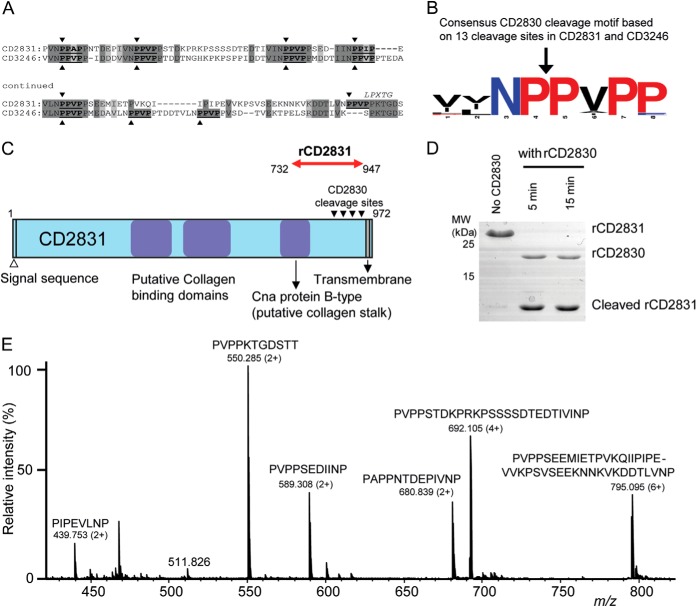
Identification of multiple CD2830 cleavage sites in putative C. difficile surface proteins. A, identification of multiple CD2830 cleavage sites (indicated by arrowheads) in the C-terminal region of the C. difficile putative adhesion proteins CD2831 and CD3246. Both putative substrates contain an LPXTG motif (PPXTG and SPXTG, respectively) and show considerable sequence similarity around the CD2830 cleavage sites. B, prevalence of amino acids around the scissile bond in the 13 CD2830 cleavage sites identified in CD2831 and CD3246. The cleavage sites were aligned using WebLogo and visualized using the following coloring: red, proline; black, nonpolar; blue, polar (not proline). C, schematic representation of C. difficile CD2831 showing the putative collagen binding domains and transmembrane domain. Recombinant CD2831 (rCD2831) protein corresponding to amino acids 732–947 (red arrow) was produced containing all the CD2830 cleavage sites. D, SDS-PAGE analysis of rCD2831 treated with rCD2830 for different time periods. E, mass spectrometric analysis (Q-TOF-MS) of the small peptide cleavage products derived from rCD2831 after incubation with rCD2830 for 30 min.
Fig. 5.
Fig. 5.
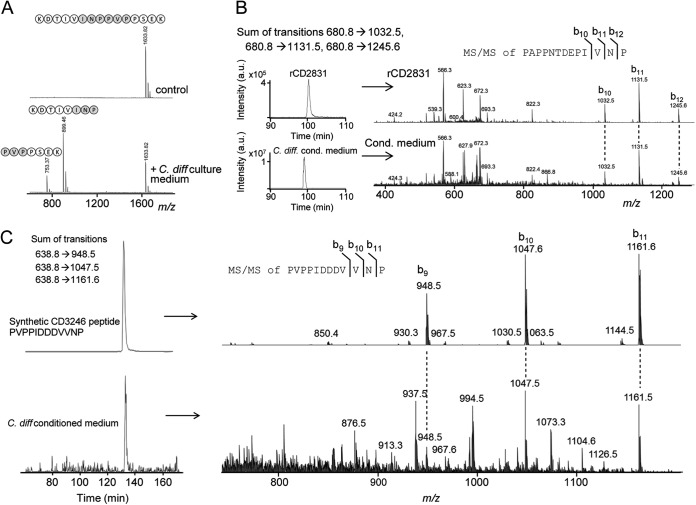
Detection of native CD2830 protease activity in the secretome of C. difficile and cleavage of endogenous CD2831 and CD3246. A, a synthetic peptide containing one of the CD2830 cleavage sites in CD2831 (KDTIVINPPVPPSEK) was incubated with the conditioned medium collected from cultures of C. difficile cells. After incubation for 16 h, samples were analyzed via MALDI-TOF-MS to determine substrate peptide cleavage. B, upper panel: LC–ion trap MS/MS analysis of recombinant CD2831 after treatment with rCD2830 demonstrating the elution profile (left) and MS/MS identification (right) of the CD2831 cleavage product PAPPNTDEPIVNP. Lower panel: LC-MS/MS analysis of C. difficile conditioned medium. Shown are the sum of the specific transitions 680.8 1032.5, 680.8 1131.5, and 680.8 1245.6 in the LC-MS/MS elution profile (left) and MS/MS identification (right), which are both equivalent to that observed with rCD2831 (upper panel), thereby unambiguously demonstrating the presence of the CD2831 cleavage product in C. difficile conditioned medium. C, upper panel: a synthetic peptide corresponding to one of the putative cleavage products of CD3246 (PVPPIDDDVVNP) was analyzed via LC–ion trap MS/MS to determine its elution time and MS/MS spectrum. Lower graph: LC-MS/MS analysis of C. difficile conditioned medium. Shown are the sum of the specific transitions 638.8 948.5, 638.8 1047.6, and 638.8 1161.6 (left) and MS/MS identification (right), which are both equivalent to that observed with the synthetic peptide (upper panel), thereby clearly demonstrating the presence of the CD3246 cleavage product in C. difficile conditioned medium.
Fig. 6.
Fig. 6.
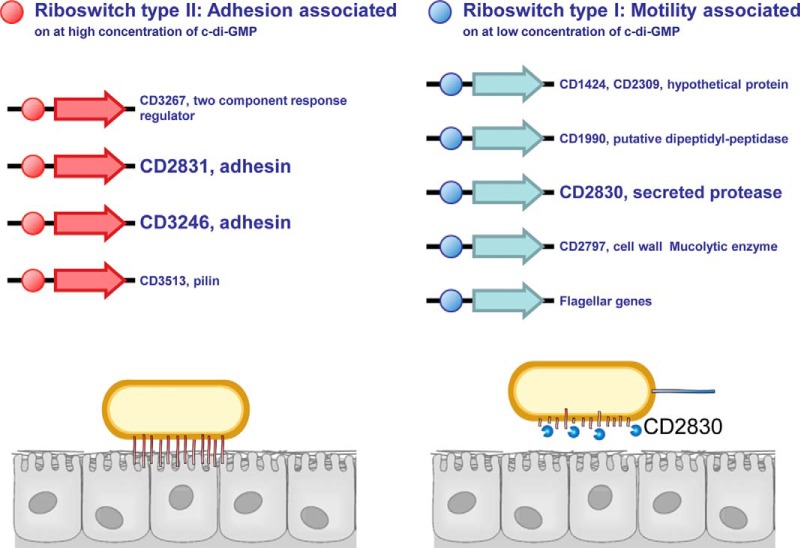
Model for the proposed role of CD2830 in regulation of adhesion versus motility in C. difficile. The C. difficile secreted protease CD2830 cleaves adhesin proteins CD2831 and CD3246, thereby releasing these cell surface anchors. Both adhesin mRNAs contain a riboswitch type II (red balls), which is turned on by elevated levels of c-di-GMP, a central mediator of motility and adhesion in bacteria (top panel). In total, four genes in the C. difficile strain 630 genome contain the type II riboswitch. The cd2830 gene contains a riboswitch type I (blue balls), which is turned on at lower levels of c-di-GMP, as was also shown for the flagellar operon. We postulate that this opposite regulation of expression of adhesins and CD2830 by c-di-GMP plays an important role in the regulation of motility and adhesion: low c-di-GMP concentrations result in the down-regulation of surface levels of adhesins both by repressing their gene expression and by the concomitant cell surface release mediated by CD2830 protease cleavage.

References

    1. Rupnik M., Wilcox M. H., Gerding D. N. (2009) Clostridium difficile infection: new developments in epidemiology and pathogenesis. Nat. Rev. Microbiol. 7, 526–536 - PubMed
    1. Muniz L. R., Knosp C., Yeretssian G. (2012) Intestinal antimicrobial peptides during homeostasis, infection, and disease. Front. Immunol. 3, 310. - PMC - PubMed
    1. Kuehne S. A., Cartman S. T., Heap J. T., Kelly M. L., Cockayne A., Minton N. P. (2010) The role of toxin A and toxin B in Clostridium difficile infection. Nature 467, 711–713 - PubMed
    1. Lyras D., O'Connor J. R., Howarth P. M., Sambol S. P., Carter G. P., Phumoonna T., Poon R., Adams V., Vedantam G., Johnson S., Gerding D. N., Rood J. I. (2009) Toxin B is essential for virulence of Clostridium difficile. Nature 458, 1176–1179 - PMC - PubMed
    1. McBride S. M., Sonenshein A. L. (2011) The dlt operon confers resistance to cationic antimicrobial peptides in Clostridium difficile. Microbiology 157, 1457–1465 - PMC - PubMed

LinkOut - more resources