. 2014:2014:195327.
doi: 10.1155/2014/195327. Epub 2014 Jan 30.

Potent anti-inflammatory and antiproliferative effects of gambogic acid in a rat model of antigen-induced arthritis

Affiliations

Potent anti-inflammatory and antiproliferative effects of gambogic acid in a rat model of antigen-induced arthritis

Rita Cascão et al. Mediators Inflamm. 2014.

Abstract

Background: We have previously reported a continuous activation of caspase-1 and increased interleukin (IL)-1β levels in early rheumatoid arthritis (RA). These observations raised the hypothesis that drugs targeting the IL-1β pathway, in addition to tumour necrosis factor (TNF), may be particularly effective for early RA treatment. We have recently identified gambogic acid as a promising therapeutic candidate to simultaneously block IL-1β and TNF secretion. Our main goal here was to investigate whether gambogic acid administration was able to attenuate inflammation in antigen-induced arthritis (AIA) rats.

Methods: Gambogic acid was administered to AIA rats in the early and late phases of arthritis. The inflammatory score, ankle perimeter, and body weight were evaluated during the period of treatment. Rats were sacrificed after 19 days of disease progression and paw samples were collected for histological and immunohistochemical evaluation.

Results: We found that inflammation in joints was significantly suppressed following gambogic acid administration. Histological and immunohistochemical evaluation of treated rats revealed normal joint structures with complete abrogation of the inflammatory infiltrate and cellular proliferation.

Conclusions: Our results suggest that gambogic acid has significant anti-inflammatory properties and can possibly constitute a prototype anti-inflammatory drug with therapeutic efficacy in the treatment of inflammatory diseases such as RA.


Figures
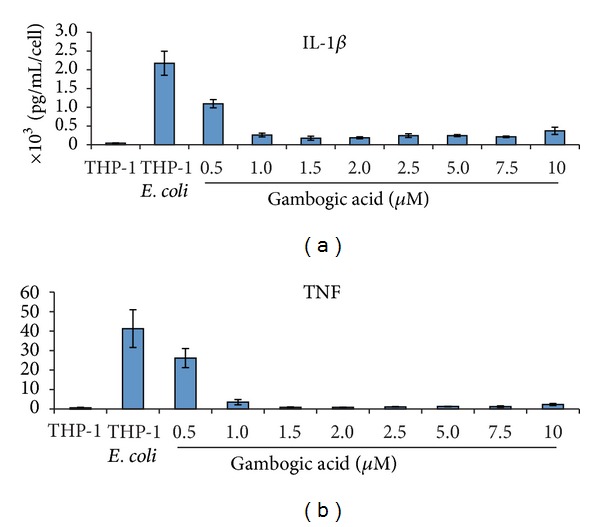
Figure 1
Figure 1
IL-1β and TNF secretion are inhibited by gambogic acid treatment. Media samples from human THP-1 macrophage-like cell line cultured with growing concentrations of gambogic acid were analyzed by ELISA technique. Differences were considered statistically significant for P values < 0.05.
Figure 2
Figure 2
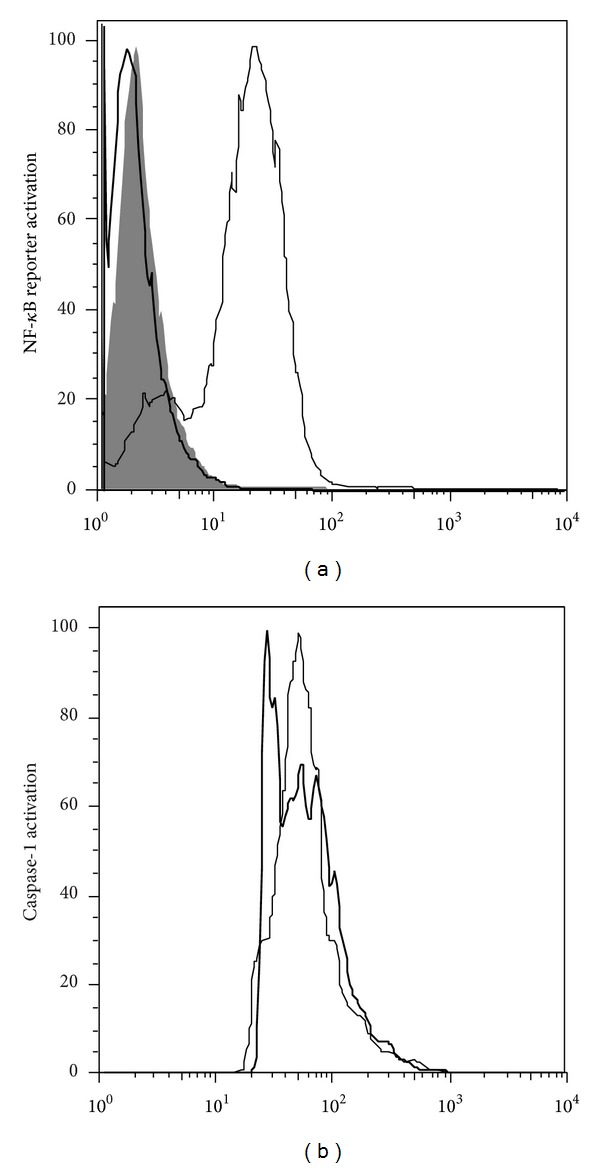
(a) NF-κB reporter activation is suppressed by gambogic acid treatment. NF-κB expression was measured by flow cytometry in a THP-1/NF-κB reporter cell line incubated with gambogic acid and then stimulated for 24 h with E. coli. Each thin line in the histogram corresponds to untreated but E. coli stimulated cells, the shaded area corresponds to drug-treated and E. coli stimulated cells, and the thick line corresponds to untreated non-stimulated cells as a control. (b) Caspase-1 activation is decreased with gambogic acid treatment. Caspase-1 activation was measured using flow cytometry in a THP-1 cell line incubated with gambogic acid and then stimulated for 8 h with E. coli. Each thin line in the histogram corresponds to untreated but E. coli stimulated cells used as control and the thick line corresponds to drug-treated and E. coli stimulated cells.
Figure 3
Figure 3
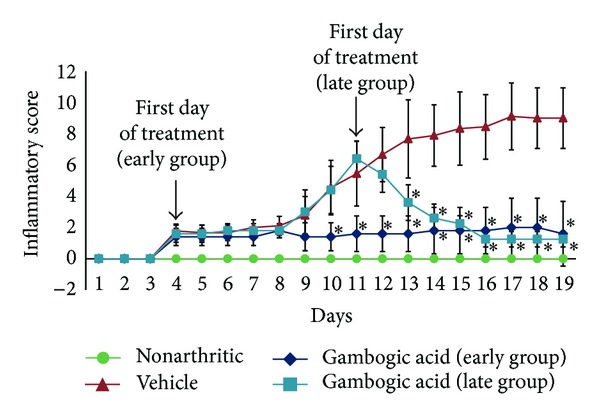
Gambogic acid is able to suppress inflammation throughout time. After 6 days of treatment, the vehicle-injected group increased inflammatory manifestations, whereas, in gambogic acid-treated rats, there was a significant reduction in the inflammatory activity. Arrows indicate the beginning of treatment after 4 and 11 days of disease induction. Differences were considered statistically significant for P values < 0.05.
Figure 4
Figure 4
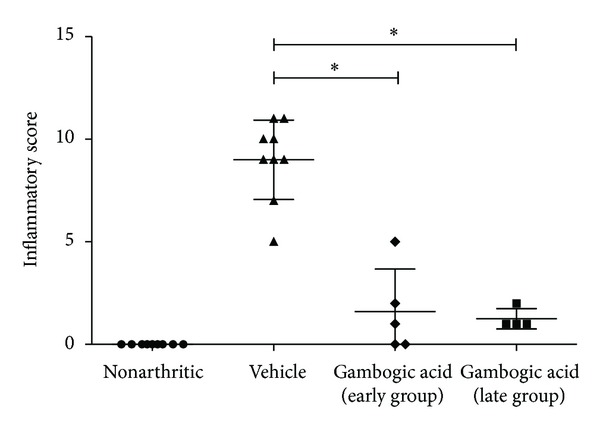
Gambogic acid possesses anti-inflammatory properties. Inflammatory score in gambogic acid-treated AIA rats is significantly diminished in comparison with vehicle-treated rats after treatment. Differences were considered statistically significant for P values < 0.05.
Figure 5
Figure 5
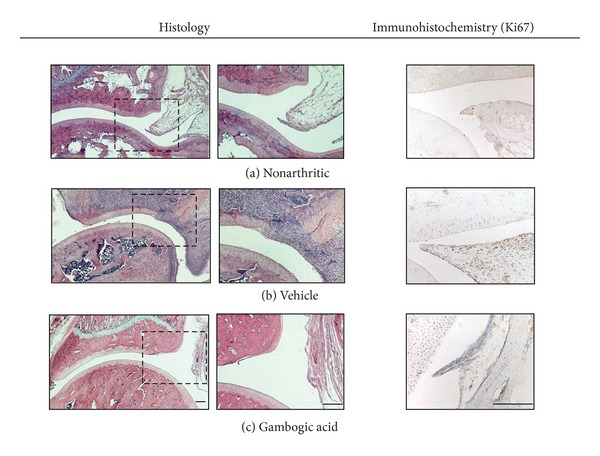
Histological and immunohistochemical evaluation of joints after 15 days of treatment. Nonarthritic control (a), vehicle-treated (b), and gambogic acid in the early treated group (c) AIA rats (magnification of 50x and 100x in histological images and a magnification of 200x in immunohistochemical images). Notice that gambogic acid has completely prevented immune cellular infiltration and proliferation, as well as bone invasion. Bars: 100 μm.

References

    1. Yelin E, Callahan LF. The economic cost and social and psychological impact of musculoskeletal conditions. Arthritis & Rheumatism. 1995;38(10):1351–1362. - PubMed
    1. Radner H, Smolen JS, Aletaha D. Impact of comorbidity on physical function in patients with rheumatoid arthritis. Annals of the Rheumatic Diseases. 2010;69(3):536–541. - PubMed
    1. Lindqvist E, Saxne T, Geborek P, Eberhardt K. Ten year outcome in a cohort of patients with early rheumatoid arthritis: health status, disease process, and damage. Annals of the Rheumatic Diseases. 2002;61(12):1055–1059. - PMC - PubMed
    1. Goldbach-Mansky R. Blocking interleukin-1 in rheumatic diseases: its initial disappointments and recent successes in the treatment of autoinflammatory diseases. Annals of the New York Academy of Sciences. 2009;1182:111–123. - PMC - PubMed
    1. Cascão R, Moura RA, Perpétuo I, et al. Identification of a cytokine network sustaining neutrophil and Th17 activation in untreated early rheumatoid arthritis. Arthritis Research & Therapy. 2010;12(5, article R196) - PMC - PubMed

Publication types

LinkOut - more resources