Review
. 2014 Mar 3:6:28.
doi: 10.3389/fnagi.2014.00028. eCollection 2014.

Aging causes a reorganization of cortical and spinal control of posture

Affiliations
Review

Aging causes a reorganization of cortical and spinal control of posture

Selma Papegaaij et al. Front Aging Neurosci. .

Abstract

Classical studies in animal preparations suggest a strong role for spinal control of posture. In humans it is now established that the cerebral cortex contributes to postural control of unperturbed and perturbed standing. The age-related degeneration and accompanying functional changes in the brain, reported so far mainly in conjunction with simple manual motor tasks, may also affect the mechanisms that control complex motor tasks involving posture. This review outlines the age-related structural and functional changes at spinal and cortical levels and provides a mechanistic analysis of how such changes may be linked to the behaviorally manifest postural deficits in old adults. The emerging picture is that the age-related reorganization in motor control during voluntary tasks, characterized by differential modulation of spinal reflexes, greater cortical activation and cortical disinhibition, is also present during postural tasks. We discuss the possibility that this reorganization underlies the increased coactivation and dual task interference reported in elderly. Finally, we propose a model for future studies to unravel the structure-function-behavior relations in postural control and aging.

Keywords: TMS; aging; cerebral cortex; fMRI; neuroplasticity; postural control.


Figures
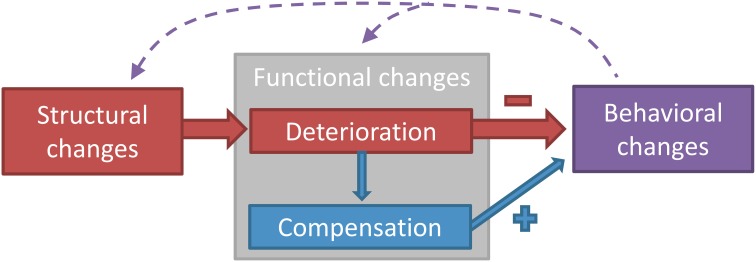
Figure 1
Figure 1
A classification model of the different domains of age-related changes in the neuromotor system controlling postural and manual tasks. Three domains can be distinguished: structural changes, functional changes, and behavioral changes. Structural changes refer to the degeneration of brain or nerve structures with aging, whereas functional changes refer to the age-related modification in how these structures operate in the act of motor control. Behavioral changes denote the changes in performance on the motor task, which can be both a postural or a manual task. Functional changes can be divided into deterioration (as a direct result of the structural changes) and compensation (changes in function to counteract the deterioration). Structural degeneration causes functional deterioration (Rivner et al., 2001), which triggers the need for functional compensation (Mattay et al., 2002). Functional deterioration has a negative impact on performance (Nardone et al., 1995), whereas functional compensation has a positive impact (Mattay et al., 2002). The dashed arrows acknowledge the influence that acute or chronic behavioral changes, i.e., intervention or differences in lifestyle, have on structure and function of the neuromotor system (Taube et al., ; Rovio et al., ; McGregor et al., 2011). The model can be used in future studies to systematically examine the structure-function-behavior link in the aging neuromotor system and could also be applied to other fields of research.

References

    1. Allum J. H., Carpenter M. G., Honegger F., Adkin A. L., Bloem B. R. (2002). Age-dependent variations in the directional sensitivity of balance corrections and compensatory arm movements in man. J. Physiol. 542, 643–663 10.1113/jphysiol.2001.015644 - DOI - PMC - PubMed
    1. Arthurs O. J., Boniface S. (2002). How well do we understand the neural origins of the fMRI BOLD signal? Trends Neurosci. 25, 27–31 10.1016/S0166-2236(00)01995-0 - DOI - PubMed
    1. Baezner H., Blahak C., Poggesi A., Pantoni L., Inzitari D., Chabriat H., et al. (2008). Association of gait and balance disorders with age-related white matter changes: the LADIS study. Neurology 70, 935–942 10.1212/01.wnl.0000305959.46197.e6 - DOI - PubMed
    1. Baloh R. W., Ying S. H., Jacobson K. M. (2003). A longitudinal study of gait and balance dysfunction in normal older people. Arch. Neurol. 60, 835–839 10.1001/archneur.60.6.835 - DOI - PubMed
    1. Bard P. (1933). Studies on the cerebral cortex I. Localized control of placing and hopping reactions in the cat and their normal management by small cortical remnants. Arch. Neurol. Psychiatry 30, 40–74 10.1001/archneurpsyc.1933.02240130048003 - DOI

LinkOut - more resources
