Review
. 2014 Jan 9:2:411-29.
doi: 10.1016/j.redox.2013.12.016. eCollection 2014.

Role of advanced glycation end products in cellular signaling

Affiliations
Review

Role of advanced glycation end products in cellular signaling

Christiane Ott et al. Redox Biol. .

Abstract

Improvements in health care and lifestyle have led to an elevated lifespan and increased focus on age-associated diseases, such as neurodegeneration, cardiovascular disease, frailty and arteriosclerosis. In all these chronic diseases protein, lipid or nucleic acid modifications are involved, including cross-linked and non-degradable aggregates, such as advanced glycation end products (AGEs). Formation of endogenous or uptake of dietary AGEs can lead to further protein modifications and activation of several inflammatory signaling pathways. This review will give an overview of the most prominent AGE-mediated signaling cascades, AGE receptor interactions, prevention of AGE formation and the impact of AGEs during pathophysiological processes.

Keywords: ADAMST, a disintegrin and metalloproteinase with a thrombospondin type 1 motif; AGE, advanced glycation end products; AGE-receptors; Advanced glycation end products; Age-associated diseases; Aggregates; Aging; E, from embryonic day; EGFR, epidermal growth factor receptor; ERK, extracellular-signal regulated kinase; F3NK, fructosamine 3-phosphokinase; FKHRL1, forkhead transcription factor; HDL, high density lipoprotein; HMGB1, high-mobility-group-protein B1; HNE, 4-hydroxy-trans-2-nonenal; Jak1/2, Janus kinase 1/2; LDL, low density lipoprotein; MDA, malondialdehyde; MEKK, mitogen-activated protein/ERK kinase kinases; MnSOD, manganese superoxide dismutase; NF-κB; Nf-κB, nuclear factor-light-chain-enhancer of activated B; Oxidative stress; PIK3, phosphoinositol 3 kinase; RAGE; RAGE, receptor of AGEs; RCC, reactive carbonyl compounds; Reactive carbonyl compounds; S100B, S100 calcium binding protein B; SIRt1, NAD+-dependent deacetylase and survival factor 1; SR-A, scavenger receptor class A; Signaling; Stat 1/2, signal transducers and activators of transcription 1/2; VSMC, vascular smooth muscle cells.


Figures
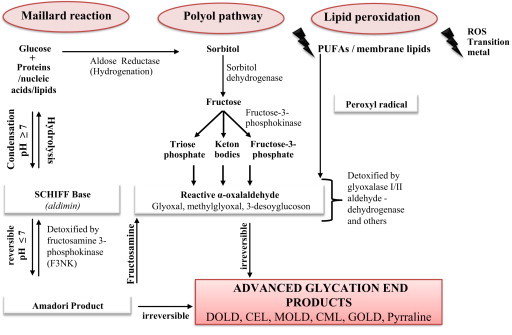
Fig. 1
Fig. 1
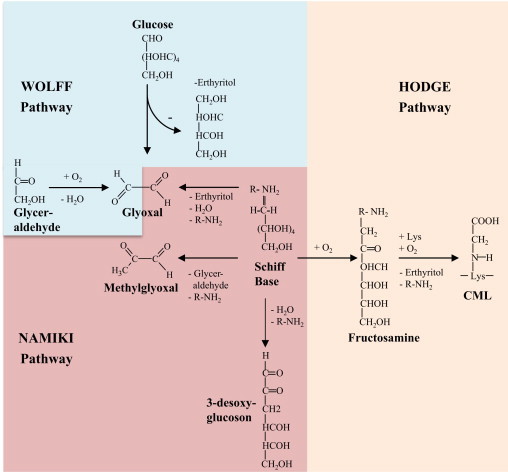
Formation of advanced glycation end products in vivo. Endogenous formation of advanced glycation end products has been described by three different paths in vivo: the non-enzymatic Maillard reaction, the Polyol-Pathway and lipid peroxidation. During all three reactions, formation of AGEs occurs over formation of reactive carbonyl compounds, such as glyoxal, methylglyoxal and 3-desoxyglucoson. If detoxification is impaired, they are able to react further until the formation of irreversible AGEs (modified from [3], [37], [41], [42], [216], [218]).
Fig. 2
Fig. 2
Formation of AGEs via Wolff'-, Namiki- and Hodge-pathway. Autoxidation of monosaccharides or carbonyl compounds (Wolff' pathway), aldimins (Namiki-pathway) or Amadori products (Hodge-pathway) via transition metals or ROS can lead directly to the formation of RCCs and in further reaction to AGEs (modified from [3], [17], [38], [39], [40]).
Fig. 3
Fig. 3
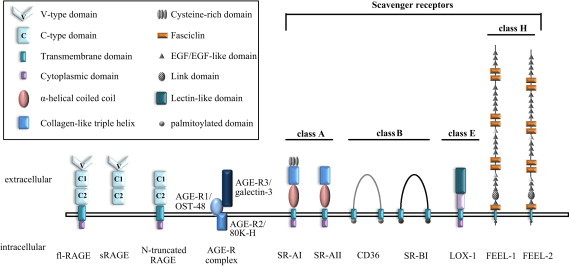
Structure of AGE receptors. Scavenger receptor family and AGE receptors. The scavenger receptor family is divided into class A, class B, class C and other not classified receptors. Some of these receptors are able to recognize AGEs. The AGE receptor complex (OST48; 80 K-H; Galectin-3) and RAGE are also identified as AGE-binding receptors but they do not belong to the scavenger receptor family (modified from [49]).
Fig. 4
Fig. 4
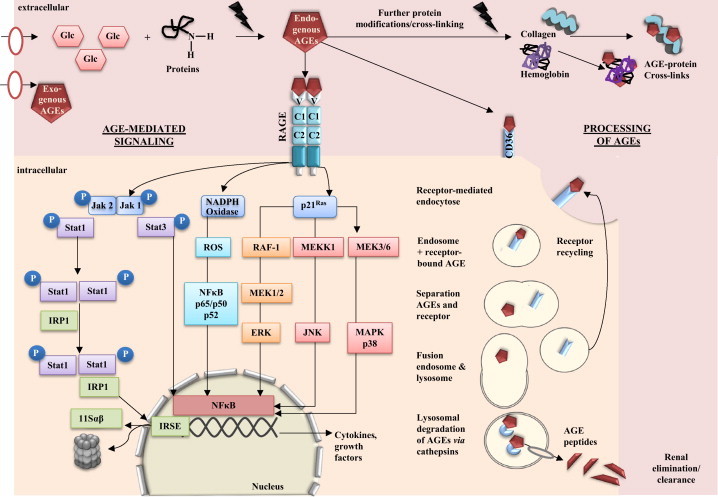
AGE-mediated signaling and detoxification of AGEs via lysosomal system. AGE–RAGE interaction stimulates a various number of signaling cascades, including Jak/Stat, NADPH oxidase, mitogen activated protein kinasen (MAPK), such as p38, extracellular regulated (ERK)-1/2 and c-Jun N-terminal kinase (JNK). AGE-mediated signaling via RAGE leads to the activation of transcription factors, such as nuclear factor (NF-kB) or IFN-stimulated response elements (ISRE) followed by an increased expression of cytokines, growth factors or i.e., immunoproteasomal subunits. While RAGE–AGE interactions are believed to activate inflammatory pathways, other receptors i.e., the family of scavenger receptors play an important role in receptor-mediated endocytosis, leading to intracellular uptake and (parial) degradation of AGEs by fusion with lysosomes. Furthermore, AGE peptides can be transferred to the renal system, while the receptors will be recycled and available for endocytosis processes (modified from [30], [54], [83], [86], [139], [215]).
Fig. 5
Fig. 5
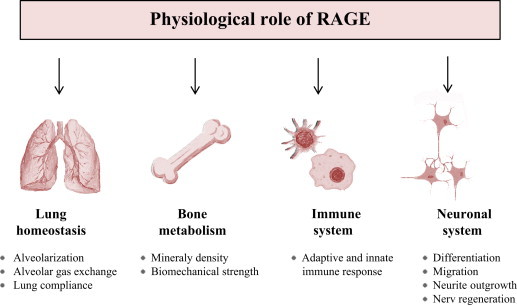
Physiological role of RAGE. AGE–RAGE mediated changes in physiology of lung homeostasis, bone metabolism, immune system and neuronal system.
Fig. 6
Fig. 6
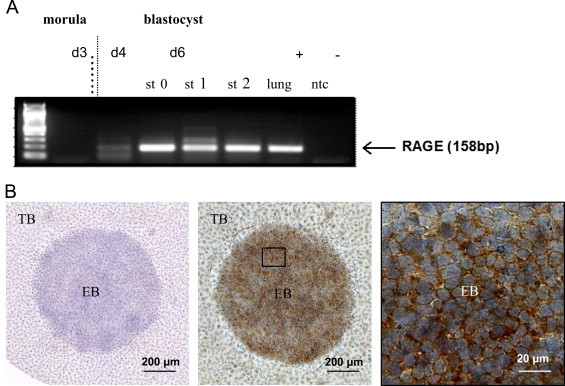
Expression of RAGE in the early rabbit embryo. Transcripts of RAGE were detected in day 3, 4, and 6 p.c. embryos and blastocysts in gastrulation stages 0 (st 0), 1 (st 1), and 2 (st 2). A probe without cDNA was used as negative control (ntc), cDNA from lung tissue was used as positive control. Internal control was the expression of GAPDH in all probes (A). Immunohistochemical detection of RAGE in 6 day old rabbit blastocysts. RAGE localization was visualized by peroxidase-diaminobenzidine reaction (brown color). The nucleus was counterstained with hemalum (blue color). The negative control is the control reaction of the HRP-conjugated secondary goat-anti mouse-IgG. RAGE is mainly localized in the membrane of embryoblast cells (EB). In trophoblast cells (TB) RAGE is barely present (B) (own unpublished data from EH and BF).

References

    1. Vaupel J.W., Kistowski K.G.V. The remarkable rise in life expectancy and how it will affect medicine. Bundesgesundheitsblatt, Gesundheitsforschung, Gesundheitsschutz. 2005;48:586–592. - PubMed
    1. Oeppen J., Vaupel J.W. Demography. Broken limits to life expectancy. Science. 2002;296:1029–1031. - PubMed
    1. Singh R., Barden A., Mori T., Beilin L. Advanced glycation end-products: a review. Diabetologia. 2001;44:129–146. - PubMed
    1. Farouque H.M., O’Brien R.C., Meredith I.T. Diabetes mellitus and coronary heart disease—from prevention to intervention: part I. Aust. N. Z. J. Med. 2000;30:351–359. - PubMed
    1. Cerami C., Founds H., Nicholl I., Mitsuhashi T., Giordano D., Vanpatten S., Lee A., Al-Abed Y., Vlassara H., Bucala R., Cerami A. Tobacco smoke is a source of toxic reactive glycation products. Proc. Natl. Acad. Sci. USA. 1997;94:13915–13920. - PMC - PubMed

MeSH terms