Socioeconomic status, food security, and dental caries in US children: mediation analyses of data from the National Health and Nutrition Examination Survey, 2007-2008
- PMID: 24625141
- PMCID: PMC3987603
- DOI: 10.2105/AJPH.2013.301699
Socioeconomic status, food security, and dental caries in US children: mediation analyses of data from the National Health and Nutrition Examination Survey, 2007-2008
Abstract
Objectives: We examined associations of household socioeconomic status (SES) and food security with children's oral health outcomes.
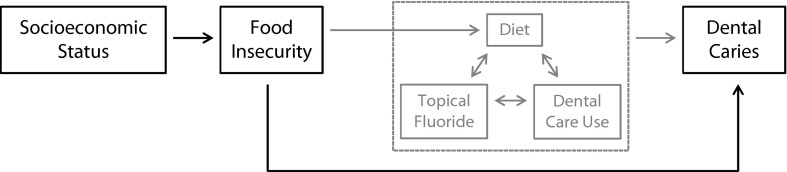
Methods: We analyzed 2007 and 2008 US National Health and Nutrition Examination Survey data for children aged 5 to 17 years (n = 2206) to examine the relationship between food security and untreated dental caries and to assess whether food security mediates the SES-caries relationship.
Results: About 20.1% of children had untreated caries. Most households had full food security (62%); 13% had marginal, 17% had low, and 8% had very low food security. Higher SES was associated with significantly lower caries prevalence (prevalence ratio [PR] = 0.77; 95% confidence interval = 0.63, 0.94; P = .01). Children from households with low or very low food security had significantly higher caries prevalence (PR = 2.00 and PR = 1.70, respectively) than did children living in fully food-secure households. Caries prevalence did not differ among children from fully and marginally food-secure households (P = .17). Food insecurity did not appear to mediate the SES-caries relationship.
Conclusions: Interventions and policies to ensure food security may help address the US pediatric caries epidemic.
Figures
References
-
- National Institute of Dental and Craniofacial Research. Oral Health in America: A Report of the Surgeon General. Rockville, MD: National Institute of Health; 2000.
-
- Dye BA, Tan S, Smith Vet al.Trends in oral health status: United States, 1988–1994 and 1999–2004 Vital Health Stat 11 2007248)1–92. - PubMed
-
- Casamassimo PS, Thikkurissy S, Edelstein BL, Maiorini E. Beyond the dmft: the human and economic cost of early childhood caries. J Am Dent Assoc. 2009;140(6):650–657. - PubMed
Publication types
MeSH terms
Grants and funding
LinkOut - more resources
Full Text Sources
Other Literature Sources
Medical
Research Materials