


Review
doi: 10.1038/nrmicro3236.
The cryptic sexual strategies of human fungal pathogens
Affiliations
- PMID: 24625892
- PMCID: PMC4102497
- DOI: 10.1038/nrmicro3236
Item in Clipboard
Review
The cryptic sexual strategies of human fungal pathogens
Nat Rev Microbiol.
2014 Apr.
Abstract
Sexual reproduction is a pervasive attribute of eukaryotic species and is now recognized to occur in many clinically important human fungal pathogens. These fungi use sexual or parasexual strategies for various purposes that can have an impact on pathogenesis, such as the formation of drug-resistant isolates, the generation of strains with increased virulence or the modulation of interactions with host cells. In this Review, we examine the mechanisms regulating fungal sex and the consequences of these programmes for human disease.
Figures
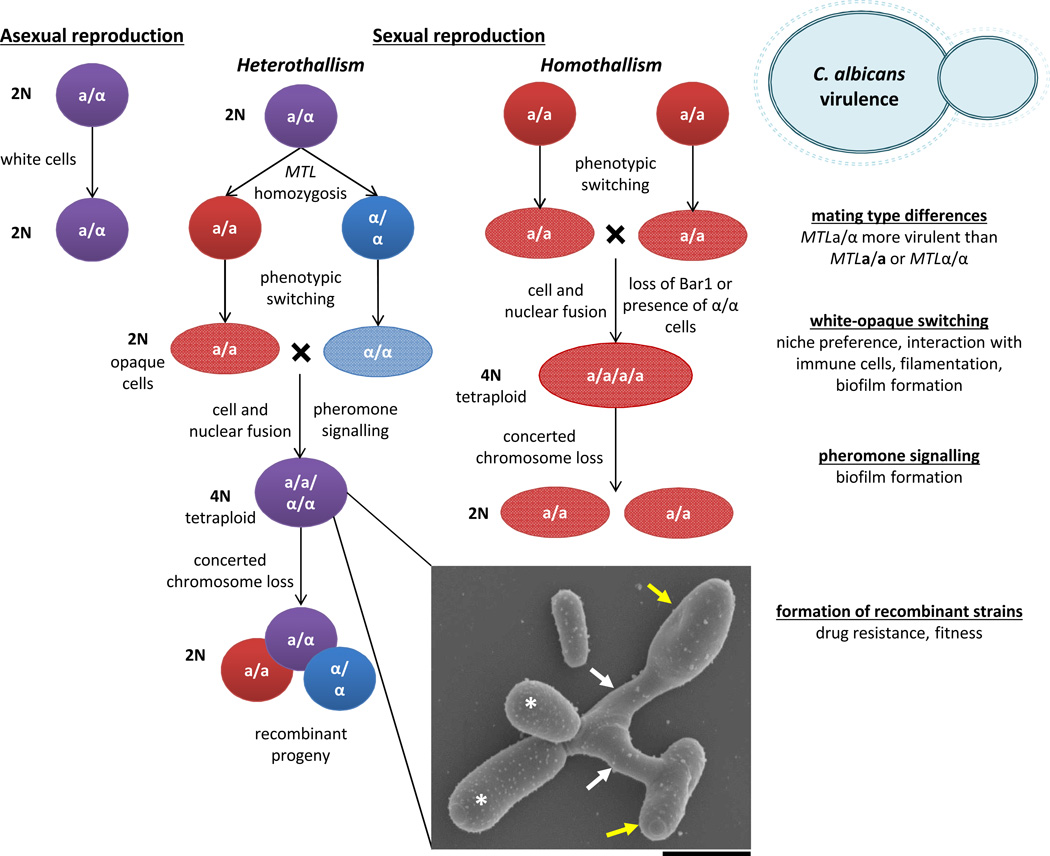
Parasexual and asexual reproduction in C. albicans. C. albicans cells are diploid and can divide asexually, or can undergo heterothallic or homothallic mating. MTLa and MTLα cells must switch to opaque to become mating competent (see also BOX 2). Opaque cells secrete pheromones that result in the formation of conjugation tubes, and subsequently cell and nuclear fusion occur to form tetraploid cells. Mating products can be induced to undergo concerted chromosome loss to return to the diploid state. The relationship between virulence and parasexual reproduction is indicated on the right side of the figure. Inset, scanning electron micrograph of a C. albicans mating zygote. Parental opaque cells (yellow arrows) form mating projections (white arrows), and subsequently fuse and generate daughter cells (white asterisk) (taken by M.P. Hirakawa, scale bar = 5 µm).
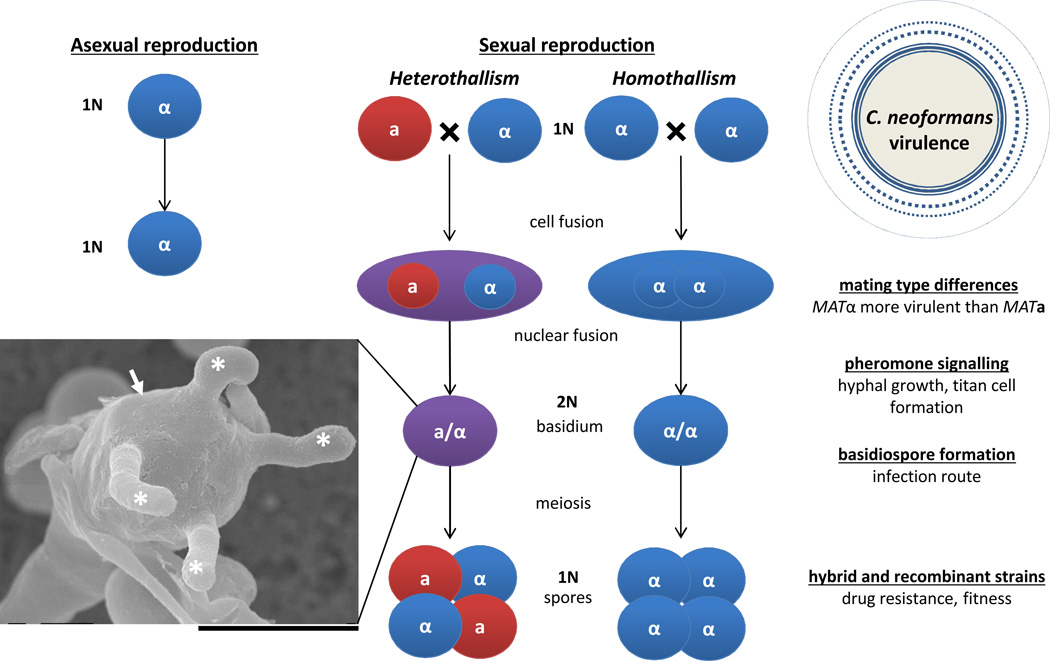
Sexual and asexual reproduction in C. neoformans. C. neoformans haploid cells can divide asexually or can enter a heterothallic or homothallic mating cycle. In heterothallic mating, pheromone signalling between a and α cells results in cell-cell fusion. Nuclei do not fuse but form a filamentous dikaryon. The tips of the filamentous cells differentiate into basidia within which nuclear fusion and meiosis occur. Additional rounds of mitotic division produce multiple, haploid basidiospores, resulting in four long chains. The consequences of sexual reproduction for virulence in C. neoformans are shown on the right side of the figure. Inset, scanning electron micrograph shows a C. gattii basidium (white arrow) with four emerging basidiospores (white asterisk) (gift of Edmond Byrnes and Joseph Heitman, scale bar = 5 µm).
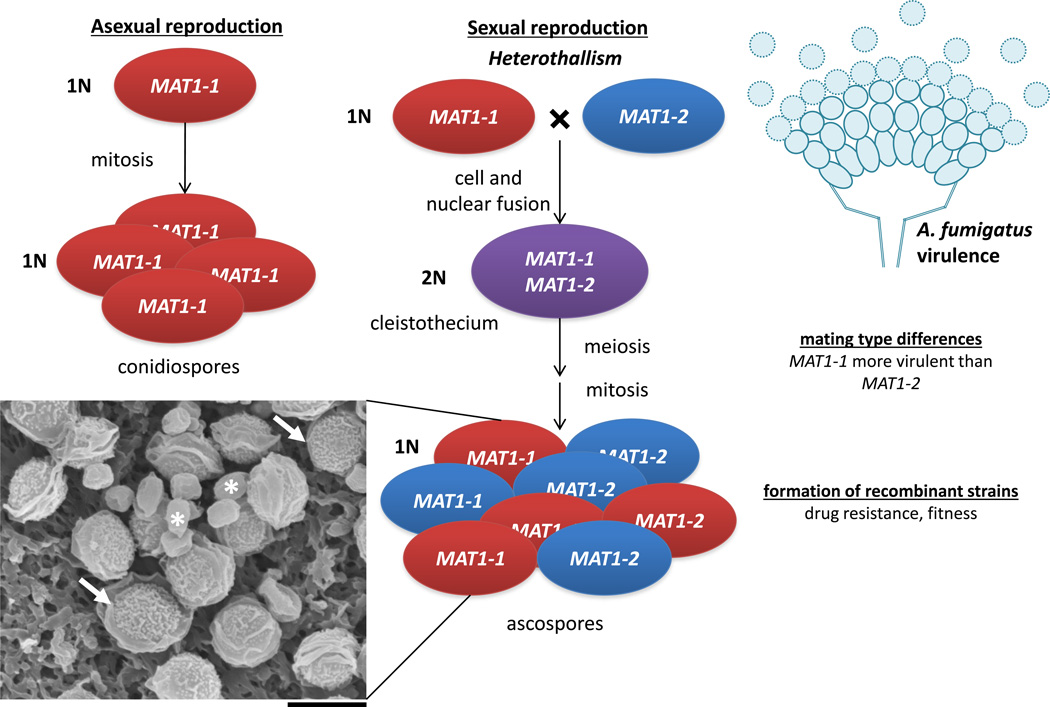
Sexual and asexual reproduction in A. fumigatus. A. fumigatus undergoes asexual reproduction via the mitotic division of haploid cells or the formation of asexual conidiospores. It can also undergo heterothallic mating between MAT1-1 and MAT1-2 mating types. The products of mating are cleistothecia (ascocarps) that contain multiple ascospores. Sexual reproduction and virulence are linked in A. fumigatus as specified on the right side of the figure. Note that sex influences virulence in all three species (see FIGS. 1 and 2) by generating recombinant strains with novel properties or through mating-type differences. However, some traits are species-specific, such as the ability of C. albicans to form pheromone-induced biofilms, or titan cell formation in C. neoformans. Inset, scanning electron micrograph showing A. lentulus cleistothecia (white arrows) with emerging ascospores (white asterisk) (gift of Celine M. O'Gorman and Paul Dyer, scale bar = 5 µm).
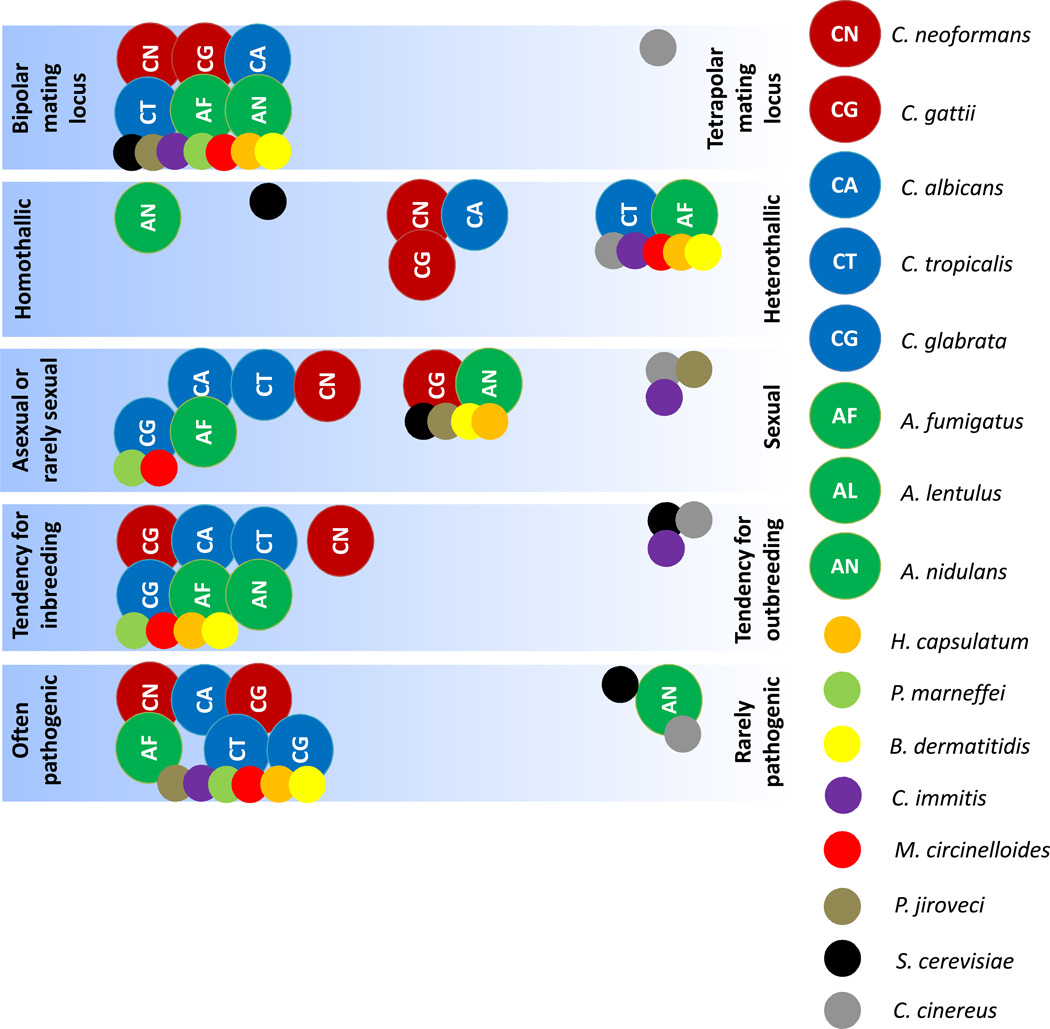
Comparative analysis of sexual reproduction and virulence leads to emerging trends among human fungal pathogens. Some of the most prevalent pathogenic species tend to promote inbreeding, have restricted and highly specialized sexual cycles, contain bipolar mating loci, and often include the potential for homothallic reproduction. S. cerevisiae and C. cinereus have been included as model organisms for ascomycetes and basidiomycetes, respectively. Members of the most commonly isolated genera - Candida, Cryptococcus and Aspergillus - are marked with larger symbols in blue, red and green, respectively. Where possible we have assigned positions for the less well-studied species.
References
-
-
Van Valen L. A new evolutionary law. Evol. Theory. 1973;1:1–30. Proposed the Red Queen Hypothesis.
-
-
- Heitman J, Sun S, James TY. Evolution of fungal sexual reproduction. Mycologia. 2013;105:1–27. - PubMed
-
- Lively CM. A review of Red Queen models for the persistence of obligate sexual reproduction. J. Hered. 2010;101(Suppl 1):S13–S20. - PubMed
-
- Jokela J, Dybdahl MF, Lively CM. The maintenance of sex, clonal dynamics, and host-parasite coevolution in a mixed population of sexual and asexual snails. Am. Nat. 2009;174(Suppl 1):S43, S53. - PubMed
Publication types
MeSH terms
Grants and funding
LinkOut - more resources
Full Text Sources
Other Literature Sources
Medical
