. 2014 Aug 1;23(15):4043-50.
doi: 10.1093/hmg/ddu118. Epub 2014 Mar 13.

Eccentric muscle challenge shows osteopontin polymorphism modulation of muscle damage

Affiliations

Eccentric muscle challenge shows osteopontin polymorphism modulation of muscle damage

Whitney L Barfield et al. Hum Mol Genet. .

Abstract

A promoter polymorphism of the osteopontin (OPN) gene (rs28357094) has been associated with multiple inflammatory states, severity of Duchenne muscular dystrophy (DMD) and muscle size in healthy young adults. We sought to define the mechanism of action of the polymorphism, using allele-specific in vitro reporter assays in muscle cells, and a genotype-stratified intervention in healthy controls. In vitro reporter constructs showed the G allele to respond to estrogen treatment, whereas the T allele showed no transcriptional response. Young adult volunteers (n = 187) were enrolled into a baseline study, and subjects with specific rs28357094 genotypes enrolled into an eccentric muscle challenge intervention [n = 3 TT; n = 3 GG/GT (dominant inheritance model)]. Female volunteers carrying the G allele showed significantly greater inflammation and increased muscle volume change as determined by magnetic resonance imaging T1- and T2-weighted images after eccentric challenge, as well as greater decrement in biceps muscle force. Our data suggest a model where the G allele enables enhanced activities of upstream enhancer elements due to loss of Sp1 binding at the polymorphic site. This results in significantly greater expression of the pro-inflammatory OPN cytokine during tissue remodeling in response to challenge in G allele carriers, promoting muscle hypertrophy in normal females, but increased damage in DMD patients.


Figures

Figure 1.
Figure 1.
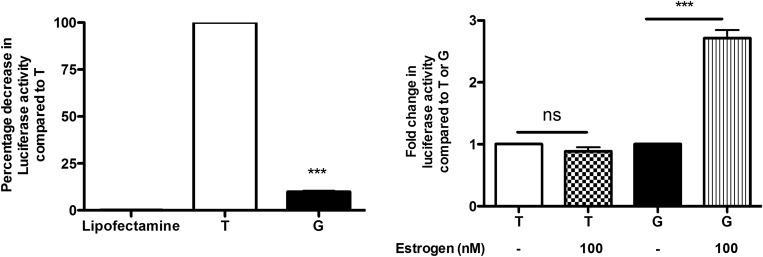
The G allele of the rs28357094 polymorphism shows decreased basal promoter activity, but higher transcriptional response to estrogen hormone treatment. (A) Allele-specific promoter reporter constructs were transfected into human myoblasts and assayed for baseline luciferase expression. The G allele showed an 80% reduction in baseline expression (P < 0.001), consistent with previous reports of loss of Sp1 binding and lower baseline expression in other cell types (3). (B) The same constructs were then tested in the presence of estrogen (100 nm). The T allele construct was unresponsive to estrogen, while the G allele construct showed a 3-fold increase in luciferase expression (P < 0.001).
Figure 2.
Figure 2.
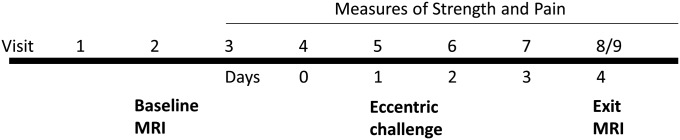
Protocol design for eccentric contraction challenge of the biceps muscle in young adult female volunteers. Initial visits were for informed consent, anthropomorphic measures and assessments of baseline phenotypes including MRI of both the dominant and non-dominant upper arm. Eccentric challenge of the non-dominant arm was at visit 4 (Day 0) with exit MRI at Day 4. Eccentric challenge was done only once on visit 4 (Day 0), with all subsequent visits done to assess the delayed effects of this challenge on strength and MRI changes.
Figure 3.
Figure 3.
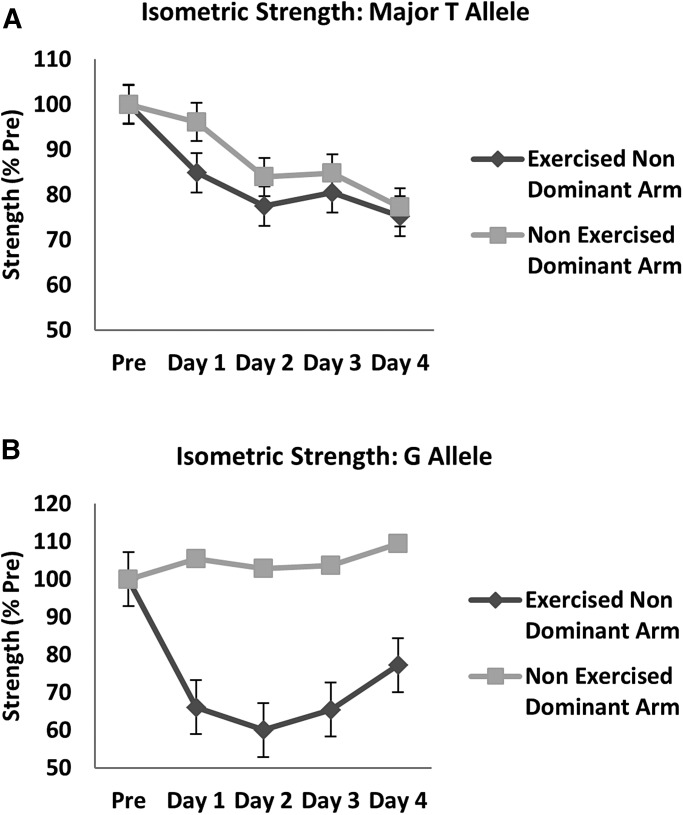
Measures of maximal isometric strength in genotype-stratified young adult female volunteers. Isometric strength of both the non-dominant arm (eccentric bout) and dominant arm (non-exercised control) was measured in TT homozygotes (n = 3) (A), and G allele carriers (GG and GT; n = 3) (B). Pre is prior to the eccentric exercise challenge, with measures then subsequent days after the bout. TT homozygotes showed a small drop in force that was similar in both arms (A). G allele carriers showed a 40% drop in muscle strength in the exercised arm (P < 0.001), with a small increase in strength in the non-exercised arm (B).
Figure 4.
Figure 4.
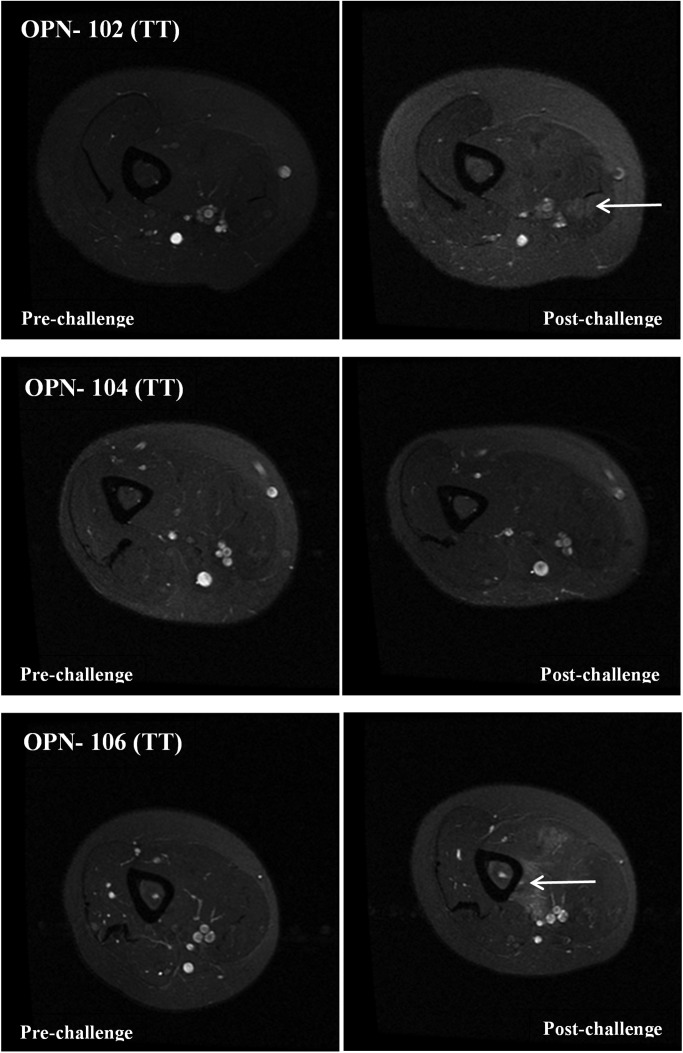
T2-weighted MRI images of young adult female volunteers having TT OPN genotype. Shown are MRI T2-weighted images of the non-dominant upper arm prior to eccentric challenge (pre-challenge) and 4 days after eccentric challenge (post-challenge). Subjects OPN-102 and OPN-106 show areas with an increase of T2 signal in the biceps in the post-challenge images consistent with increased water content (swelling) (white arrows). Areas of hyper-intensity were not evident in OPN-104.
Figure 5.
Figure 5.
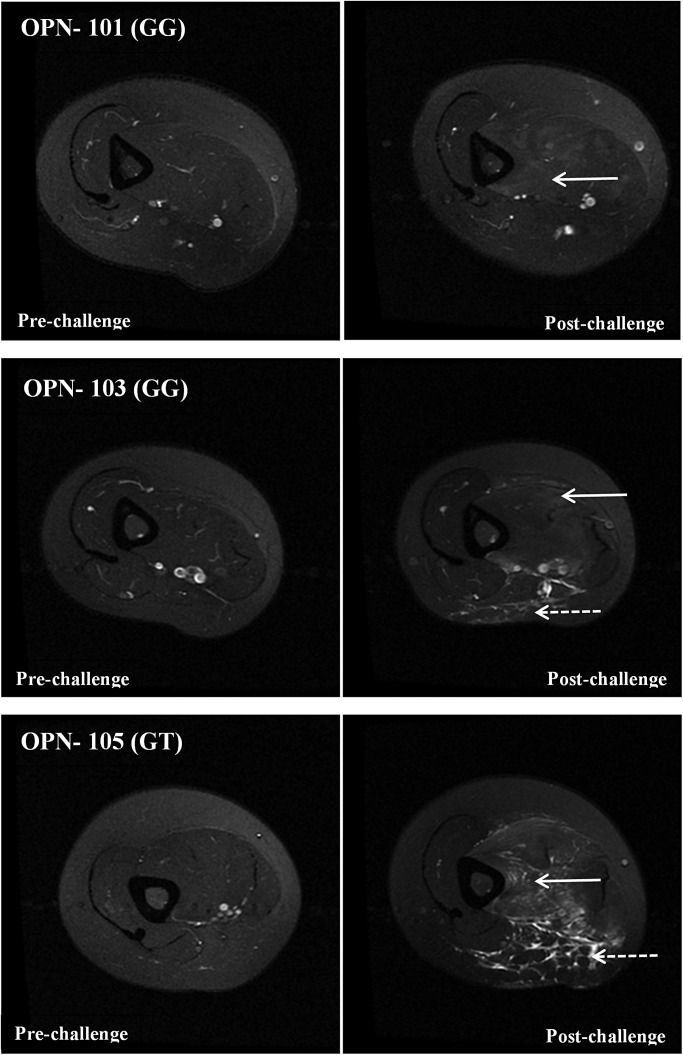
T2-weighted MRI images of young adult females carrying the G allele of the OPN promoter polymorphism. Shown are MRI images using the same methods and time points as in Figure 4. The three subjects carrying the G allele show extensive hyper-intensity throughout much of the biceps muscle (white solid arrows). Subjects OPN-103 and OPN-105 also show evidence of inflammation (stippled arrows) surrounding the brachial artery/nerve area. The inflammation extended into the biceps, and also into the ventral subcutaneous fat tissue.
Figure 6.
Figure 6.
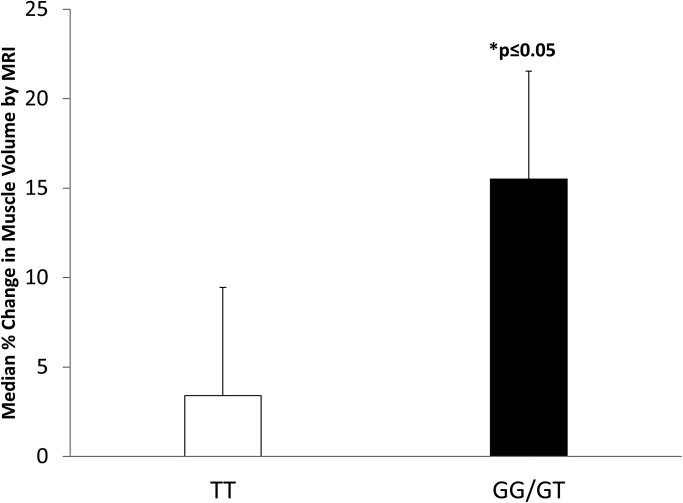
Percent volume change in biceps muscles after an acute eccentric exercise bout. Biceps muscle volume change was measured from MRI images in the exercised arm of genotype-stratified subjects at Day 4 after the bout of eccentric challenge. G allele carriers showed greater biceps swelling compared with TT homozygotes (P < 0.05).
Figure 7.
Figure 7.
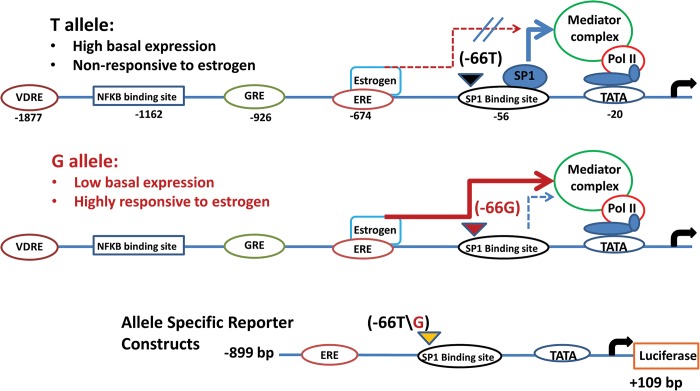
Schematic of the OPN gene promoter structure, and proposed model for effect of genotype on OPN gene expression. The top two lines show the OPN gene promoter structure and proposed model for the allele-specific effects of the rs28357094 polymorphism (−66T, −66G) on transcriptional regulation of the OPN gene. The −66 T allele is shown to have high basal expression, but blocks positive transcriptional response to the estrogen enhancer due to residency of the SP1 transcription factor in the intact SP1-binding site (top line of figure). The −66G allele shows reduced basal expression, but is highly responsive to estrogen due to loss of the SP1-binding site (second line of figure) (3). The predicted enhancer elements are in the more distal regions of the OPN gene promoter (VDRE, vitamin D receptor element; GRE, glucocorticoid response element; ERE, estrogen response element). The lower line of the figure shows the allele-specific reporter constructs used for transfection of human muscle cells. The genotype/phenotype associations of this polymorphism with muscle phenotypes have shown data consistent with a dominant model of inheritance, with two genotype groups (TT and GT + GG).

References

    1. Hoffman E.P., Gordish-Dressman H., McLane V.D., Devaney J.M., Thompson P.D., Visich P., Gordon P.M., Pescatello L.S., Zoeller R.F., Moyna N.M., et al. Alterations in osteopontin modify muscle size in females in both humans and mice. Med. Sci. Sports Exerc. 2013;45:1060–1068. - PMC - PubMed
    1. Pegoraro E., Hoffman E.P., Piva L., Gavassini B.F., Cagnin S., Ermani M., Bello L., Soraru G., Pacchioni B., Bonifati M.D., et al. SPP1 genotype is a determinant of disease severity in Duchenne muscular dystrophy. Neurology. 2011;76:219–226. - PMC - PubMed
    1. Giacopelli F., Marciano R., Pistorio A., Catarsi P., Canini S., Karsenty G., Ravazzolo R. Polymorphisms in the osteopontin promoter affect its transcriptional activity. Physiol. Genomics. 2004;20:87–96. - PubMed
    1. Niewold T.B., Kariuki S.N., Morgan G.A., Shrestha S., Pachman L.M. Gene-gene-sex interaction in cytokine gene polymorphisms revealed by serum interferon alpha phenotype in juvenile dermatomyositis. J. Pediatr. 2010;157:653–657. - PMC - PubMed
    1. Trivedi T., Franek B.S., Green S.L., Kariuki S.N., Kumabe M., Mikolaitis R.A., Jolly M., Utset T.O., Niewold T.B. Osteopontin alleles are associated with clinical characteristics in systemic lupus erythematosus. J. Biomed. Biotechnol., 2011;2011:802581. - PMC - PubMed

Publication types

MeSH terms