


Promoting quality and evidence-based care in early-stage breast cancer follow-up
- PMID: 24627271
- PMCID: PMC4311189
- DOI: 10.1093/jnci/dju034
Promoting quality and evidence-based care in early-stage breast cancer follow-up
Erratum in
- J Natl Cancer Inst. 2014 May;106(5):dju126. Henry, Lynn N [corrected to Henry, N Lynn]
Abstract
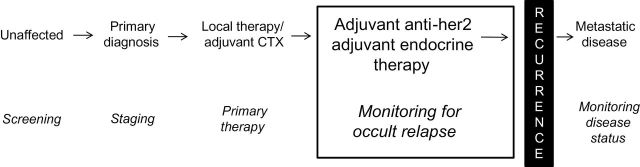
Evidence-based guidelines for long-term follow-up of early-stage breast cancer patients developed by oncology societies in the United States and Europe recommend that breast cancer survivors undergo regular evaluation with history and physical examination, as well as annual mammography. Routine blood tests, circulating tumor markers, and/or surveillance imaging studies beyond mammography are not recommended in the absence of concerning symptoms or physical examination findings because of lack of supportive clinical evidence. Despite these guidelines, studies have shown that 20% to 40% of oncologists assess serum tumor markers as part of routine monitoring of early-stage breast cancer patients. As part of efforts to both address the financial challenges confronting the health-care system and optimize patient outcomes, the American Society of Clinical Oncology's Cost of Care Task Force identified adherence to breast cancer surveillance guidelines as an opportunity to improve care and reduce cost. However, these recommendations are based on trials done in an era of outdated technology and limited therapeutic options. It is possible that recent improvements in diagnostics and treatments could make earlier detection of recurrent disease important for improving both survival and quality of life outcomes. Research is necessary to further inform optimal breast cancer follow-up strategies, which could impact these recommendations. At this time, outside of well-conducted clinical trials, there is no role for ordering routine serial blood or imaging tests in monitoring for recurrence in early-stage breast cancer patients.
Figures
References
-
- Brody H. Medicine’s ethical responsibility for health care reform—the top five list. N Engl J Med. 2010;362(4):283–285. - PubMed
-
- Schnipper LE, Smith TJ, Raghavan D, et al. American Society of Clinical Oncology identifies five key opportunities to improve care and reduce costs: the top five list for oncology. J Clin Oncol. 2012;30(14):1715–1724. - PubMed
-
- Harris L, Fritsche H, Mennel R, et al. American Society of Clinical Oncology 2007 update of recommendations for the use of tumor markers in breast cancer. J Clin Oncol. 2007;25(33):5287–5312. - PubMed
-
- Khatcheressian JL, Hurley P, Bantug E, et al. Breast cancer follow-up and management after primary treatment: American Society of Clinical Oncology Clinical Practice Guideline update. J Clin Oncol. 2013;31(7):961–965. - PubMed
-
- Hensley ML, Dowell J, Herndon JE. 2nd, et al. Economic outcomes of breast cancer survivorship: CALGB study 79804. Breast Cancer Res Treat. 2005;91(2):153–161. - PubMed
Publication types
MeSH terms
Substances
Grants and funding
LinkOut - more resources
Full Text Sources
Other Literature Sources
Medical
